
Flow-Factory
Unified Online RL and Offline Fine-Tuning for Diffusion and Flow-Matching Models
🔥 News
- [2026-09-20] Qwen-Image 2.1 support! Train the unified text-to-image and ordered multi-image editing model with the GRPO + LoRA recipe. Until Qwen-Image 2.1 reaches a released Diffusers package, install the pinned submodule:
git submodule update --init
pip install -e ./diffusers
pip install -e .
- [2026-08-21] MiniMax H3 Audio-Video support! Fine-tune text-to-audio-video, first/last-frame-to-audio-video, and ordered-reference-to-audio-video workflows with GRPO + LoRA. H3 requires diffusers 0.40.0 or newer:
pip install 'diffusers>=0.40.0'
pip install -e .
- [2026-04-25] LTX-2 Audio-Video support! Generate synchronized audio-video content with RL fine-tuning through the released Diffusers API:
pip install 'diffusers>=0.40.0'
- [2026-02-01] Support for multiple Attention Backends! Attention-backend selection now lives in the unified
acceleration:block (the oldmodel.attn_backendknob was removed), where it can be combined withtorch.compileand feature caching — applied in list order:
  acceleration:
    shared:
      - name: attention_backend
        params: { backend: "flash" } # Options: "native", "xformers", "flash_hub", "_flash_3_hub", "_flash_3_varlen_hub"
This experimental feature leverages diffusers's transformer.set_attention_backend. Check the official diffusers documentation for all available options. See guidance/acceleration.md for the full acceleration layer.
We recommend installing the
kernelspackage (pip install kernels) and usingflash_hub,flash_varlen_hub,_flash_3_hub, or_flash_3_varlen_hubto avoid the complexity and potential incompatibility of installing Flash-Attention directly.
📕 Table of Contents
🤗 Supported Models
Task
Model
Model Size
Model Type
Text-to-Image
stable-diffusion-3.5-medium/large
2.5B/8.1B
sd3-5
13B
flux1
6B
z-image
6B
z-image
20B
qwen-image
20B
qwen-image
Image-to-Image
13B
flux1-kontext
Image(s)-to-Image
20B
qwen-image-edit-plus
20B
qwen-image-edit-plus
Text-to-Image & Image(s)-to-Image
32B
flux2
4B
flux2-klein
9B
flux2-klein
4B
flux2-klein
9B
flux2-klein
14B
bagel
16B
sensenova
16B
sensenova
7B
qwen-image-2.1
Text-to-Video
1.3B
wan2_t2v
14B
wan2_t2v
5B
wan2_t2v
A14B
wan2_t2v
Image-to-Video
14B
wan2_i2v
14B
wan2_i2v
5B
wan2_i2v
A14B
wan2_i2v
First/Last-Frame-to-Video
14B
wan2_i2v
Text-to-Audio-Video
19B
ltx2_t2av
22B
ltx2_t2av
Image-to-Audio-Video
19B
ltx2_i2av
22B
ltx2_i2av
Text-to-Audio-Video
33B
minimax-h3-t2va
First/Last-Frame-to-Audio-Video
33B
minimax-h3-fl2va
Ordered-Reference-to-Audio-Video
33B
minimax-h3-ref2va
To support new models, see Guidance/New Model.
Offline output support: SFT and offline DPO currently support
sd3-5,flux1,flux1-kontext,flux2,flux2-klein,qwen-image,qwen-image-edit-plus,qwen-image-2.1,z-image,bagel,sensenova,wan2_t2v,wan2_i2v,ltx2_t2av,ltx2_i2av, and all MiniMax H3 workflows. Video/audio targets are encoded on demand and are never written to the preprocessing cache. Conditioned adapters prepare one immutable condition state per batch; offline DPO shares that exact realization across chosen and rejected arms. See the offline model matrix.
MiniMax H3 status: T2VA, FL2VA, and Ref2VA completed all 36 real-weight smoke cells in the documented matrix: three workflows x DDP/DeepSpeed ZeRO-2/FSDP2 x GRPO/SFT/offline DPO/TDM. The FL2VA first-plus-last SFT/offline-DPO gate also passed. The T2VA native-quality FSDP2 path has separate initialization, checkpoint, decode, and evaluation coverage. These results do not claim a completed long-run reward trend, convergence, or numerical parity. H3 requires B=1, has no CFG, uses neutral guidance
1.0, and keeps separate video/audio trajectories. Video uses shift 12, audio uses shift 3, and the model predicts data-ward velocity.num_inference_steps=Nmeans N transitions and N + 1 states.
💻 Supported Algorithms
| Algorithm | trainer_type |
Reference / objective |
|---|---|---|
| SFT | sft | Supervised flow matching over V2 demonstrations |
| Offline DPO | offline-dpo | Diffusion-DPO over V2 preference pairs |
| Online DPO | dpo | Diffusion-DPO with generated, reward-ranked pairs |
| GRPO | grpo | Flow-GRPO / Dance-GRPO |
| DiffusionNFT | nft | DiffusionNFT |
| AWM | awm | Advantage Weighted Matching |
| DGPO | dgpo | DGPO |
| GRPO-Guard | grpo-guard | GRPO-Guard |
| DPPO | dppo | Flow-DPPO |
| CRD | crd | Centered Reward Distillation (Blog (Chinese)) |
| DiffusionOPD | diffusion-opd | DiffusionOPD |
| DMD2 | dmd2 | DMD2 |
| TDM | tdm | Trajectory Distribution Matching |
| TDM-R1 | tdm-r1 | TDM-R1 |
See Algorithm Guidance for more information.
Models and algorithms are decoupled at the framework interface. The documented ten-mode real-weight smoke matrix completed all 120 model/backend/algorithm cells. Combinations outside that matrix still require separate execution evidence, and smoke completion is not a claim of reward improvement.
💾 Hardware Requirements
🚀 Get Started
Installation
git clone https://github.com/X-GenGroup/Flow-Factory.git
cd Flow-Factory
pip install -e .
Flow-Factory requires Python 3.10 or newer and PyTorch 2.10 or newer. PyTorch 2.10 includes the
native torch.optim.Muon API used by Muon optimizer configs.
Optional dependencies, such as deepspeed, are also available. Install them with:
pip install -e .[deepspeed]
Note: The Bagel adapter requires
flash-attn(>= 2.5.8) andopencv-python. Install them withpip install -e .[bagel](the[bagel]extra is intentionally not part of[all]because flash-attn is heavy to build).
Dependency: MiniMax H3 and LTX2 require the released
diffusers>=0.40.0API. Qwen-Image 2.1 currently requires the bundleddiffuserssubmodule; rungit submodule update --init && pip install -e ./diffusersbefore installing Flow-Factory. Its initial adapter deliberately uses batch size 1 and disables the model's prefix KV cache so online rollout and gradient replay follow the same numerical path. PyAV >=17.0.0 decodes ordered video/audio references and target media. TorchAudio 2.10 delegates audio loading and saving to TorchCodec, which also requires FFmpeg shared libraries. The CUDA image installs those system libraries automatically.
A CUDA training image (Python 3.12, uv-based install, PyTorch 2.10 + cu129, deepspeed, wandb, released diffusers) is defined under docker/docker-cuda/. See docker/README.md for build and run instructions (including linux/amd64 on Apple Silicon).
Experiment Trackers
To use Weights & Biases or SwanLab to log experimental results, install extra dependencies via pip install -e .[wandb] or pip install -e .[swanlab].
After installation, set corresponding arguments in the config file:
run_name: null  # Run name (auto: {model_type}_{finetune_type}_{trainer_type}_{timestamp})
project: "Flow-Factory"  # Project name for logging
logging_backend: "wandb"  # Options: wandb, swanlab, tensorboard, none
These trackers allow you to visualize both training samples and metric curves online:
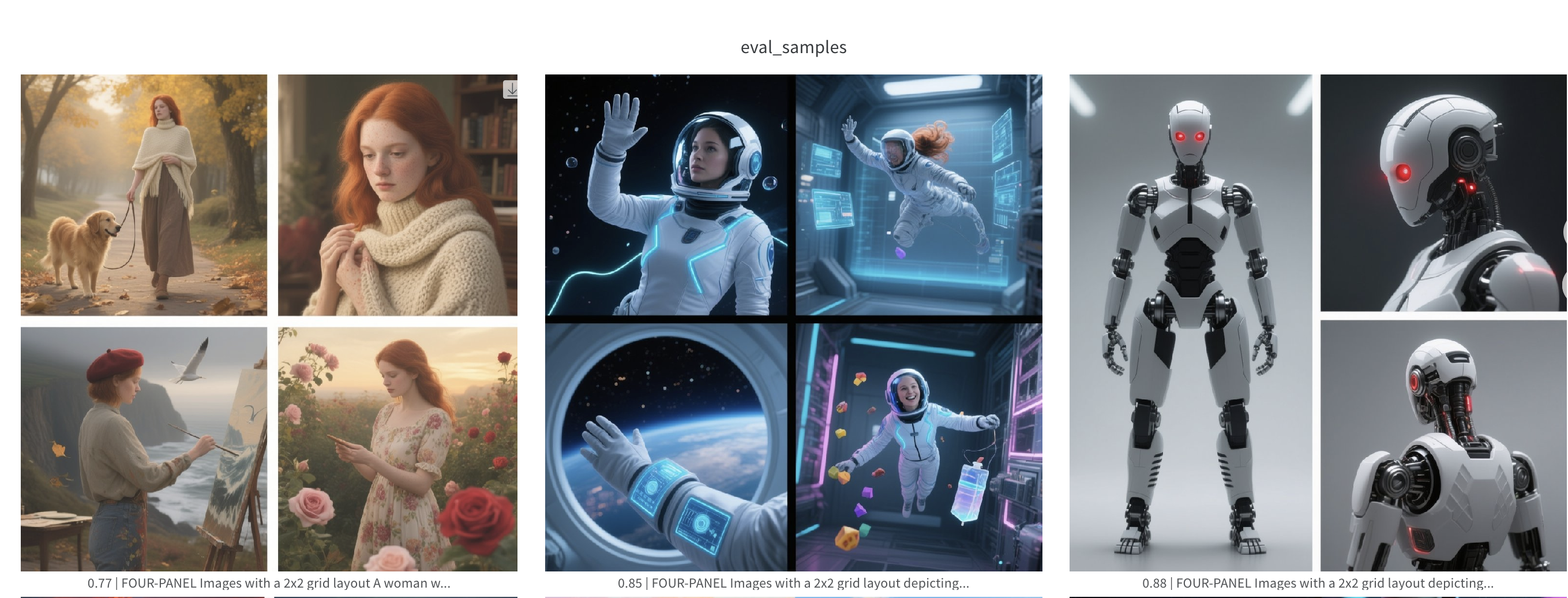
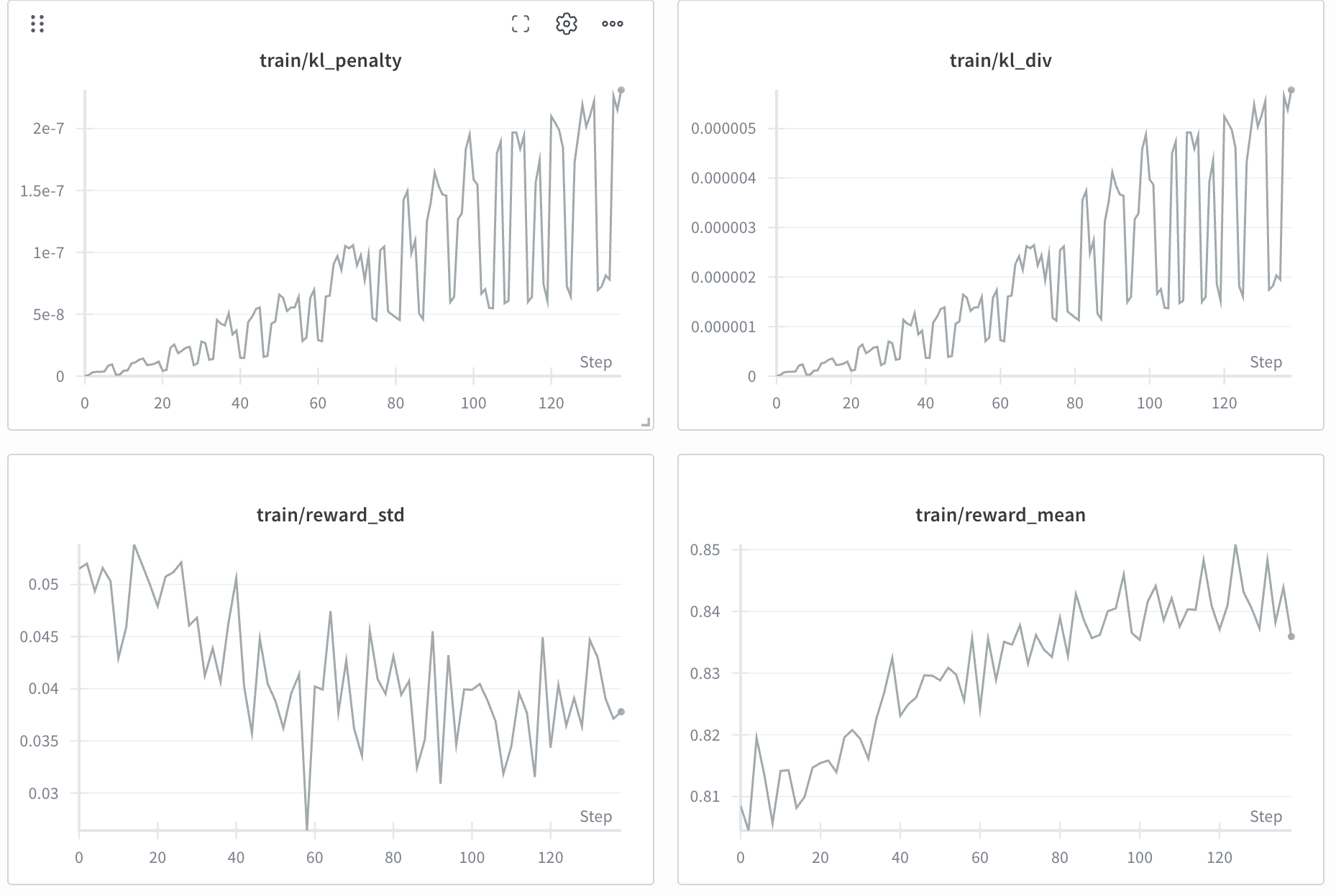
Quick Start Example
Start training with the following simple command:
ff-train examples/grpo/lora/flux1/default.yaml
Offline examples use strict V2 manifests and require no training reward model:
ff-train examples/sft/lora/sd3_5/default.yaml
ff-train examples/offline_dpo/lora/sd3_5/default.yaml
ff-train examples/sft/lora/wan2_t2v/wan22_ti2v5b.yaml
📖 Guidance
We provide a set of guidance documents to help you understand the framework and extend it. For a comprehensive understanding of the framework's design and motivation, refer to our technique report.
| Document | Description |
|---|---|
| Workflow | End-to-end training pipeline: the overall stages from data preprocessing to policy optimization |
| Algorithms | Supported online RL, SFT, offline DPO, and distillation algorithms and their configurations |
| Rewards | Reward model system: built-in models, custom rewards, and remote reward servers |
| Datasets | Dataset schemas, media paths, and ordered-reference inputs |
| New Model | How to add support for a new Diffusion/Flow-Matching model |
📊 Dataset
The unified structure of dataset is:
|---- dataset
|----|--- train.txt / train.jsonl
|----|--- test.txt / test.jsonl (optional)
|----|--- images (optional)
|----|---| image1.png
|----|---| ...
|----|--- videos (optional)
|----|---| video1.mp4
|----|---| ...
Offline SFT and Preference Data
SFT and offline DPO use strict JSONL with schema_version: 2. Public media objects use type as
their sole discriminator:
{"schema_version":2,"input":{"prompt":"A clean poster.","media":[]},"supervision":{"type":"demonstration","target":{"media":[{"type":"image","path":"targets/poster.png"}]}},"metadata":{}}
{"schema_version":2,"input":{"prompt":"A clean poster.","media":[]},"supervision":{"type":"preference","chosen":{"media":[{"type":"image","path":"pairs/chosen.png"}]},"rejected":{"media":[{"type":"image","path":"pairs/rejected.png"}]}},"metadata":{}}
{"schema_version":2,"input":{"prompt":"Animate toward this ending.","media":[{"type":"image","path":"conditions/end.png","slot":"last_frame"}]},"supervision":{"type":"demonstration","target":{"media":[{"type":"video","path":"targets/story.mp4","fps":24.0},{"type":"audio","path":"targets/story.wav","sample_rate":32000}]}},"metadata":{}}
The optional input-only slot field binds sparse conditions to adapter-declared semantic
arguments. Unslotted media fills remaining slots positionally; supervision outputs reject slots.
The checked-in SFT demonstration fixture and
offline-DPO preference fixture provide minimal examples
under the repository's canonical dataset/ root.
Prompt and input-condition encodings are cached. Target, chosen, and rejected media are decoded and
encoded on the fly; their VAE latents are never stored in the preprocessing cache. One offline
epoch is one complete dataloader traversal sharded by PyTorch's official DistributedSampler. See the
dataset guide for the full schema and cadence rules, and
the completed GPU validation matrix for the 120 main jobs and 24
additional dynamic gates.
The offline smoke builder reconstructs independent SFT and
offline-DPO mini datasets for every currently implemented image, video, and audio-video profile.
Text-to-Image & Text-to-Video
For text-to-image and text-to-video tasks, the only required input is the prompt in plain text format. Use train.txt and test.txt (optional) with following format:
A hill in a sunset.
An astronaut riding a horse on Mars.
Example: dataset/pickscore
Each line represents a single text prompt. Alternatively, you can use train.jsonl and test.jsonl in the following format:
{"prompt": "A hill in a sunset."}
{"prompt": "An astronaut riding a horse on Mars."}
Example: dataset/t2is
negative_prompt is also supported:
{"prompt": "A hill in a sunset.", "negative_prompt": "low quality, blurry, distorted, poorly drawn"}
{"prompt": "An astronaut riding a horse on Mars.", "negative_prompt": "low quality, blurry, distorted, poorly drawn"}
Example: dataset/t2is_neg
Image-to-Image & Image-to-Video
For tasks involving conditioning images, use train.jsonl and test.jsonl in the following format:
{"prompt": "A hill in a sunset.", "image": "path/to/image1.png"}
{"prompt": "An astronaut riding a horse on Mars.", "image": "path/to/image2/png"}
Example: dataset/sharegpt4o_image_mini
The default root directory for images is dataset_dir/images, and for videos, it is dataset_dir/videos. You can override these locations by setting the image_dir and video_dir variables in the config file:
data:
    dataset_dir: "path/to/dataset"
    image_dir: "path/to/image_dir" # (default to "{dataset_dir}/images")
    video_dir: "path/to/video_dir" # (default to "{dataset_dir}/videos")
For models such as FLUX.2-dev,
Qwen-Image-Edit-2511,
BAGEL-7B-MoT, and
SenseNova-U1 that accept
multiple conditioning images, use the images key with an ordered list of image paths:
{"prompt": "A hill in a sunset.", "images": ["path/to/condition_image_1_1.png", "path/to/condition_image_1_2.png"]}
{"prompt": "An astronaut riding a horse on Mars.", "images": ["path/to/condition_image_2_1.png", "path/to/condition_image_2_2.png"]}
💯 Reward Model
Flow-Factory provides a flexible reward model system that supports both built-in and custom reward models for reinforcement learning.
Reward Model Types
Flow-Factory supports two types of reward models:
- Pointwise Reward: Computes independent scores for each sample (e.g., aesthetic quality, text-image alignment).
- Pairwise Reward: Computes rewards based on the pairwise comparison within the group. This is a special case of the following Groupwise Reward.
- Groupwise Reward: Computes rewards that requires the all samples in a group (e.g., ranking-based score or pairwise comparison).
Built-in Reward Models
The following reward models are pre-registered and ready to use:
| Name | Type | Description | Reference |
|---|---|---|---|
PickScore |
Pointwise | CLIP-based aesthetic scoring model | PickScore |
PickScore_Rank |
Groupwise | Ranking-based reward using PickScore | PickScore |
CLIP |
Pointwise | Image-text cosine similarity | CLIP |
OCR |
Pointwise | Text rendering in images | PaddleOCR |
GenEval |
Pointwise | Compositional T2I evaluation (object count, color, position) | GenEval |
vllm_evaluate |
Pointwise | VLM Yes/No judge + logprobs over an OpenAI-compatible API | Rewards: VLM-as-Judge |
rational_rewards_t2i |
Pointwise | A reasoning reward model that provides multi-aspect reward for text-to-image; parsed aspects → scalar in [0, 1] | RationalRewards-8B-T2I |
rational_rewards_edit |
Pointwise | A reasoning reward model that provides multi-aspect reward for image edit; four aspects → scalar in [0, 1] | RationalRewards-8B-Edit |
qwen_image_bench |
Pointwise | Qwen-Image-Bench "Q-Judger"; hierarchical 5-dim / 56-facet scoring with per-prompt dims_en → scalar in [0, 1] |
Qwen-Image-Bench |
GenEval requires extra dependencies (mmcv, mmdet, open_clip). Install with:
bash scripts/install_geneval_deps.sh(Python 3.10 or newer). See guidance/rewards.md for dataset format.
VLM-as-Judge (remote vLLM / OpenAI-style HTTP) is covered in guidance/rewards.md#vlm-as-judge (
vllm_evaluate, Rational Rewards,qwen_image_bench, async tips). For RationalRewards specifically, serve the judge withscripts/start_vllm_rational_reward.shand set YAMLapi_base_url/vlm_modelto match--served-model-name(defaults:RationalRewards-8B-T2I/RationalRewards-8B-Edit). For Qwen-Image-Bench, usescripts/start_vllm_qwen_image_bench.shand build the dataset withpython dataset/qwen_image_bench/prepare.py.
Using Built-in Reward Models
Simply specify the reward model name in your config file:
rewards:
  name: "aesthetic" # Alias for this reward model
  reward_model: "PickScore" # Reward model type or a path like 'my_package.rewards.CustomReward'
  batch_size: 16
  device: "cuda"
  dtype: bfloat16
Refer to Rewards Guidance for more information about advanced usage, such as creating a custom reward model.
🤗 Acknowledgements
This repository is based on diffusers, accelerate and peft. We thank them for their contributions to the community!!!
📝 Citation
If you find Flow-Factory useful in your research, please consider citing our paper:
@article{ping2026flowfactory,
  title={Flow-Factory: A Unified Framework for Reinforcement Learning in Flow-Matching Models},
  author={Bowen Ping and Chengyou Jia and Minnan Luo and Hangwei Qian and Ivor Tsang},
  journal={arXiv preprint arXiv:2602.12529},
  year={2026},
  url={https://arxiv.org/abs/2602.12529},
}