EvoMaster: A Tool For Automatically Generating System-Level Test Cases




Summary

EvoMaster (www.evomaster.org) is the first (2016) open-source AI-driven tool that automatically generates system-level test cases for web/enterprise applications. This is related to Fuzzing. In particular, EvoMaster can fuzz APIs such as REST, GraphQL and RPC. Not only EvoMaster can generate inputs that find program crashes, but also it generates small effective test suites (e.g., in Python, JavaScript and Java/Kotlin JUnit format) that can be used for regression testing. More than 30 different kinds of faults can be automatically found, from HTTP semantics checks to security vulnerabilities such as BOLA and SQLi.
EvoMaster is an AI driven tool. In particular, internally it uses an Evolutionary Algorithm and Dynamic Program Analysis to be able to generate effective test cases. The approach is to evolve test cases from an initial population of random ones, trying to maximize measures like code coverage and fault detection. EvoMaster uses several kinds of AI heuristics to improve performance even further, building on decades of research in the field of Search-Based Software Testing.
1-Minute Example
Since version 6.0.0, the recommended way to install EvoMaster is through PyPi:
pip install evomaster
You can then run it on the command-line with evomster , like for example:
evomaster --schema https://petstore.swagger.io/v2/swagger.json
It will fuzz the PetClinic example API from Swagger, for 60 seconds.
If instead of downloading for first time, you need to update it, you can run
pip install --upgrade evomaster
Note: some Mac users have reported issues with that command, not picking up latest version of _EvoMaster. In such cases, you should use:
python3 -m pip install --upgrade evomaster
If you prefer, you can rather use Docker, as shown in the following video.
docker run -v "$(pwd)/generated_tests":/generated_tests webfuzzing/evomaster --schema https://petstore.swagger.io/v2/swagger.json
Note the video is old, using version 3.4.0, with some parameters that are no longer necessary.

Using Docker on Different Shells
Note that, depending on which shell and operating system you are using, you might need slightly different commands when mounting folders with the -v option.
For example, if run in a MSYS shell on Windows like Git Bash, there is the need of an extra / before the $.
docker run -v "/$(pwd)/generated_tests":/generated_tests webfuzzing/evomaster --schema https://petstore.swagger.io/v2/swagger.json
If you are rather using a Command Prompt (Cmd.exe) terminal, you need to use %CD% instead of $(pwd) to refer to the current folder:
docker run -v %CD%/generated_tests:/generated_tests webfuzzing/evomaster --schema https://petstore.swagger.io/v2/swagger.json
On the other hand, on a PowerShell you need ${PWD}:
docker run -v ${PWD}/generated_tests:/generated_tests webfuzzing/evomaster --schema https://petstore.swagger.io/v2/swagger.json
Troubleshooting
If you encounter issues running the command:
- Ensure Docker is installed and running.
- Check that you have the correct rights/permissions to mount the specified volume.
- Consult the Docker documentation for your shell environment for specific syntax requirements.
Generated Output
Once the command is executed, you can inspect the generated files under generated_tests folder.
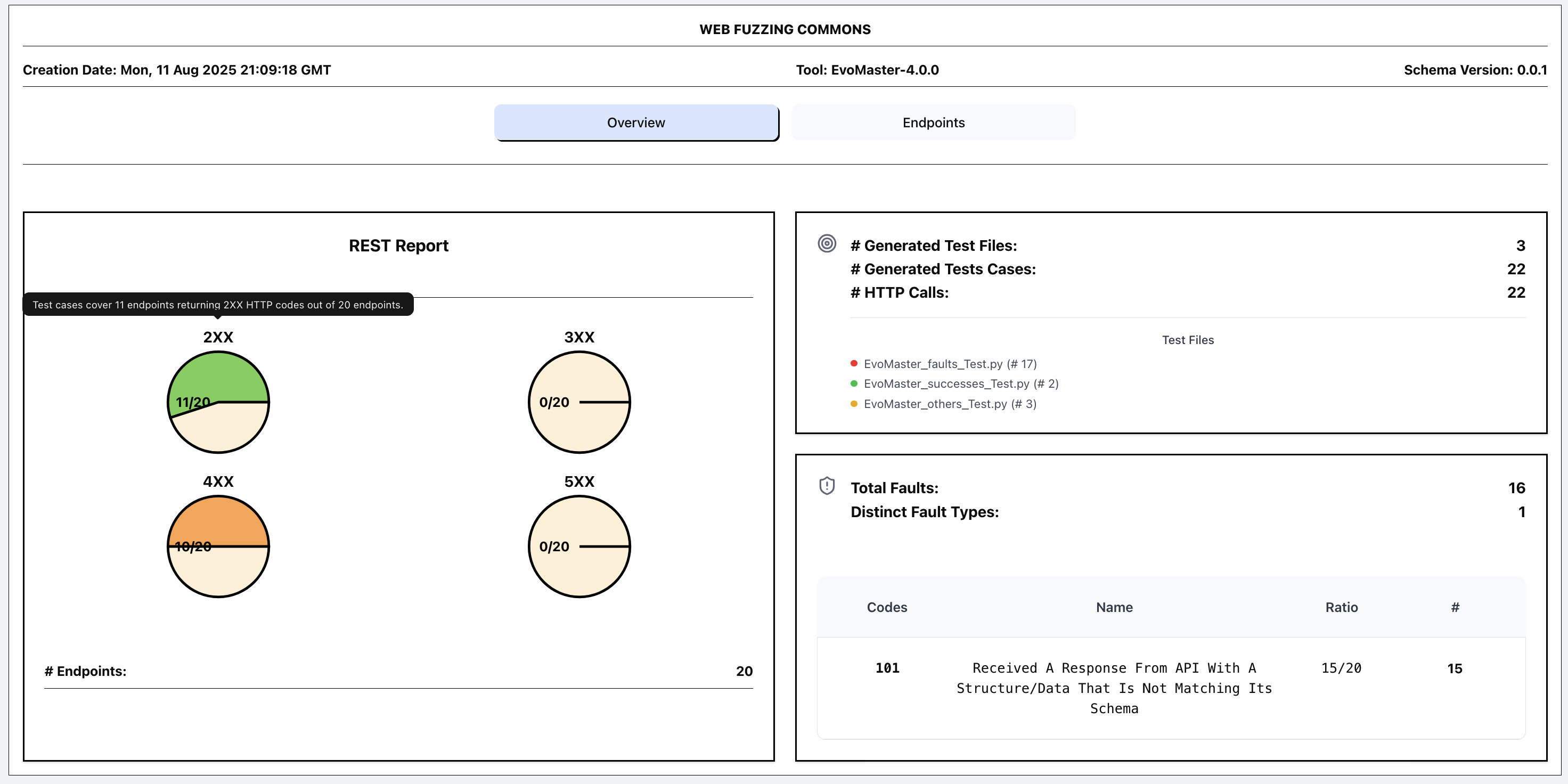
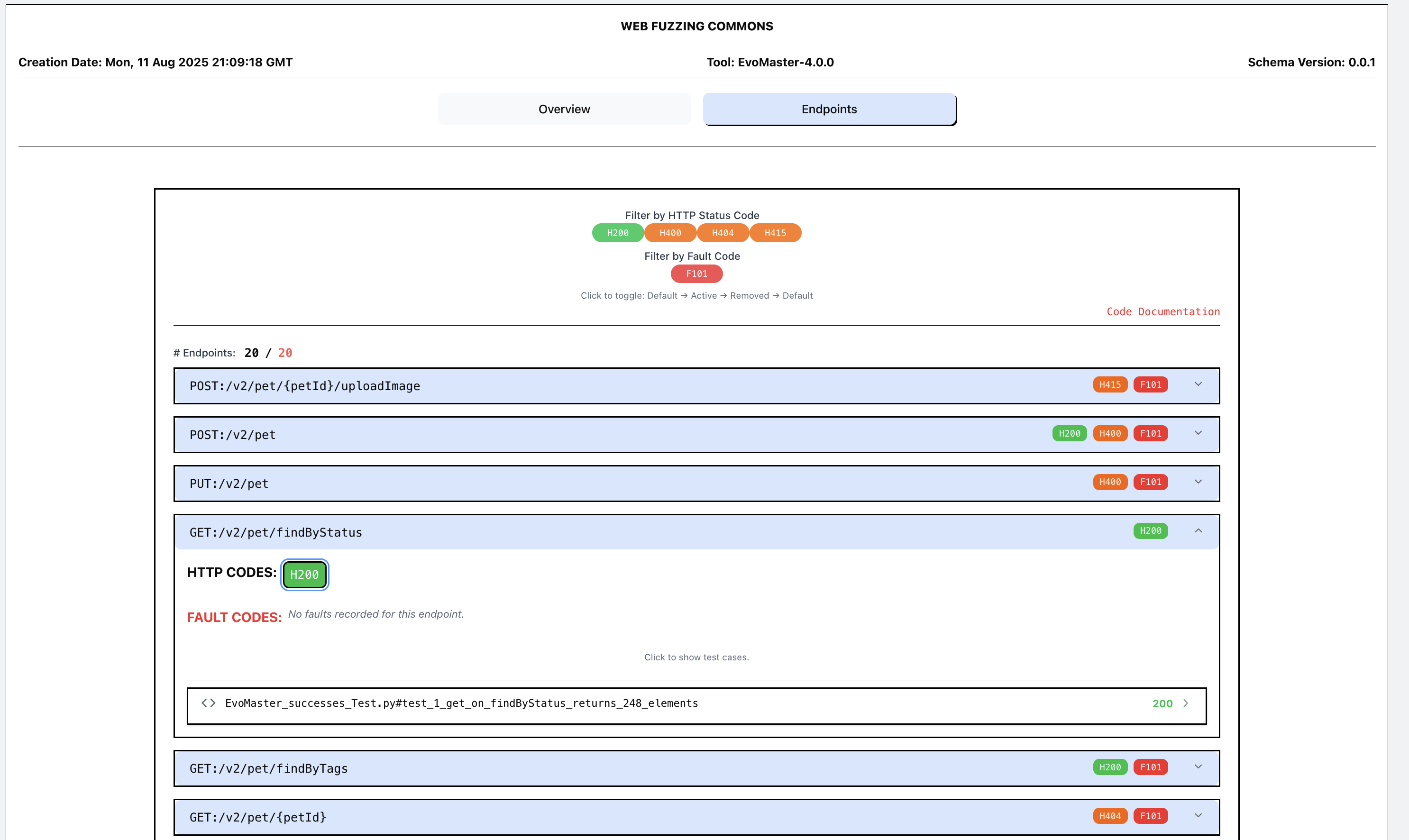
Note, since version 4.0.0, now EvoMaster by default also creates an interactive web report.
Key features
-
Web APIs: At the moment, EvoMaster can generate test cases for REST, GraphQL and RPC (e.g., gRPC and Thrift) APIs.
-
Free: this is an open-source project, with funding from public research (e.g., professors, postdocs and PhD students). There is no monetary cost involved in using this tool, or need to use any paid external services (e.g., external LLM APIs). If you are a resident in EU, Norway, Argentina, China, or any associate country involved with ERC, thanks for your tax money supporting this project.
-
In-house, no telemetry: currently there is no telemetry in use in EvoMaster, and it does not require to connect to any external service on internet, besides the tested application. AFAIK, it can be run in-house without any worry of leaking any IP to external parties (if not, please open a new issue to tell us how that could happen, and we will try to fix it).
-
Black-Box testing mode: can run on any API (regardless of its programming language, e.g., Python and Go). However, results for black-box testing will be worse than white-box testing (e.g., due to lack of code analysis). Default test case output is in Python, but other formats are available as well.
-
White-Box testing mode: can be used for APIs compiled to JVM (e.g., Java and Kotlin). EvoMaster analyses the bytecode of the tested applications, and uses several heuristics such as testability transformations and taint analysis to be able to generate more effective test cases. We support JDK 8 and the major LTS versions after that (currently JDK 21). Might work on other JVM versions, but we provide NO support for it. Note: there was initial support for other languages as well, like for example JavaScript/TypeScript and C#, but they were not in a stable, feature-complete state. The support for those languages for white-box testing has been dropped, at least for the time being.
-
Installation: the current recommended way to install EvoMaster is via PyPi, e.g.,
pip install evomaster. We also provide an uber-fat JAR file. To download it, see the Release page. Release notes are present in the file release_notes.md. If you are using the uber-fat JAR, it should work with any major LTS version (from JDK 17 on). Whereas for the client library, needed for white-box testing, we will support JDK 8 likely for a long, long while. Note that we provide as well installers for the main operating systems: Windows (.msi), OSX (.dmg) and Linux (.deb). Unfortunately, due to the Microsoft/Apple Tax, those installers should be considered "deprecated", see documentation. -
Docker: EvoMaster is now released via Docker as well, under webfuzzing/evomaster on Docker Hub. For more information on how to use EvoMaster via Docker, see documentation.
-
GitHub Action: it is possible to run EvoMaster in GitHub Actions, as part of Continuous Integration, by using the following custom action (which is in a different GitHub repository).
-
Hardware: although state-of-the-art AI techniques are used, there is no major hardware requirement to be able to run EvoMaster. It will work even on old laptops. The main computational bottleneck is running the tested applications, and making network calls to them.
-
State-of-the-art: an independent study (2022), comparing 10 fuzzers on 20 RESTful APIs, shows that EvoMaster gives the best results. Another independent study (2024) done by a different research group confirms these results.
-
Schema: REST APIs must provide a schema in OpenAPI format. We support versions 2.0, 3.0 and 3.1. Unfortunately, support for version 3.2 is currently on hold due to swagger-parser.
-
OAI Overlay: for REST APIs, we natively support Overlay transformations. This is needed for testers that want to add test data via "examples" entries without modifying the OpenAPI scheme directly, see documentation.
-
Output: the tool generates JUnit (version 4 or 5) tests, written in either Java or Kotlin, as well as test suites in Python and JavaScript. For a complete list, see the documentation for the CLI parameter --outputFormat. Some examples are: PYTHON_UNITTEST, KOTLIN_JUNIT_5, JAVA_JUNIT_4 and JS_JEST. Note that the generated tests rely on third-party libraries (e.g., to make HTTP calls). These will need to be setup in your projects, see documentation.
-
Web Report: besides generating executable tests in different programming language, an interactive index.html web report is created as well by default, visualizing and summarizing the results of the generated tests.
-
Fault detection: EvoMaster can generate tests cases that reveal faults/bugs in the tested applications. Different heuristics are employed, like checking for 500 status codes, mismatches from the API schemas, access policy violations like BOLA, and SQL Injection. More than 30 oracles are currently used. Full details with documentation at faults.md.
-
Self-contained tests: for white-box testing, the generated tests do start/stop the application, binding to an ephemeral port. This means that the generated tests can be used for regression testing (e.g., added to the Git repository of the application, and run with any build tool such as Maven and Gradle). For black-box testing, you will need to make sure the application is up and running before executing the tests.
-
Database handling: for white-box testing, EvoMaster can intercept and analyse all communications done with SQL and MongoDB databases, and use such information to generate higher code coverage test cases. Furthermore, it can generate data directly into the databases, and have such initialization automatically added in the generated tests. At the moment, EvoMaster supports Postgres, MySQL, H2 and MongoDB databases.
-
Authentication: we support auth based on authentication headers and cookies. Besides using fixed HTTP headers, it is also possible to declaratively specify which login endpoint should be used to dynamically obtain authentication info (e.g., auth tokens or cookies) for each test execution. See documentation.
Known Limitations
-
Driver: to be used for white-box testing, users need to write a driver manually. We recommend to try black-box mode first (should just need a few minutes to get it up and running) to get an idea of what EvoMaster can do for you.
-
JDK 9+: white-box testing requires bytecode manipulation. Each new release of the JDK makes doing this harder and harder. Dealing with JDKs above 8 is doable, but it requires some settings. See documentation.
-
Execution time: to get good results, you might need to run the search for several hours. We recommend to first try the search for 10 minutes, just to get an idea of what type of tests can be generated. But, then, you should run EvoMaster for something like between 1 and 24 hours (the longer the better, but it is unlikely to get better results after 24 hours).
-
RPC APIs: for the moment, we do not directly support RPC schema definitions. Fuzzing RPC APIs requires to write a driver, using the client library of the API to make the calls.
-
External services: (e.g., other RESTful APIs) currently there is no support for them (e.g., to automatically mock them). It is work in progress.
-
Failing tests: the tests generated by EvoMaster should all pass, and not fail, even when they detect a fault. In those cases, comments/test-names would point out that a test is revealing a possible fault, while still passing. However, in some cases the generated tests might fail. This is due to the so called flaky tests, e.g., when a test has assertions based on the time clock (e.g., dates and timestamps). There is ongoing effort to address this problem, but it is still not fully solved.
Use in Industry
Several enterprises use EvoMaster to fuzz their Web APIs. We do few academia-industry collaborations (see more info here), where we help test engineers to apply EvoMaster on their systems, as long as we can then report on such experience. Examples of Fortune 500 companies using EvoMaster are:
Videos

-
A 45-minute talk given at TestCon'25 on Fuzz Testing Web APIs gives an overview of what can be expected from this kind of fuzzers. A shorter version (16 minutes) was given at Nordic APIs 2025 Platform Summit.
-
A short video (5 minutes) shows the use of EvoMaster on one of the case studies in EMB.
-
This 13-minute video shows how to write a white-box driver for EvoMaster, for the rest-api-example.
-
How to Download and Install EvoMaster on Windows 10, using its .msi installer.
-
Short presentation (5 minutes) about version 2.0.0.
Alternatives
In the last few years, several few tools have been proposed in the academic literature and in the open-source community. You can read more details in this 2023 survey on REST API testing.
Existing open-source tools for REST API fuzzing, with at least 100 stars on GitHub, are for example (in alphabetic order): CATS, Dredd, Fuzz-lightyear, ResTest, Restler, Schemathesis and WuppieFuzz.
Apart from WuppieFuzz, all these tools are black-box, i.e., they do not analyze the source-code of the tested APIs to generate more effective test data. As we are the authors of EvoMaster, we are too biased to compare it properly with those other black-box tools. However, different independent studies (e.g., in 2022 and 2024) shows that EvoMaster is among the best performant. Furthermore, if your APIs are running on the JVM (e.g., written in Java or Kotlin), then EvoMaster has clearly an advantage, as it supports white-box testing.
Documentation
If you are trying to use EvoMaster, but the instructions in this documentation are not enough to get you started, or they are too unclear, then it means it is a bug in the documentation, which then would need to be clarified and updated. In such cases, please create a new issue.
Also, feel free to start new discussion topics in the Discussions forum. If you have time, please consider answering the polls there.
If you are working on an open-source API, you can drop us a message if you have problems using EvoMaster on it. Otherwise, if you are working in industry on closed-source APIs, we have options for academia-industry collaborations (see more info here).
- Example of generated tests
- Download and Install EvoMaster
- Build EvoMaster from source
- Command-Line Interface (CLI) options
- OpenApi/Swagger Schema
- Using EvoMaster for Black-Box Testing (easier to setup, but worse results)
- Using EvoMaster for White-Box Testing (harder to setup, but better results)
- Configuring authentication
- Console output
- Library dependencies for the generated tests
- How to contribute
- Troubleshooting
- More Info
Funding
EvoMaster has been funded by:
- 2020-2026: a 2 million Euro grant by the European Research Council (ERC), as part of the ERC Consolidator project Using Evolutionary Algorithms to Understand and Secure Web/Enterprise Systems.
- 2018-2021: a 7.8 million Norwegian Kroner grant by the Research Council of Norway (RCN), as part of the Frinatek project Evolutionary Enterprise Testing.

This project has received funding from the European Research Council (ERC) under the European Union’s Horizon 2020 research and innovation programme (grant agreement No 864972).
License
EvoMaster's source code is released under the LGPL (v3) license. For a list of the used third-party libraries, you can directly see the root pom.xml file. For a list of code directly imported (and then possibly modified/updated) from other open-source projects, see here.