Memento-Skills: Let Agents Design Agents
Deploy an agent with reusable, persistent, and extensible skills.
Memento-S Desktop App Is Live
The skill-centric agent runtime is now available as a desktop app.
You no longer need to start Memento-S from source. Windows and macOS users can install the app directly and try desktop chat, web research, multi-step task execution, skill calls, and reflection-based replanning.
During the launch period, new app users can receive a generous token package for long tasks, multi-turn collaboration, and agent reflection workflows. Check the app for the latest campaign details.


App Launch · What's New · Learning Results · Install · Quick Start · What Is This · Why It Matters · Ecosystem · Citation
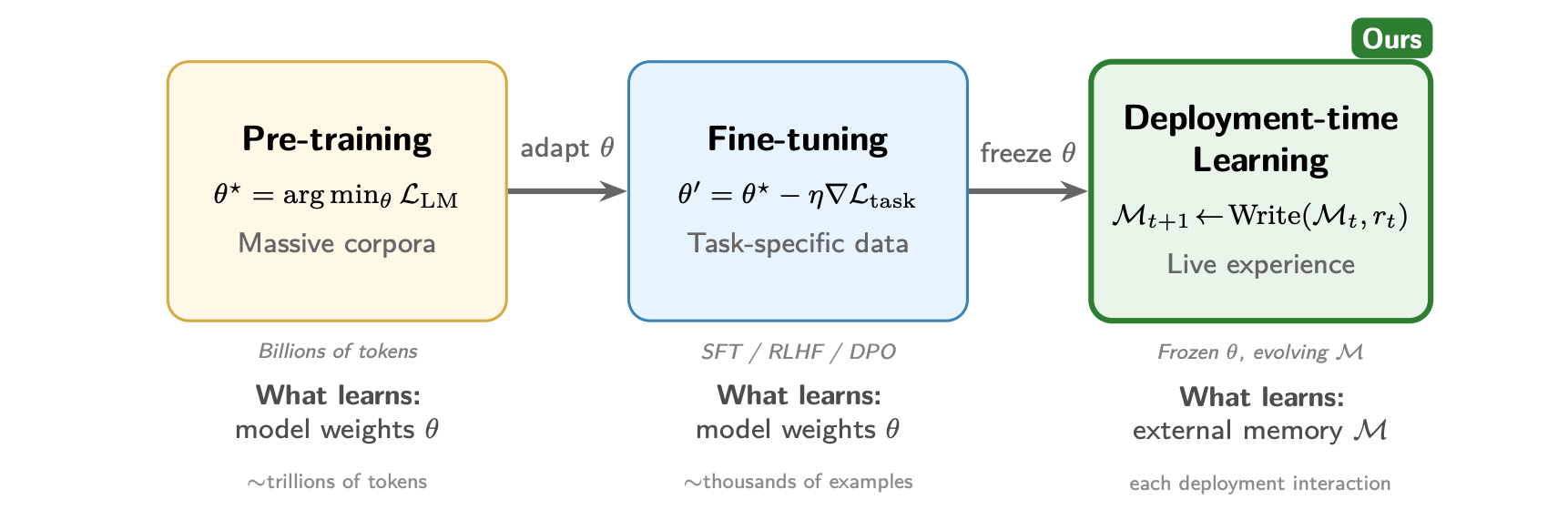
The accompanying technical study compares parameter training with deployment-time skill learning. Its research configuration keeps θ frozen and stores reusable behaviour in an external skill memory M.
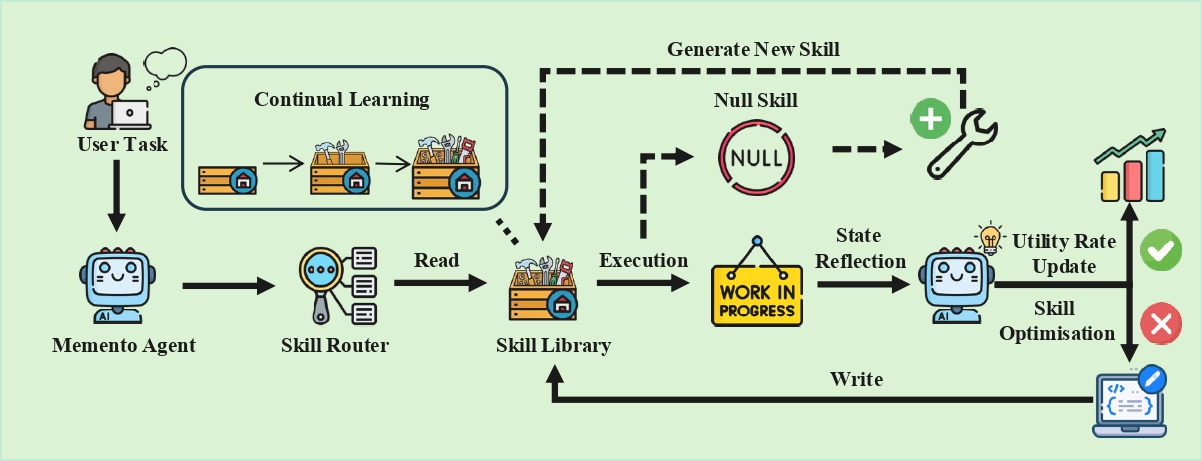
Read–Execute–Reflect–Write architecture studied in the accompanying technical work. The public runtime supplies Qwen/keyword skill routing, execution, reflection and replanning, explicit skill creation, and guarded automatic skill repair.
What's New in v0.4.0
v0.4.0 prepares the public runtime for reproducible software review with consistent release metadata, explicit source licensing, installed-package checks, and clearer contributor and security guidance.
| Update | Description |
|---|---|
| Release identity | Python, Flet, Briefcase, runtime, citation, and configuration metadata identify the v0.4.0 source line consistently. |
| Source licensing | Project-owned source files carry Apache-2.0 SPDX identifiers; separately licensed third-party material remains identified in THIRD_PARTY_NOTICES.md. |
| Installed-package CI | Linux, macOS, and Windows install the built wheel, validate package metadata and dependencies, import public runtime modules, and exercise the CLI help entry point without credentials. |
| Public project guidance | Stale implementation references are corrected, and citation and security-reporting files are included in the source distribution. |
| Qwen skill router | Planning uses configurable keyword, Qwen3/Memento-Qwen, or hybrid local-skill routing with graceful fallback. |
| Guarded skill evolution | Failed traces support automatic attribution, isolated file updates, static/unit/synthetic gates, atomic deployment, audit history, and rollback. |
What's New in v0.3.8
v0.3.8 publishes the Memento-S desktop app as the recommended path for most users. Windows and macOS builds are now available directly from the README, with future product updates continuing through the app.
| Update | Description |
|---|---|
| Desktop app launch | Memento-S can now be installed directly on Windows and macOS without setting up Python or launching from source. |
| Top-level launch banner | The README now opens with a clear app launch announcement, download buttons, and launch offer messaging. |
| Launch announcement | A standalone English announcement is available at docs/MEMENTO_APP_LAUNCH_PR.md for external publishing. |
| Launch offer | New app users can receive a generous token package during the launch period. Check the app for current campaign details. |
What's New in v0.3.0
v0.3.0 focuses on cleaner separation of concerns. The runtime is now organised into a dedicated infrastructure layer, a unified tool registry, and a long-lived agent profile system, so that core agent logic, infrastructure, and tools can evolve independently.
Infrastructure Layer (infra/)
A new top-level infra/ package isolates infrastructure concerns from core/ so that agent logic and platform code can evolve independently.
| Module | Description |
|---|---|
infra/memory/ |
Long-term and session memory implementations, plus context-block builders. |
infra/context/ |
Pluggable context providers and shared utilities used by the runtime. |
infra/compact/ |
Context compaction pipeline (strategies, storage, models, utilities) for long-conversation summarisation. |
infra/service.py |
InfraService entry that wires the above into the agent runtime. |
infra/shared/ |
Shared compact / extract helpers reused across providers. |
Unified Tool Registry (tools/)
Tooling has been promoted to a top-level tools/ package with a single ToolRegistry. The previous builtin/tools/ layer has been retired in favour of this unified surface.
| Module | Description |
|---|---|
tools/atomics/ |
Atomic tools (bash, file ops, grep, glob, list, web, python_repl, js_repl, MCP wrappers). |
tools/mcp/ |
MCP client integration for loading external MCP servers as tools. |
tools/registry.py |
Single registration / discovery surface (get_registry) consumed by the agent and skill executor. |
Agent Profile System
core/agent_profile/ introduces persistent profiles that capture an agent's long-term identity, while a matching daemon/agent_profile/ package evolves those profiles in the background.
| Module | Description |
|---|---|
core/agent_profile/manager.py |
Read / write API for soul and user profiles. |
core/agent_profile/soul_manager.py |
Maintains the agent's long-term identity, traits, and policies. |
core/agent_profile/user_manager.py |
Tracks per-user preferences and history. |
daemon/agent_profile/orchestrator.py |
Background orchestrator that triggers soul / user evolution. |
daemon/agent_profile/soul_evolver.py / user_evolver.py |
Periodically refines profiles from recent conversations and outcomes. |
Dream Daemon
A new daemon/dream/ package runs background consolidation between sessions, similar to how reflection updates the skill library.
| Module | Description |
|---|---|
daemon/dream/consolidator.py |
Consolidates recent experiences into long-term memory and skill candidates. |
daemon/dream/loop.py |
Long-running loop that schedules consolidation passes. |
Shared Layer Expansion (shared/)
The shared/ package has grown beyond chat utilities into a broader foundation for cross-cutting helpers.
| Module | Description |
|---|---|
shared/fs/ |
Filesystem helpers shared by core, infra, and tools. |
shared/hooks/ |
Lifecycle hooks for runtime extension points. |
shared/schema/ |
Reusable schema definitions. |
shared/security/ |
Path / argument security primitives. |
shared/tools/ |
Common tool utilities and dispatcher helpers. |
Runtime & Developer Experience
| Addition | Description |
|---|---|
utils/runtime_requirements/ |
Runtime dependency checker and auto-installer that resolves missing packages on first use. |
utils/runtime_mode.py |
Runtime mode detection (CLI vs GUI vs daemon). |
utils/log_config.py |
Centralised logging configuration. |
utils/strings.py |
Shared string helpers used across the codebase. |
core/skill/downloader/ |
Dedicated downloader pipeline split out from the skill market. |
docs/ARCHITECTURE.md, docs/API_SPEC.md |
Up-to-date architecture and API references. |
docs/dependency_auto_install.md, docs/README_DEPENDENCY.md |
Runtime dependency model and auto-install behaviour. |
docs/database_optimization.md, docs/uni_response_design.md |
New design notes for storage and unified response handling. |
docs/QWEN_ROUTER_AND_SKILL_EVOLUTION.md |
Qwen routing and transactional Read-Write skill updates. |
Refactors and Removals
The new layout supersedes several v0.2.0 modules. The v0.2.0 tool_bridge/ layer (runner, bridge, context, args_processor, result_processor) is replaced by the unified tools/ registry. builtin/tools/ (bash, file_ops, grep, python_repl, web) has been moved to tools/atomics/. The monolithic core/skill/execution/executor.py and core/context/manager.py, together with core/context/{block,scratchpad,runtime_state,memory}.py, have been split into tools/, infra/context/, and infra/memory/. IM startup no longer goes through middleware/im/gateway_starter.py and middleware/im/gateway/agent_worker.py; both are removed and replaced by a single EndpointService (server/endpoint/im/) that manages all IM channels and the agent worker. bootstrap.py and middleware/llm/llm_client.py have been reworked to align with this new wiring.
Compatibility Notes
- Modules previously imported from
builtin.tools.*are now undertools.*(for example,tools.atomics,tools.mcp,tools.registry). - Modules previously under
core/shared/*(compact, memory, context wiring) now live underinfra/*. Update any direct imports accordingly. core/manager/has been removed; conversation and session management now lives inshared/chat/.- IM channels are now started via
EndpointService.start_channel(...)(server/endpoint/im/); direct use ofgateway_starter/agent_workerno longer applies.
What's New in v0.2.0
v0.2.0 is a major architectural upgrade. The core agent, skill system, configuration layer, and deployment surfaces have all been redesigned or significantly extended compared to v0.1.0.
Core Architecture
| Change | Description |
|---|---|
| Bounded Context redesign | The agent and skill modules have been restructured using a Bounded Context architecture, improving modularity and long-term maintainability. |
| Execution phase refactoring | The monolithic execution phase has been split into dedicated sub-modules (runner, tool_handler, step_boundary, helpers), enabling finer-grained control over multi-step reasoning. |
| New Finalize phase | A dedicated finalize phase has been added to the 4-stage pipeline for structured result summarisation. |
| Protocol layer | A new core/protocol/ module defines communication protocols between system components. |
| Tool Bridge system | A new tool_bridge/ layer (runner, bridge, context, args_processor, result_processor) provides cleaner tool invocation and result handling. |
| Execution policies | New policy modules (tool_gate, path_validator, pre_execute, recovery) add fine-grained safety and execution control. |
| Error recovery and loop detection | New error_recovery.py and loop_detector.py modules handle agent self-repair and infinite loop prevention during skill execution. |
Configuration System v2
| Change | Description |
|---|---|
| Three-layer isolation | System Config (read-only defaults) / User Config (persistent customisation) / Runtime Config (merged at startup). |
| Automatic migration | When the config template updates, the system auto-merges new fields while preserving user-modified values via x-managed-by: user markers. |
| Schema validation | Pydantic-based config models with JSON Schema for IDE auto-completion and validation. |
Skill Ecosystem
| Change | Description |
|---|---|
| Skill Market | A built-in marketplace for searching, downloading, and auto-installing skills from the cloud catalogue. |
| Skill Builder | New core/skill/builder/ module for programmatic skill creation and generation. |
| Skill Loader | New core/skill/loader/ replaces the old importer system with a cleaner discovery and loading pipeline. |
| Enhanced retrieval | Retrieval has been refactored into local_db_recall, local_file_recall, and remote_recall, with BM25 + semantic vector hybrid search for improved routing accuracy. |
| Pluggable storage | Skill store now supports db_storage, file_storage, and vector_storage backends. |
| Content analyser | New content_analyzer.py for inspecting and validating skill outputs. |
IM Platform Integration (New)
| Platform | Mode | Notes |
|---|---|---|
| Feishu | Bridge + Gateway | WebSocket long-connection with per-user persistent sessions |
| DingTalk | Gateway | Webhook + event subscription |
| WeCom | Gateway | Enterprise WeChat integration |
| Optional iLink API | Requires a separately installed SDK whose terms the user has reviewed |
A unified IM Gateway (middleware/im/gateway/) with AgentWorker, ConnectionManager, and platform-specific channels enables real-time message handling across all four platforms.
IM Gateway
| Component | Description |
|---|---|
middleware/im/ |
IM platform operations across Feishu, DingTalk, WeCom, and optional personal WeChat integrations. |
GUI Enhancements
- Workspace browser — integrated file tree with drag-and-drop and in-place file operations.
- Session management — save, load, rename, and delete conversation history.
- Slash commands —
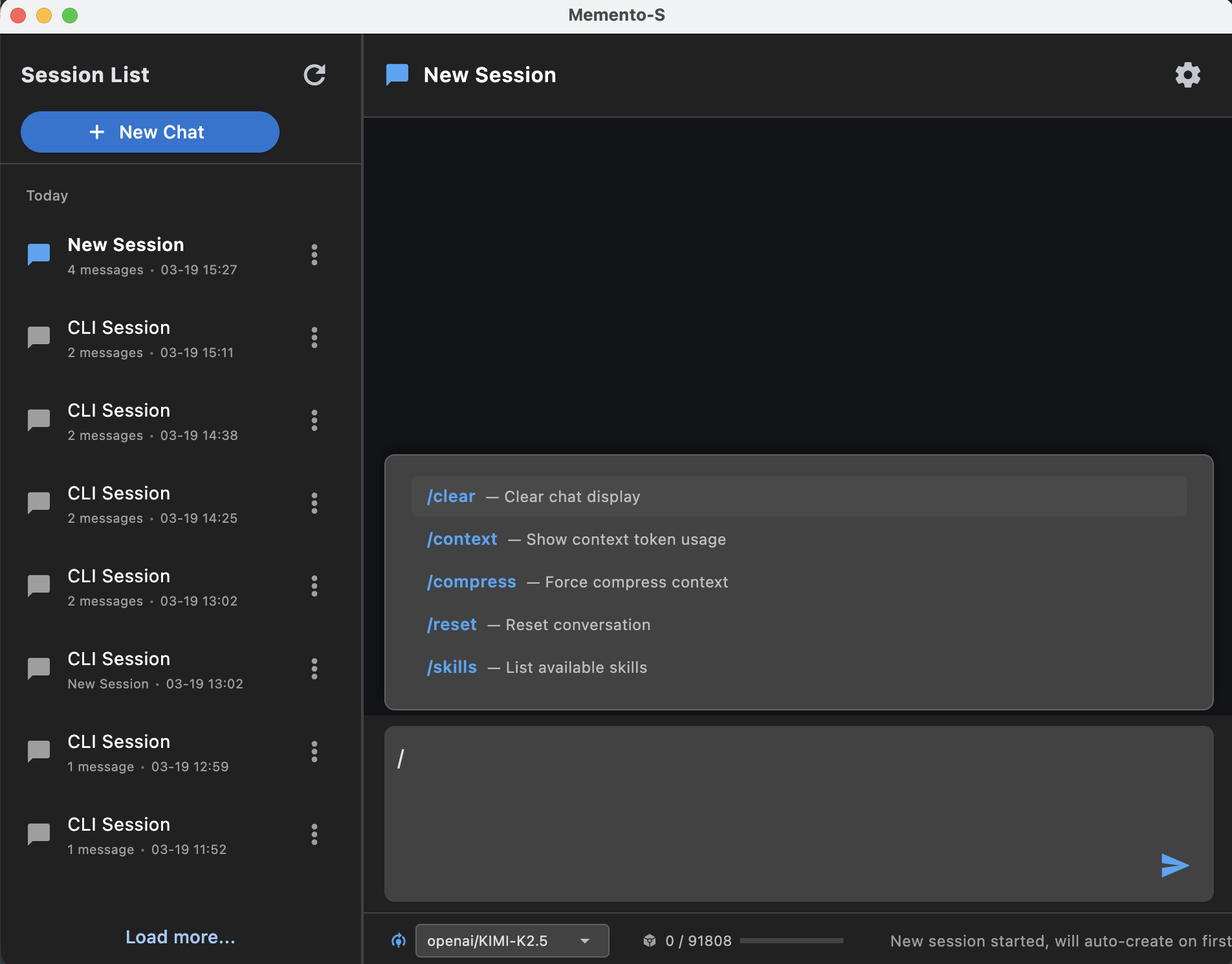
/skills,/context,/compress,/feishu start|stop|status, and more.
Developer Experience
| Addition | Description |
|---|---|
bootstrap.py |
Centralised application initialisation entry point. |
version.py |
Single source of truth for version metadata. |
| Test suite | Unit, integration, and smoke tests covering skills, config, context, tools, and security. |
| Build scripts | PyInstaller / Nuitka packaging, database migrations, and deployment automation (scripts/). |
| OTA auto-update | Packaged builds can auto-detect and apply incremental updates. |
memento doctor |
One-command environment diagnostics — Python version, dependencies, config validity, and API availability. |
Operations
howto.md— a standalone quick-start guide for local source-based deployment.requirements-dev.txt— separate dev dependencies..github/— CI/CD workflows.
Learning Results
The accompanying technical study evaluates a research configuration of Memento-Skills on two challenging benchmarks:
-
HLE (Humanity's Last Exam) — a benchmark of extremely difficult questions spanning diverse academic disciplines, designed to probe the upper limits of frontier AI systems on expert-level reasoning and knowledge.
-
GAIA (General AI Assistants) — a benchmark for evaluating general-purpose AI assistants on real-world tasks that require multi-step reasoning, web browsing, file handling, and tool use.
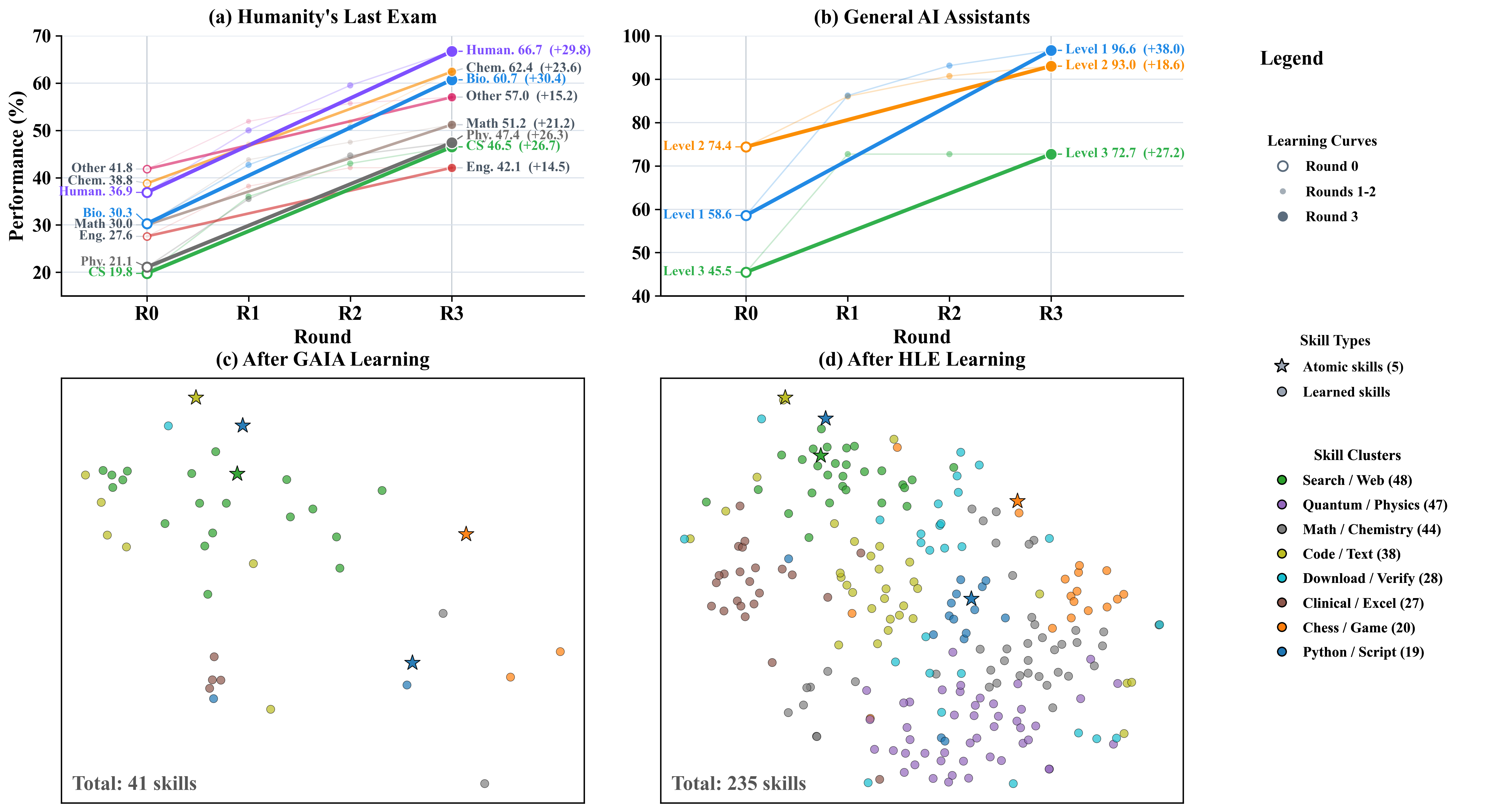
Results from the research configuration on two benchmarks. (a, b) depict task performance across reflective learning rounds on HLE and GAIA. (c, d) depict growth of the research skill memory and its semantic clusters.
The reported results improve over multiple learning rounds on HLE and GAIA, while the research skill library grows from a small set of atomic skills into a richer set of learned skills.
Core question. How can a deployable agent organise behaviour as reusable skills, reflect on execution, and persist newly authored capabilities? The accompanying technical study motivates the runtime's guarded automatic skill repair loop.
Reflect on execution
Step results inform whether the runtime continues, replans, or finalises.
Author reusable skills
The runtime can create missing skills and repair an attributed skill after a failed trajectory.
Run in the real world
Local execution, persistent state, CLI, GUI, and multi-platform IM integration make it deployable beyond a paper demo.
Key Features
| Feature | Why it matters |
|---|---|
| Skill-centric agent runtime | Memento-Skills ships orchestration, skill routing, execution, reflection, storage, CLI, and GUI components; third-party provenance is documented in THIRD_PARTY_NOTICES.md. |
| 4-stage ReAct architecture | Intent, Planning, Execution (multi-step ReAct loop), and Reflection — structured reasoning with a dedicated Finalize phase for result summarisation. |
| Designed for open-source LLM ecosystems | The profile-based LLM layer is especially friendly to mainstream open-source model platforms such as Kimi / Moonshot, MiniMax, GLM / Zhipu, as well as other OpenAI-compatible endpoints. |
| Qwen skill router | Qwen3/Memento-Qwen behaviour-oriented embeddings can route a goal to a compact skill set, with keyword + dense hybrid fusion and safe fallback. |
| Guarded skill evolution | Failed runs are attributed to one skill, rewritten in isolation, tested on static/unit/synthetic gates, and atomically deployed or rolled back. |
| Persistent skill lifecycle | The runtime retrieves, executes, installs, creates, validates, versions, and persists reusable skills. |
| Skill Market | Built-in cloud catalogue with search, download, and auto-install — share and reuse validated skills across deployments. |
| Multi-platform IM Gateway | Unified real-time messaging across Feishu, DingTalk, WeCom, and WeChat with WebSocket long-connections and per-user persistent sessions. |
| Configuration v2 | Three-layer isolation (System / User / Runtime) with automatic migration, schema validation, and version management. |
| Local-first deployment surfaces | CLI, desktop GUI, IM bridges, local sandbox execution, and persistent state make it practical for real-world deployment rather than one-off demos. |
What Is Memento-Skills?
Memento-Skills is a skill-centric agent runtime organised around skills as
first-class units of capability. Skills are retrievable, executable, and
persistent. Instead of treating tools as a flat pile of functions,
Memento-Skills treats them as a library that can be routed, installed, authored,
and reused over time.
The runtime combines step-boundary reflection and replanning with explicit skill authoring and guarded automatic write-back. Failed trajectories can repair the attributed skill without changing the underlying language model, while tests and directory snapshots prevent a bad candidate from replacing the active version.
What Makes It Different?
Memento-Skills exposes a Read -> Execute -> Reflect -> Write skill lifecycle.
| Loop | What it means |
|---|---|
| Read | Retrieve candidate skills from the local library and remote catalogue instead of stuffing every skill into context. |
| Execute | Run skills through tool calling and a local sandbox so the agent can act on files, scripts, webpages, and external systems. |
| Reflect | Inspect step results and choose whether to continue, replan, or finalise. |
| Write | Attribute failures, update one skill in isolation, run automatic gates, then deploy or roll back; create a new skill when no capability is suitable. |
This lifecycle keeps skill retrieval, execution, reflection, authoring, and persistence within one deployable runtime.
Memento-Skills vs OpenClaw
The two systems share a lot of DNA, but they are not centred on the same question.
- OpenClaw is more about getting an assistant to run in the real world.
- Memento-Skills is more about getting an agent to learn from the real world.
Shared Foundation
| Common Ground | Memento-Skills | OpenClaw |
|---|---|---|
| Skills as capability units | Yes | Yes |
| Deployable, engineerable system | Yes | Yes |
| Tool use and local execution | Yes | Yes |
| Persistent or stateful memory | Yes | Yes |
Key Differences
| Dimension | Memento-Skills | OpenClaw |
|---|---|---|
| Product focus | Focused on a persistent skill lifecycle with routing, execution, reflection, creation, and guarded repair. | Focused on how an assistant gets deployed and connected to the real world. |
| Learning and evolution | The runtime can attribute a failed trace, update one skill in isolation, test the candidate, and deploy or roll it back. | Capability growth is more commonly driven by external plugins, tools, and human-provided integrations. |
| Skill routing | Treats retrieval and routing as core problems, especially when the skill library becomes large. | Better optimised for broad real-world integrations; context and hit-rate management depend more on the surrounding engineering setup. |
| Skill download | Includes a cloud catalogue plus download flow, moving toward deduped and validated reusable skills. | More open-ended ecosystem growth, with quality and duplication control relying more on platform or community processes. |
| Skill creation | Can explicitly create and persist a new skill when nothing suitable exists locally or remotely. | Missing skills are more often supplied by humans or installed explicitly. |
| Evaluation | Emphasises measured learning behaviour on benchmarks such as GAIA and HLE. | Emphasises assistant usability and real-world system integration. |
| Use cases | Hard multi-step reasoning plus daily productivity and personal life management. | Daily productivity, messaging, web tasks, devices, and real-world assistant workflows. |
In one sentence: OpenClaw is about getting the assistant running; Memento-Skills is about getting the agent learning.
Deployment Surfaces
| Surface | Current support | Notes |
|---|---|---|
| CLI | memento agent |
Interactive mode or single-message mode (-m "...") |
| Desktop GUI | memento-gui |
Session list, chat UI, workspace browser, slash commands |
| Feishu bridge | memento feishu |
WebSocket-based IM bridge with per-user persistent sessions |
| DingTalk gateway | IM Gateway | Webhook + event subscription |
| WeCom gateway | IM Gateway | Enterprise WeChat integration |
| iLink API | Personal WeChat binding via QR code scan | |
| Skill verification | memento verify |
Download, static review, and execution validation |
| Local sandbox | uv |
Isolated skill execution, dependency install, and local tool invocation |
One Repo. One Learning Agent.
python -m venv .venv && source .venv/bin/activate && pip install -e . && memento doctor && memento agent
One-Click GUI Install
Download the pre-built desktop app — no Python or terminal needed. Install the package for your platform and start using Memento-S directly.
The desktop app is now the recommended path for most users. We will keep shipping product updates through the app, while this repository remains available for developers who want to inspect, extend, or run the source code.
| Platform | Download |
|---|---|
| Windows | Download for Windows |
| macOS | Download for Mac |
Launch offer: new app users can receive a generous token package during the launch period. Open the app to check the latest campaign details.
For source-based development, continue with the developer quick start below.
Quick Start (Developer)
git clone https://github.com/Memento-Teams/Memento-Skills.git
cd Memento-Skills
python -m venv .venv
source .venv/bin/activate
pip install -e .
On first launch, ~/memento_s/config.json is created automatically. Fill in your model profile, then start the app:
memento doctor    # Check environment, dependencies, and config validity
memento agent     # Start an interactive agent session in the terminal
memento-gui       # Launch the desktop GUI with chat interface
| Command | Description |
|---|---|
memento doctor |
Runs a diagnostic check on your environment — verifies Python version, installed dependencies, config file validity, and API key availability. Run this first to make sure everything is set up correctly. |
memento agent |
Starts an interactive agent session in the terminal. The agent can receive tasks, route to skills, execute them in a local sandbox, and reflect on results. Add -m "..." for single-message mode. |
memento-gui |
Launches the desktop GUI built with Flet, providing a visual chat interface with session management, workspace browser, slash commands, and real-time skill execution feedback. |
Configuration system (v2)
Memento-Skills uses a three-layer configuration architecture (introduced in v0.2.0):
- System Config (
system_config.json) — read-only defaults shipped with the codebase. - User Config (
~/memento_s/config.json) — persistent user customisation, read-write. - Runtime Config — merged at startup (System + User), used at runtime.
When the config template updates across versions, the system automatically detects and merges new fields while preserving existing user values. Fields marked with x-managed-by: user are protected from auto-migration.
{
  "llm": {
    "active_profile": "default",
    "profiles": {
      "default": {
        "model": "openai/gpt-4o",
        "api_key": "your-api-key",
        "base_url": "https://api.openai.com/v1",
        "max_tokens": 8192,
        "temperature": 0.7,
        "timeout": 120
      }
    }
  },
  "env": {
    "TAVILY_API_KEY": "your-search-api-key"
  }
}
The model field uses the provider/model format, for example anthropic/claude-3.5-sonnet, openai/gpt-4o, or ollama/llama3.
TAVILY_API_KEY is only required for web search.
The same profile system is also convenient for mainstream open-source model ecosystems, including Kimi / Moonshot, MiniMax, GLM / Zhipu, and other OpenAI-compatible endpoints.
Common commands
memento agent             # Interactive agent session
memento agent -m "..."    # Single-message mode
memento doctor            # Environment and config checks
memento verify            # Skill download / audit / execution validation
memento feishu            # Feishu IM bridge
memento wechat            # Optional WeChat integration (external SDK required)
memento im_status         # IM gateway status
memento-gui               # Desktop GUI
Supported LLM providers
| Provider | Model example | base_url |
|---|---|---|
| Anthropic Claude | anthropic/claude-3.5-sonnet |
default |
| OpenAI | openai/gpt-4o |
default |
| OpenRouter | anthropic/claude-3.5-sonnet |
https://openrouter.ai/api/v1 |
| Ollama | ollama/llama3 |
http://localhost:11434 |
| Open-source LLM ecosystems | Kimi, MiniMax, GLM, and similar endpoints | configurable via profile + base_url |
| Self-hosted (vLLM / SGLang) | openai/your-model |
custom endpoint |
Built-in Skills
The four Apache-compatible built-in skills are a starting point. Additional skills can be installed or authored after their licenses and provenance have been reviewed.
| Skill | Description |
|---|---|
filesystem |
File read, write, search, and directory operations |
web-search |
Tavily-based web search and page fetching |
skill-creator |
New skill creation, optimisation, and evaluation |
uv-pip-install |
Python dependency installation via uv |
Verification and Contributions
GitHub Actions runs a deterministic smoke suite on Linux, macOS, and Windows, publishes coverage reports for that suite, and builds and inspects both the wheel and source archive. The artifact check prevents retired non-redistributable components from re-entering release packages.
See CONTRIBUTING.md for the development setup, exact local checks, integration-test policy, and third-party intake requirements.
Developer Notes
Project structure
Memento-Skills/
├── core/                  # Core agent framework
│   ├── memento_s/         # Agent orchestrator (4-stage ReAct + Finalize)
│   │   ├── phases/        # Intent, Planning, Execution/, Reflection, Finalize
│   │   └── skill_dispatch/ # Skill dispatch and tool routing
│   ├── skill/             # Skill framework
│   │   ├── loader/        # Skill discovery and loading
│   │   ├── retrieval/     # BM25 + vector hybrid retrieval
│   │   ├── execution/     # Sandbox execution + policies
│   │   ├── store/         # Skill persistence backends
│   │   ├── downloader/    # Skill download pipeline (new in v0.3.0)
│   │   ├── market.py      # Skill Market
│   │   └── gateway.py     # Unified skill gateway
│   ├── agent_profile/     # Agent profile system (new in v0.3.0)
│   ├── context/           # Bounded Context management
│   ├── protocol/          # Communication protocols
│   └── prompts/           # Prompt templates
├── infra/                 # Infrastructure layer (new in v0.3.0)
│   ├── memory/            # Long-term and session memory
│   ├── context/           # Context providers
│   ├── compact/           # Context compaction pipeline
│   ├── shared/            # Compact / extract helpers
│   └── service.py         # InfraService entry
├── tools/                 # Unified tool registry (new in v0.3.0)
│   ├── atomics/           # Atomic tools (bash, file, grep, web, repl, mcp)
│   ├── mcp/               # MCP client integration
│   └── registry.py        # ToolRegistry
├── middleware/             # Middleware layer
│   ├── config/            # Config v2 (three-layer isolation)
│   ├── llm/               # LLM client (litellm multi-provider)
│   ├── storage/           # SQLite + SQLAlchemy + vector storage
│   ├── im/                # IM platform middleware
│   ├── sandbox/           # uv sandbox
│   └── utils/             # Environment, path security
├── im/                    # IM platform integrations
│   ├── gateway/           # Gateway mode
│   ├── feishu/            # Feishu
│   ├── dingtalk/          # DingTalk
│   └── wecom/             # WeCom
├── gui/                   # Flet desktop GUI
├── cli/                   # Typer CLI
├── builtin/skills/        # Apache-compatible built-in skills (4)
├── shared/                # Shared layer (expanded in v0.3.0)
│   ├── chat/              # Session and conversation
│   ├── fs/, hooks/, schema/, security/, tools/  # Cross-cutting helpers
├── utils/                 # Shared helpers (runtime_requirements/ new in v0.3.0)
├── daemon/                # Background services
│   ├── agent_profile/     # Soul / user evolver (new in v0.3.0)
│   └── dream/             # Dream consolidation loop (new in v0.3.0)
├── tests/                 # Test suite
├── scripts/               # Build and deployment scripts
├── docs/                  # Documentation
├── bootstrap.py           # Application initialisation
├── version.py             # Version metadata
├── Figures/               # README figures
└── pyproject.toml         # Project configuration
Tech stack
| Layer | Technology |
|---|---|
| Interface | Flet, Typer, Rich |
| Agent framework | Memento 4-stage ReAct architecture |
| LLM access | litellm (multi-provider) |
| Retrieval | BM25 (jieba), sqlite-vec, cloud catalogue |
| Execution | uv sandbox + subprocess isolation |
| Configuration | v2 three-layer architecture + Pydantic + auto-migration |
| Storage | SQLite, SQLAlchemy, aiosqlite, vector storage |
| IM integration | WebSocket long-connection + Webhook (Feishu, DingTalk, WeCom, WeChat) |
| Async runtime | asyncio + aiofiles + anyio |
| Build and packaging | hatchling / PyInstaller / Nuitka |
| Testing and verification | pytest, pytest-asyncio, memento verify |
FAQ
| Problem | Solution |
|---|---|
| Skills not found | Check the skill and workspace configuration in ~/memento_s/config.json. |
| API timeout | Increase the active profile timeout. |
| Import errors | Make sure the virtual environment is active and rerun pip install -e .. |
| Web skill fails | Check whether TAVILY_API_KEY is configured and whether network access is available. |
| IM gateway connection fails | Check the IM platform credentials in config.json. |
| Config migration fails | Back up then manually merge ~/memento_s/config.json with the template. |
Memento Ecosystem
Memento-Skills is part of the broader Memento project family. Visit the links below to learn more about the full ecosystem and connect with the community.
| Resource | Link | Description |
|---|---|---|
| Memento Homepage | memento.run | The hub for all Memento series projects and research |
| Memento-Skills Project Site | skills.memento.run | Official project page for this work, including demos and documentation |
| Discord Community | Join Discord | Discussion, Q&A, feature requests, and collaboration |
Citation
If you find Memento-Skills useful in your research, please cite:
- Title: Memento-Skills: Let Agents Design Agents
- Authors: Huichi Zhou, Siyuan Guo, Anjie Liu, Zhongwei Yu, Ziqin Gong, Bowen Zhao, Zhixun Chen, Menglong Zhang, Yihang Chen, Jinsong Li, Runyu Yang, Qiangbin Liu, Xinlei Yu, Jianmin Zhou, Na Wang, Chunyang Sun, Jun Wang
- Paper: https://arxiv.org/abs/2603.18743
@article{zhou2026memento,
  title={Memento-Skills: Let Agents Design Agents},
  author={Zhou, Huichi and Guo, Siyuan and Liu, Anjie and Yu, Zhongwei and Gong, Ziqin and Zhao, Bowen and Chen, Zhixun and Zhang, Menglong and Chen, Yihang and Li, Jinsong and others},
  journal={arXiv preprint arXiv:2603.18743},
  year={2026}
}
Chinese Summary
点击展开中文摘要
Memento-Skills 把能力组织成可检索、可执行、可持久化的 skills。公开运行时围绕 Read -> Execute -> Reflect -> Write 生命周期提供 Qwen/关键词技能路由、执行、步骤反思与重新规划、显式技能创建,以及带自动归因、隔离更新、测试门禁和回滚的受控写回。
和 OpenClaw 相比,两者都具备 skills、工具调用、本地执行、持久化记忆和系统化部署能力,但关注点不同。OpenClaw 更偏向让 assistant 稳定接入真实世界;Memento-Skills 更强调统一的技能生命周期与持久化运行时。
v0.3.0 主要更新: 新增独立的 infra/ 基础设施层(memory / context / compact / service),将记忆、上下文、压缩等基础能力从 core/ 中拆出,便于独立演进;新增统一的 tools/ 工具注册中心(atomics、MCP、registry),取代原有 builtin/tools/;引入 Agent Profile 系统(core/agent_profile/ + daemon/agent_profile/),通过后台 evolver 持续维护 agent 的长期身份与用户画像;新增 daemon/dream/ 后台巩固循环,在会话间进行经验整理;扩展 shared/ 共享层(fs / hooks / schema / security / tools);新增 utils/runtime_requirements/ 运行时依赖自动检测安装。
v0.2.0 主要更新: 核心架构采用 Bounded Context 重构,配置系统升级为三层隔离架构(System/User/Runtime),新增 Skill Market 支持云端技能市场,新增多平台 IM Gateway(飞书、钉钉、企业微信、微信),执行引擎拆分为细粒度子模块并增加 Tool Bridge、执行策略、错误恢复和循环检测机制,GUI 新增 Workspace 浏览器和会话管理,新增完整测试套件和构建脚本。
当前仓库已经具备比较完整的本地落地能力,包括 CLI、桌面 GUI、多平台 IM 桥接、本地 sandbox 和 skill 验证流程,因此它不仅适合 benchmark 式 agent,也适合继续往个人助理、长期运行和真实世界任务代理方向推进。
License
Memento-Skills is licensed under the Apache License 2.0. See THIRD_PARTY_NOTICES.md for bundled and optional third-party components.