JanusVLN: Decoupling Semantics and Spatiality with Dual Implicit Memory for Vision-Language Navigation
🎉🎉ICLR 2026🎉🎉
Shuang Zeng1,2, Dekang Qi1, Xinyuan Chang1, Feng Xiong1, Shichao Xie1, Xiaolong Wu1, Shiyi Liang1,2, Mu Xu1, Xing Wei2
1Amap, Alibaba Group, 2Xi’an Jiaotong University
https://github.com/user-attachments/assets/bc477e20-2dd2-4927-b382-f483f578f3e1
💡 Introduction
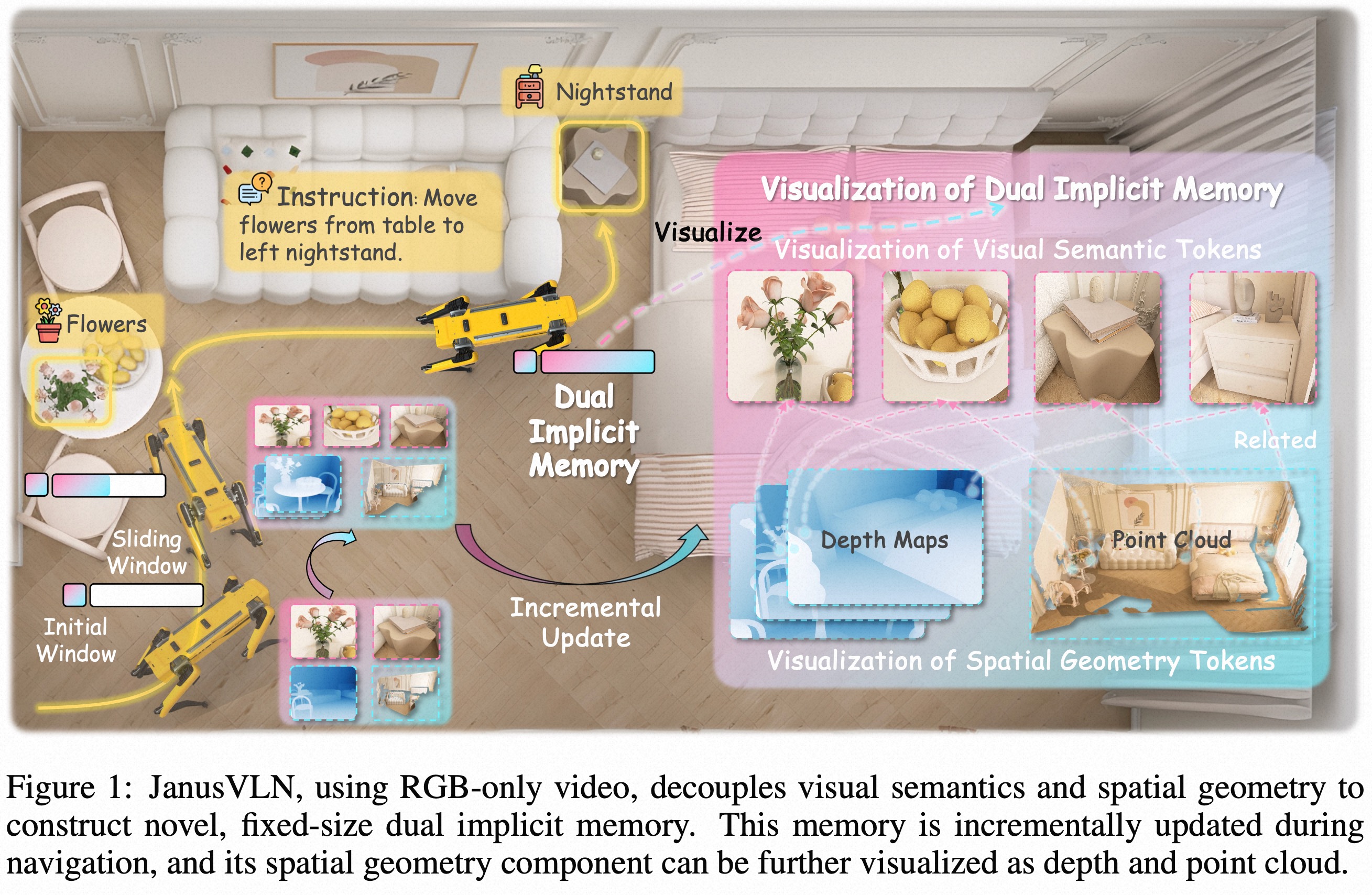
JanusVLN is a novel VLN framework and the first to feature a dual implicit memory. Inspired by the implicit scene representation in human navigation, which integrates left-brain semantic understanding with right-brain spatial cognition, JanusVLN constructs two complementary, fixed-size, compact neural memory. JanusVLN steers VLN research from 2D semantics-dominant toward 3D spatial-semantisynergy, a critical direction for developing next-generation spatial embodied agents.
📢 News
[2026-8-17] We provide tutorials for using JanusVLN in three ways: Conda, Skill (with Conda), and Docker. For details, View here.
[2026-1-26] JanusVLN has been accepted by ICLR 2026! 🎉🎉
[2025-11-06] Due to the previous upload of incorrect weights for the JanusVLN_Extra model, if you need to directly infer, please download the correct weights from JanusVLN_Extra again.
Table of Contents
- 💡 Introduction
- 📢 News
- Table of Contents
- 🛠️ Installation
- 📦 Data Preparation
- 🏆 Model Zoo
- 🚀 Training
- 📈 Evaluation
- 📖 Tutorial
- 📜 Citing
- 🙏 Acknowledgement
🛠️ Installation
Create the required environment through the following steps:
git clone https://github.com/MIV-XJTU/JanusVLN.git && cd JanusVLN

conda create -n janusvln python=3.9 -y && conda activate janusvln

conda install habitat-sim==0.2.4 withbullet headless -c conda-forge -c aihabitat

git clone --branch v0.2.4 https://github.com/facebookresearch/habitat-lab.git
cd habitat-lab
pip install -e habitat-lab
pip install -e habitat-baselines
cd ..

# CUDA 12.4
pip install torch==2.5.1 torchvision==0.20.1 torchaudio==2.5.1 --index-url https://download.pytorch.org/whl/cu124

pip install -r requirements.txt
# Install JanusVLN
pip install -e .
📦 Data Preparation
1、Scene Datasets
- For R2R, RxR: Download the MP3D scenes from the official project page, and place them under
data/scene_datasets/mp3d/. - For ScaleVLN: Download the HM3D scenes from the official github page, and place the
trainsplit underdata/scene_datasets/hm3d/.
2、VLN-CE Episodes
Download the VLN-CE episodes and extract them into the data/datasets/ directory:
- r2r (Rename
R2R_VLNCE_v1-3_preprocessed/->r2r/) - rxr (Rename
RxR_VLNCE_v0/->rxr/) - scalevln (Follow the StreamVLN to convert a subset of the ScaleVLN dataset into the VLN-CE format.)
3、Collected Trajectory Data
We provide pre-collected observation-action trajectory data for training. R2R and RxR are collected following VLN-CE. ScaleVLN is collected following StreamVLN. DAgger data is collected using JanusVLN_Base. Note: It is best to collect DAgger data using your own base model. Download the collected trajectory data from ModelScope and extract it to the data/trajectory_data/ and data/dagger_data/ directory.
Your final folder structure should look like this:
data/
├── datasets/
│   ├── r2r/
│   │   ├── train/
│   │   ├── val_seen/
│   │   │   └── val_seen.json.gz
│   │   └── val_unseen/
│   │       └── val_unseen.json.gz
│   ├── rxr/
│   │   ├── train/
│   │   ├── val_seen/
│   │   │   ├── val_seen_guide.json.gz
│   │   │   └── ...
│   │   └── val_unseen/
│   │       ├── val_unseen_guide.json.gz
│   │       └── ...
│   └── scalevln/
│       └── scalevln_subset_150k.json.gz
├── scene_datasets/
│   ├── hm3d/
│   │   ├── 00000-kfPV7w3FaU5/
│   │   ├── 00001-UVdNNRcVyV1/
│   │   └── ...
│   └── mp3d/
│       ├── 17DRP5sb8fy/
│       ├── 1LXtFkjw3qL/
│       └── ...
├── trajectory_data/
│   ├── R2R-CE-640x480/
│   │   └── images/
│   ├── RxR-CE-640x480/
│   │   └── images/
│   └── ScaleVLN/
│       ├── images/
│       └── annotations.json
└── dagger_data/
    ├── R2R/
    │   ├── images/
    │   └── annotations.json
    └── RxR/
        ├── images/
        └── annotations.json
4、Build Datasets
Construct a base dataset that only includes R2R-CE and RxR-CE:
python create_data/create_data.py
Finally, the dataset information needs to be configured in the file src/qwen_vl/data/__init__.py.
🏆 Model Zoo
We have separately provided two sets of JanusVLN model weights to distinguish whether additional data is used or not:
Model
Data
Name
JanusVLN
R2R-CE,RxR-CE
R2R-CE,RxR-CE,DAgger,ScaleVLN
🚀 Training
-
Base Training
Use the base data to train the base model:
bash scripts/train.sh -
Dagger Collection
Collecting DAgger data using the base model:
bash scripts/dagger.shConstruct extra dataset:
python create_data/create_data.py --use_extra_dataIt is also necessary to configure the dataset information in the file
src/qwen_vl/data/__init__.py. -
Extra Training
Continue training on extra data on top of the base model:
bash scripts/train_extra.sh
📈 Evaluation
Use multiple GPUs to infer the model for evaluation:
bash scripts/evaluation.sh
📖 Tutorial
We provide tutorials for using JanusVLN in three ways: Conda, Skill (with Conda), and Docker. For details, View here.
We conducted three tests using the JanusVLN_Base model on the R2R Val-Unseen dataset, with Conda- and Docker-based environment configurations on A6000 and A100 servers.
Compared with the metrics reported in the paper, the average differences were as follows: Navigation Error (NE) was 0.03 m lower; Oracle Success (OS) was 0.27 percentage points lower; Success Rate (SR) was 0.32 percentage points higher; and Success weighted by Path Length (SPL) was 0.09 percentage points higher.
| Configuration | Result Type | NE: Navigation Error (m) ↓ | OS: Oracle Success ↑ | SR: Success Rate ↑ | SPL: Success weighted by Path Length ↑ |
|---|---|---|---|---|---|
| Conda A6000 | Metrics Reported in the Paper | 5.17 | 58.0 | 52.8 | 49.2 |
| Conda A6000 | Test Results | 5.20 | 57.37 | 52.47 | 48.81 |
| Difference from the Paper | -0.03 | -0.63 | -0.33 | -0.39 | |
| Docker A6000 | Test Results | 5.11 | 58.56 | 53.94 | 50.05 |
| Difference from the Paper | +0.06 | +0.56 | +1.14 | +0.85 | |
| Docker A100 | Test Results | 5.29 | 57.26 | 52.96 | 49.01 |
| Difference from the Paper | -0.12 | -0.74 | +0.16 | -0.19 | |
| Average Difference from the Paper | -0.03 | -0.27 | +0.32 | +0.09 |
📜 Citing
If you find FSDrive is useful in your research or applications, please consider giving us a star 🌟 and citing it by the following BibTeX entry:
@article{zeng2025janusvln,
            title={JanusVLN: Decoupling Semantics and Spatiality with Dual Implicit Memory for Vision-Language Navigation},
            author={Zeng, Shuang and Qi, Dekang and Chang, Xinyuan and Xiong, Feng and Xie, Shichao and Wu, Xiaolong and Liang, Shiyi and Xu, Mu and Wei, Xing},
            journal={arXiv preprint arXiv:2509.22548},
            year={2025}
            }
🙏 Acknowledgement
Our work is primarily based on the following codebases:Qwen2.5-VL, VGGT, StreamVLN, VG-LLM. We are sincerely grateful for their work.