← 开源
FoundationVision

GLEE

[CVPR2024 Highlight]GLEE: General Object Foundation Model for Images and Videos at Scale

ModelsVision modelsPython
在 GitHub 打开
增长势头
+-224 小时新增 Star-0.2%
1.17k
Star
76
Fork
+-2
本周
1
贡献者
创建于 2023-12-15 · 更新于 2026-10-15 · 今日第 19321 名
主要开发者

FoundationVision/GLEE 排名第 19,321,有 1,169 个星标。

同类别比较

FoundationVision/GLEE 排名第 19,321,此处有 8 个同类条目;talkie-lm/talkie 排名第 19,326。

同类别比较
名称排名指标
xxlong0/Wonder3D19,285
语言:
Python
星标数:
5,445
分叉数:
441
简介:
Single Image to 3D using Cross-Domain Diffusion for 3D Generation
facebookresearch/jepa19,294
语言:
Python
星标数:
4,178
分叉数:
424
简介:
PyTorch code and models for V-JEPA self-supervised learning from video.
facebookresearch/Mask2Former19,300
语言:
Python
星标数:
3,415
分叉数:
528
简介:
Code release for "Masked-attention Mask Transformer for Universal Image Segmentation"
QwenLM/Qwen3-Embedding19,307
语言:
Python
星标数:
2,053
分叉数:
141
talkie-lm/talkie19,326
语言:
Python
星标数:
1,019
分叉数:
61
简介:
talkie is a vintage language model from 1930
TencentARC/GFPGAN19,337
语言:
Python
星标数:
37,696
分叉数:
6,288
简介:
GFPGAN aims at developing Practical Algorithms for Real-world Face Restoration.
facebookresearch/detr19,345
语言:
Python
星标数:
15,348
分叉数:
2,673
简介:
End-to-End Object Detection with Transformers
guoyww/AnimateDiff19,346
语言:
Python
星标数:
12,273
分叉数:
1,106
简介:
Official implementation of AnimateDiff.
关键参数与规格
关键参数与规格
参数值
语言Python
类别Models
子类别Vision models
星标数1,169
分叉数76
贡献者1
创建日期2023-12-15
更新日期2026-10-15
1 天星标数-2
7 天星标数-2
排名19,321
上次排名11,249
排名变化-8,072
7 天星标排名18,345
上次 7 天星标排名12,985
7 天星标排名变化-5,360
总星标排名9,912
上次总星标排名9,885
总星标排名变化-27
README 摘录

GLEE: General Object Foundation Model for Images and Videos at Scale #### Junfeng Wu\*, Yi Jiang\*, Qihao Liu, Zehuan Yuan, Xiang Bai † ,and Song Bai † \* Equal Contribution, † Correspondence \[Project Page\] \[Paper\] \[HuggingFace Demo\] \[Video Demo\] Highlight: GLEE is accepted by **CVPR2024** as **Highlight**! GLEE is a general object foundation model jointly trained on over **ten million images** from various benchmarks with diverse levels of supervision. GLEE is capable of addressing **a wide range of object-centric tasks** simultaneously

while maintaining **SOTA** performance. GLEE demonstrates remarkable versatility and robust **zero-shot transferability** across a spectrum of object-level image and video tasks, and able to **serve as a foundational component** for enhancing other architectures or models. We will release the following contents for **GLEE**:exclamation: [x] Demo Code [x] Model Zoo [x] Comprehensive User Guide [x] Training Code and Scripts [ ] Detailed Evaluation Code and Scripts [ ] Tutorial for Zero-shot Testing or Fine-tuning GLEE on New Datasets Getting started

1. Run the demo APP Try our online demo app on \[HuggingFace Demo\] or use it locally: Introduction GLEE has been trained on over ten million images from 16 datasets, fully harnessing both existing annotated data and cost-effective automatically labeled data to construct a diverse training set. This extensive training regime endows GLEE with formidable generalization capabilities. GLEE consists of an image encoder, a text encoder, a visual prompter, and an object decoder, as illustrated in Figure. The text

encoder processes arbitrary descriptions related to the task, including **1) object category list 2)object names in any form 3)captions about objects 4)referring expressions**. The visual prompter encodes user inputs such as **1) points 2) bounding boxes 3) scribbles** during interactive segmentation into corresponding visual representations of target objects. Then they are integrated into a detector for extracting objects from images according to textual and visual input. Based on the above designs, GLEE can be used to seamlessly

unify a wide range of object perception tasks in images and videos, including object detection, instance segmentation, grounding, multi-target tracking (MOT), video instance segmentation (VIS), video object segmentation (VOS), interactive segmentation and tracking, and supports **open-world/large-vocabulary image and video detection and segmentation** tasks. Results Image-level tasks Video-level tasks @misc{wu2023GLEE, author= {Junfeng Wu, Yi Jiang, Qihao Liu, Zehuan Yuan, Xiang Bai, Song Bai}, title = {General Object Foundation Model for Images and Videos at Scale

}, year={2023}, eprint={2312. 09158}, archivePrefix={arXiv} } ` Acknowledgments Thanks UNINEXT for the implementation of multi-dataset training and data processing. Thanks VNext for providing experience of Video Instance Segmentation (VIS). Thanks SEEM for providing the implementation of the visual prompter. Thanks MaskDINO for providing a powerful detector and segmenter.

常见问题

记录了多少星标和分叉?

FoundationVision/GLEE 有 1,169 个星标和 76 个分叉。

仓库排名是多少?

FoundationVision/GLEE 排名第 19,321。

记录的语言和类别是什么?

FoundationVision/GLEE 有 1,169 个星标,语言为 Python,类别为 Models。

哪个仓库排名最接近?

FoundationVision/GLEE 与 talkie-lm/talkie 比较,后者排名第 19,326,有 1,019 个星标。

README

GLEE: General Object Foundation Model for Images and Videos at Scale

Junfeng Wu*, Yi Jiang*, Qihao Liu, Zehuan Yuan, Xiang Bai†,and Song Bai†

* Equal Contribution, †Correspondence

[Project Page] [Paper] [HuggingFace Demo] [Video Demo]

Highlight:

  • GLEE is accepted by CVPR2024 as Highlight!
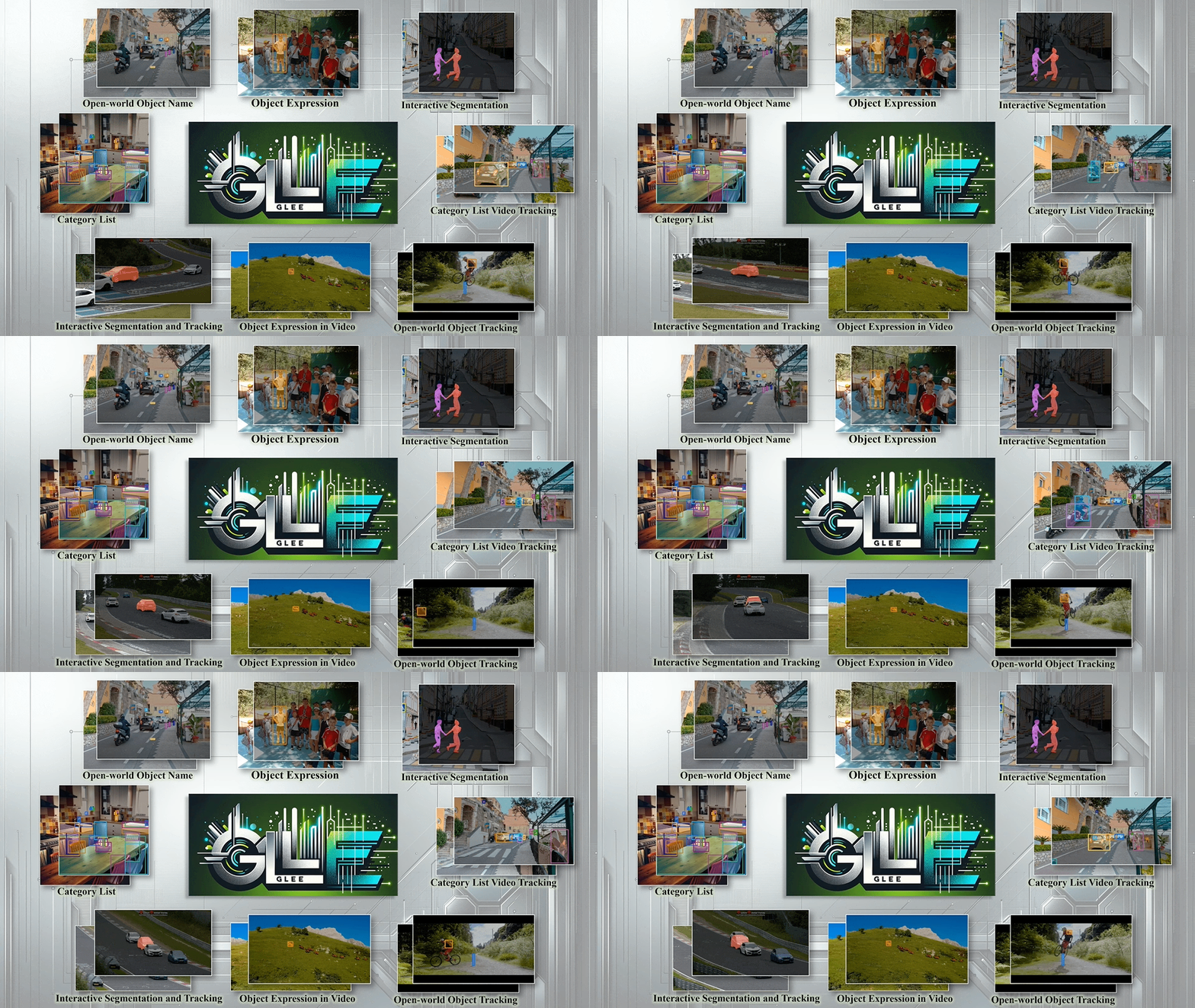
  • GLEE is a general object foundation model jointly trained on over ten million images from various benchmarks with diverse levels of supervision.
  • GLEE is capable of addressing a wide range of object-centric tasks simultaneously while maintaining SOTA performance.
  • GLEE demonstrates remarkable versatility and robust zero-shot transferability across a spectrum of object-level image and video tasks, and able to serve as a foundational component for enhancing other architectures or models.

We will release the following contents for GLEE:exclamation:

  • [x] Demo Code

  • [x] Model Zoo

  • [x] Comprehensive User Guide

  • [x] Training Code and Scripts

  • [ ] Detailed Evaluation Code and Scripts

  • [ ] Tutorial for Zero-shot Testing or Fine-tuning GLEE on New Datasets

Getting started

  1. Installation: Please refer to INSTALL.md for more details.
  2. Data preparation: Please refer to DATA.md for more details.
  3. Training: Please refer to TRAIN.md for more details.
  4. Testing: Please refer to TEST.md for more details.
  5. Model zoo: Please refer to MODEL_ZOO.md for more details.

Run the demo APP

Try our online demo app on [HuggingFace Demo] or use it locally:

git clone https://github.com/FoundationVision/GLEE
# support CPU and GPU running
python app.py

Introduction

GLEE has been trained on over ten million images from 16 datasets, fully harnessing both existing annotated data and cost-effective automatically labeled data to construct a diverse training set. This extensive training regime endows GLEE with formidable generalization capabilities.
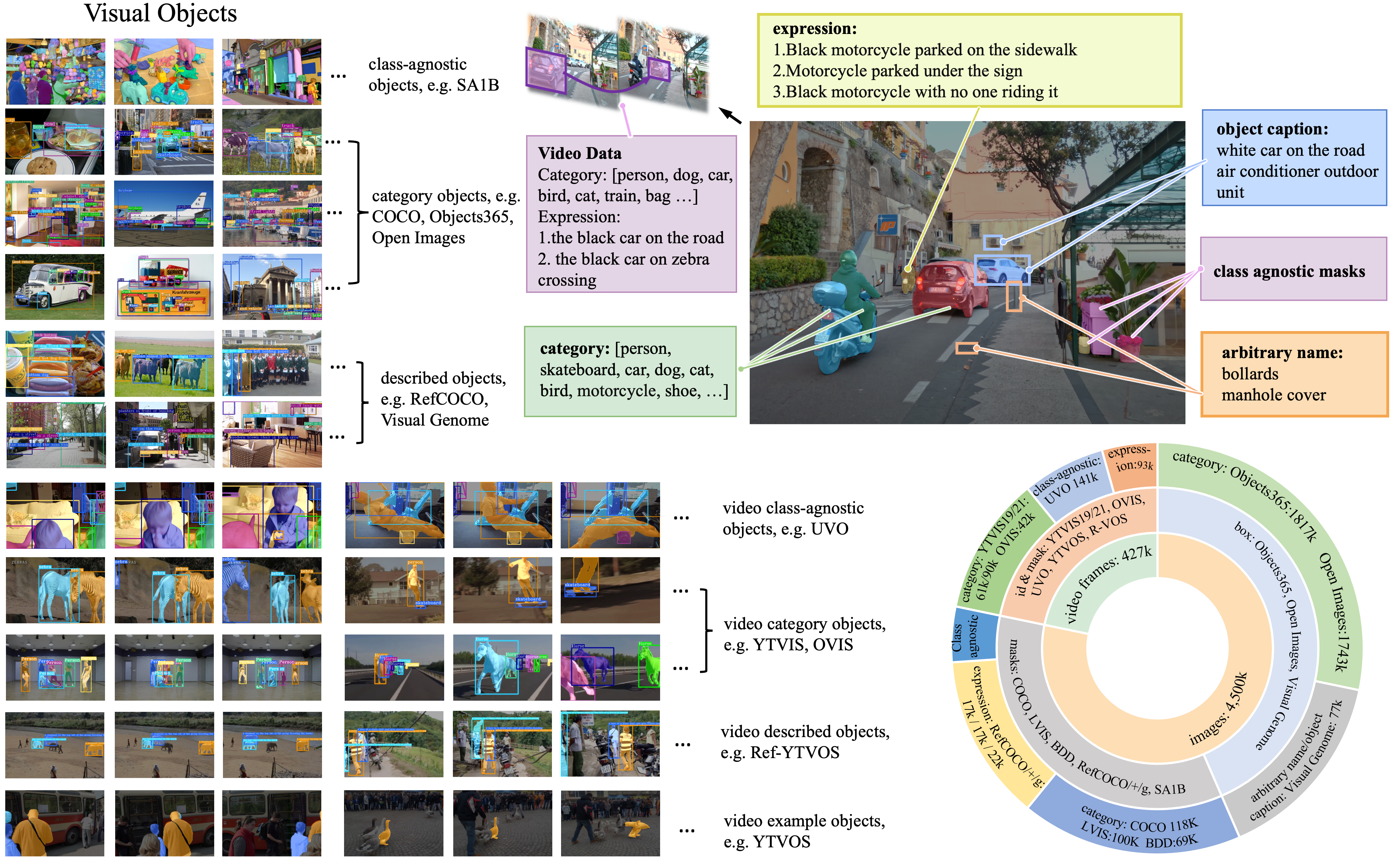
GLEE consists of an image encoder, a text encoder, a visual prompter, and an object decoder, as illustrated in Figure. The text encoder processes arbitrary descriptions related to the task, including 1) object category list 2)object names in any form 3)captions about objects 4)referring expressions. The visual prompter encodes user inputs such as 1) points 2) bounding boxes 3) scribbles during interactive segmentation into corresponding visual representations of target objects. Then they are integrated into a detector for extracting objects from images according to textual and visual input.
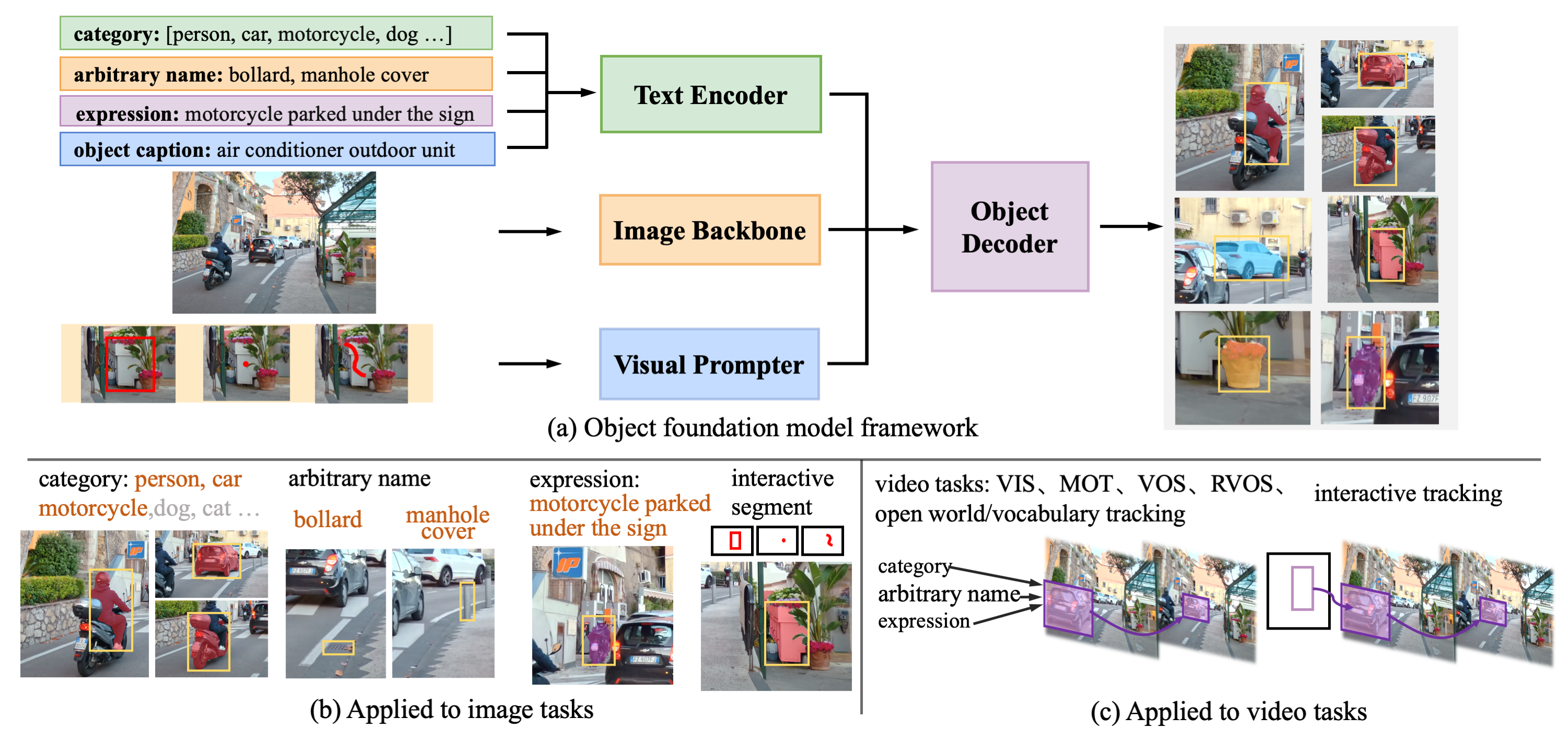
Based on the above designs, GLEE can be used to seamlessly unify a wide range of object perception tasks in images and videos, including object detection, instance segmentation, grounding, multi-target tracking (MOT), video instance segmentation (VIS), video object segmentation (VOS), interactive segmentation and tracking, and supports open-world/large-vocabulary image and video detection and segmentation tasks.

Results

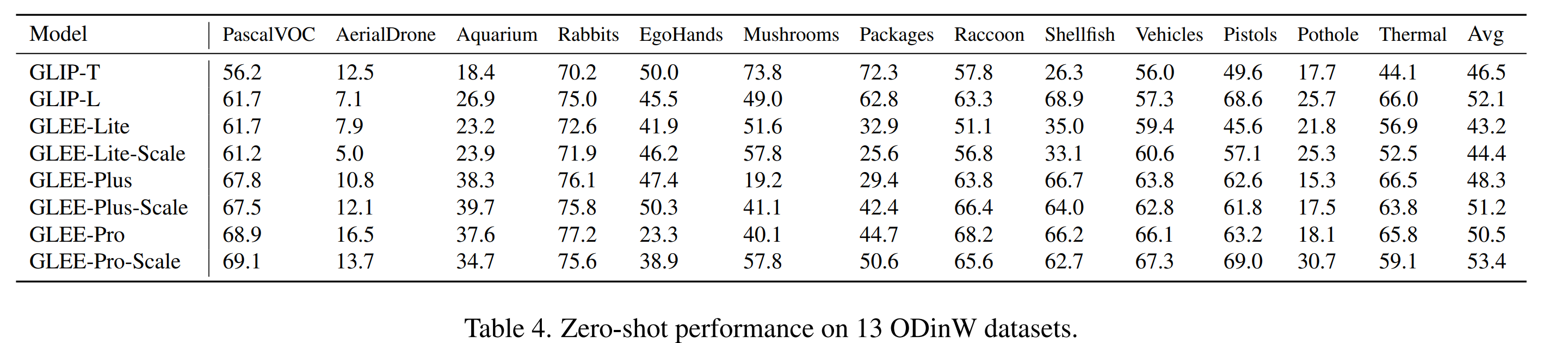
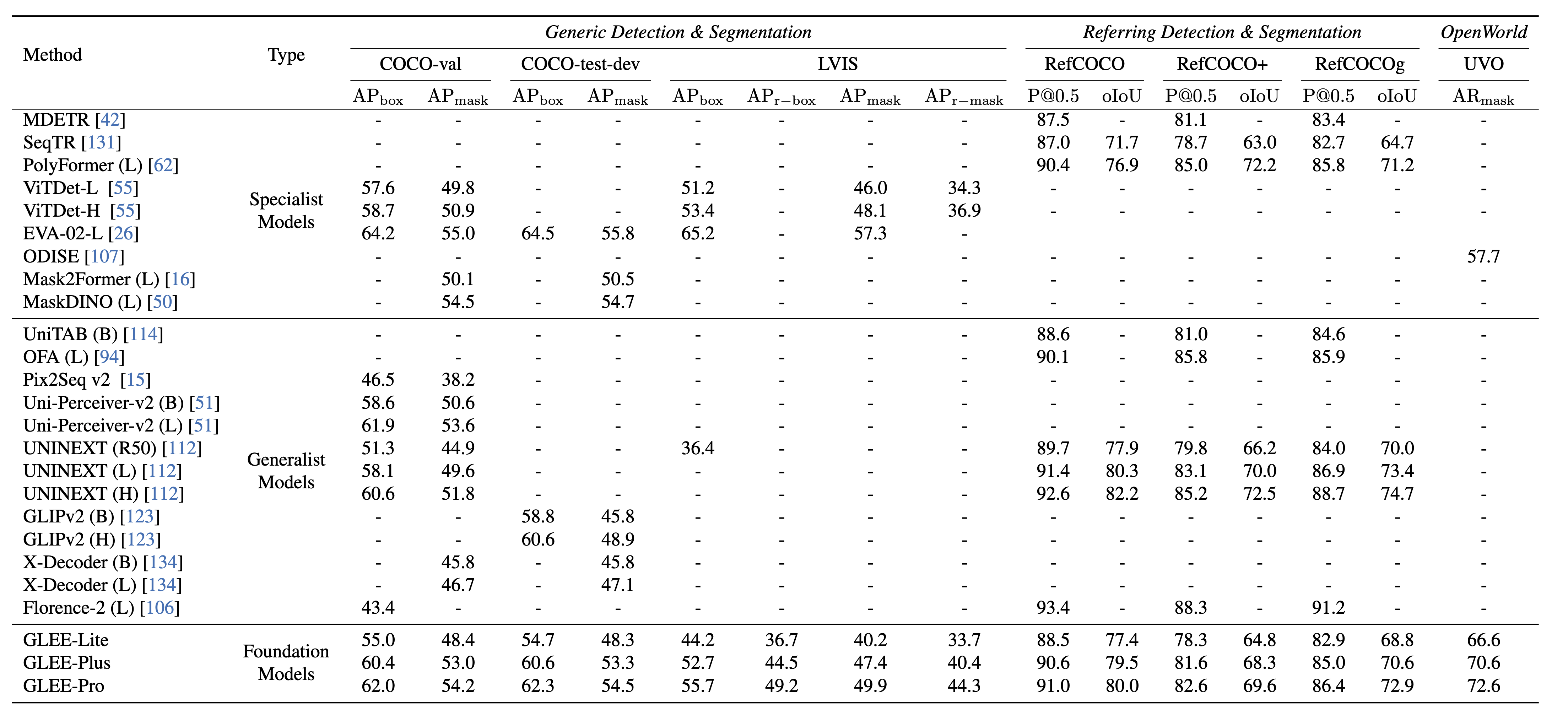
Image-level tasks
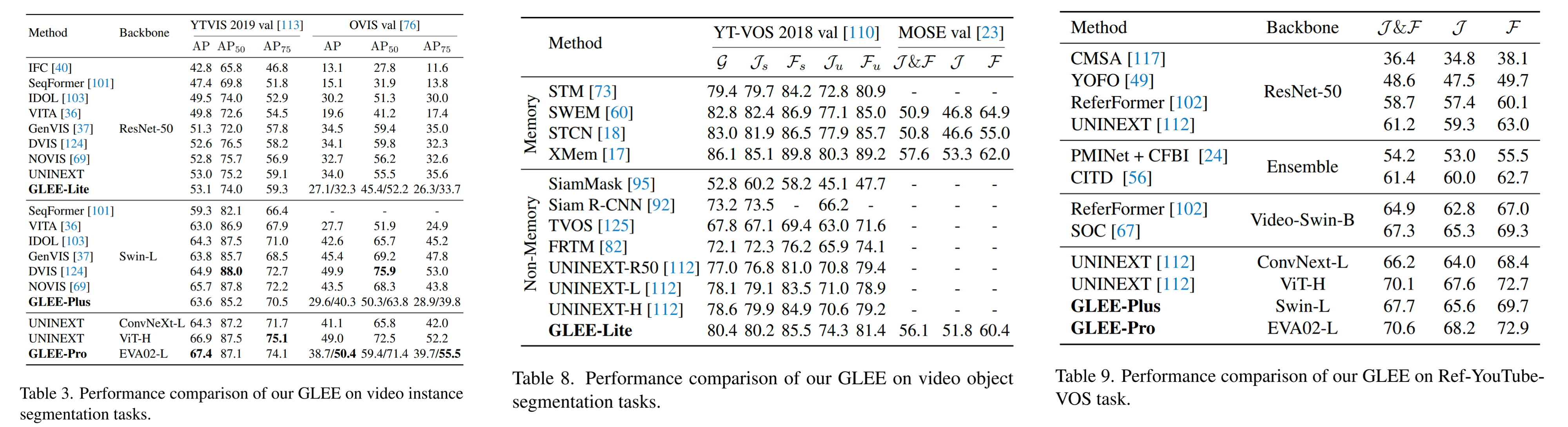
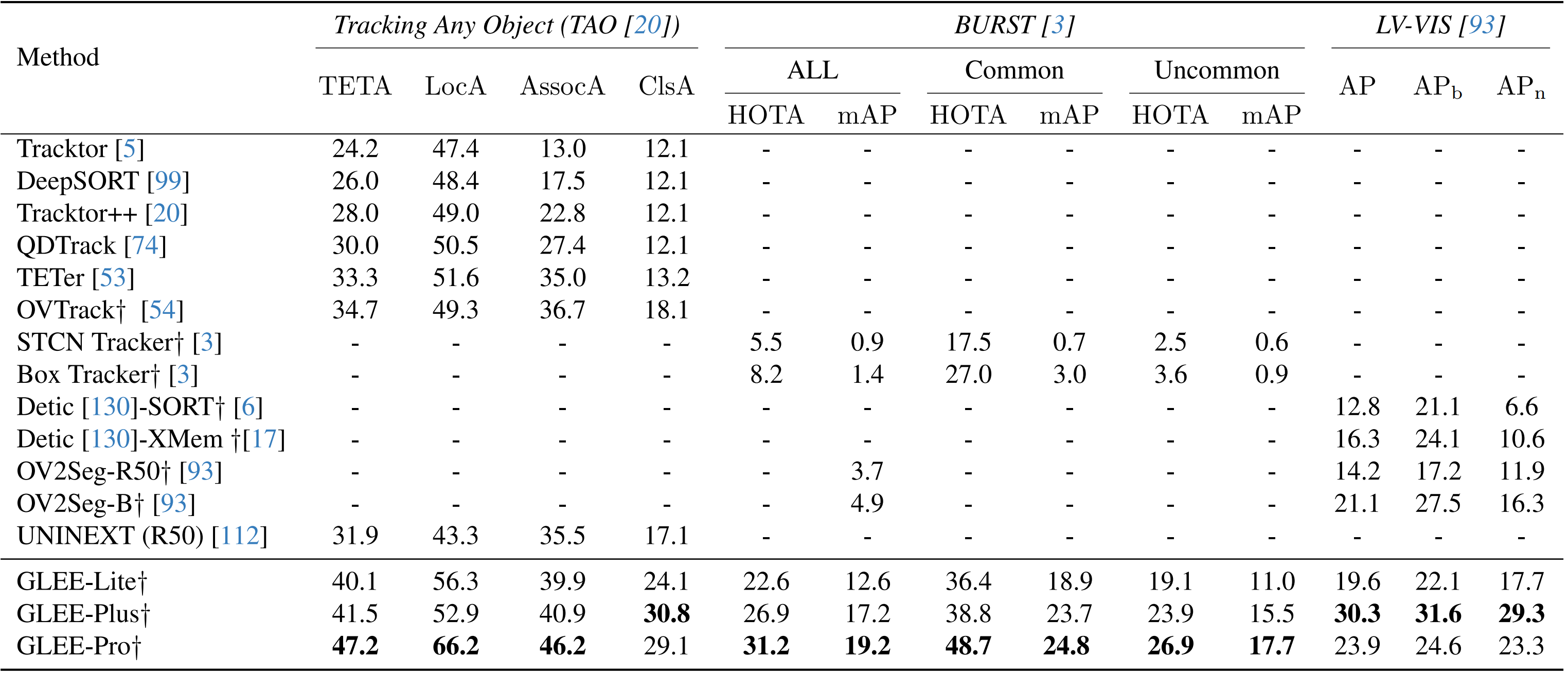
Video-level tasks
`

Citing GLEE

@misc{wu2023GLEE,
  author= {Junfeng Wu, Yi Jiang, Qihao Liu, Zehuan Yuan, Xiang Bai, Song Bai},
  title = {General Object Foundation Model for Images and Videos at Scale},
  year={2023},
  eprint={2312.09158},
  archivePrefix={arXiv}
}

Acknowledgments

  • Thanks UNINEXT for the implementation of multi-dataset training and data processing.

  • Thanks VNext for providing experience of Video Instance Segmentation (VIS).

  • Thanks SEEM for providing the implementation of the visual prompter.

  • Thanks MaskDINO for providing a powerful detector and segmenter.

排名相邻
同类项目