🎵 NotaGen: Advancing Musicality in Symbolic Music Generation with Large Language Model Training Paradigms
📖 Overview
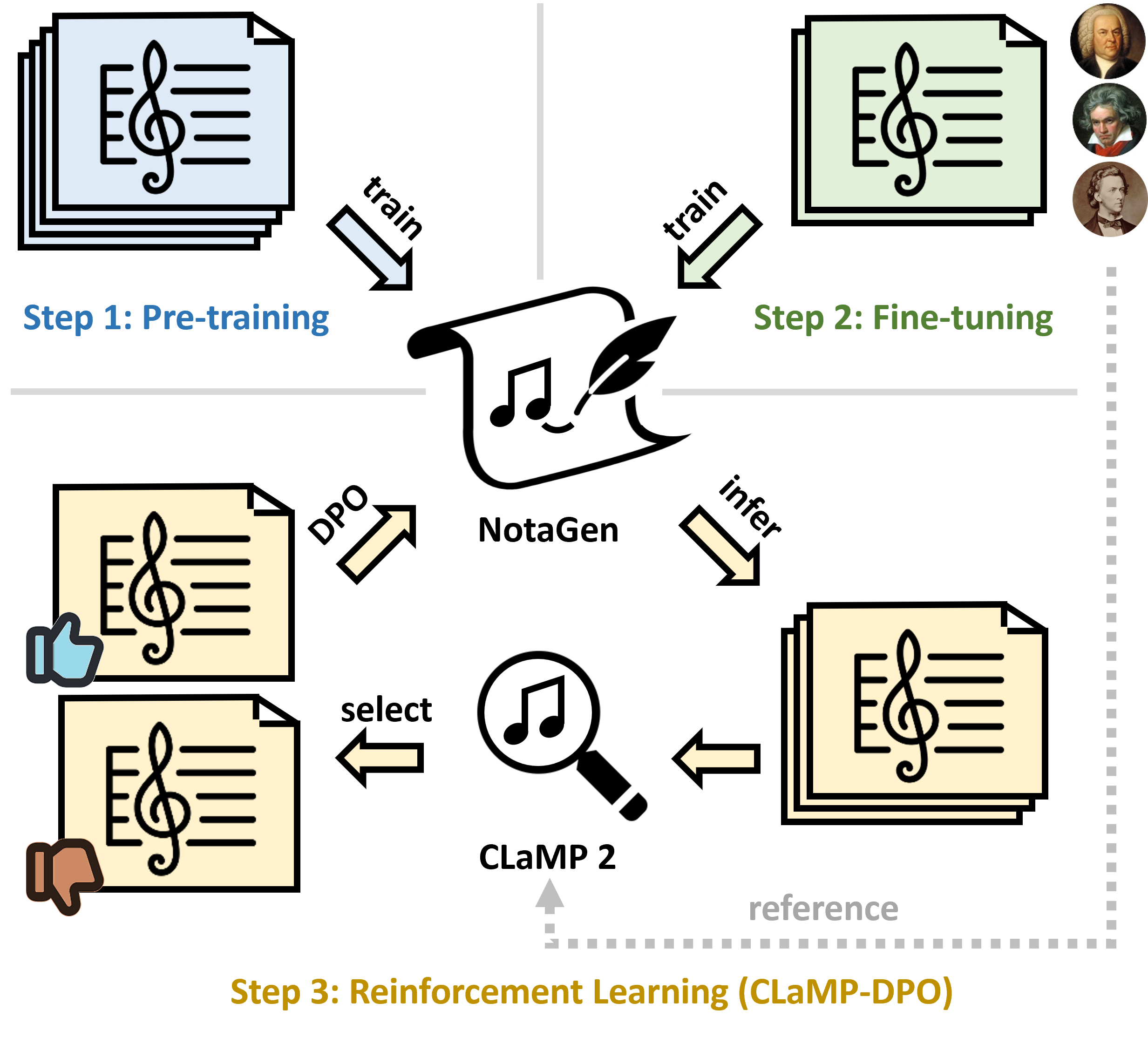
NotaGen is a symbolic music generation model that explores the potential of producing high-quality classical sheet music. Inspired by the success of Large Language Models (LLMs), NotaGen adopts a three-stage training paradigm:
- 🧠 Pre-training on 1.6M musical pieces
- 🎯 Fine-tuning on ~9K classical compositions with
period-composer-instrumentationprompts - 🚀 Reinforcement Learning using our novel CLaMP-DPO method (no human annotations or pre-defined rewards required.)
Check our demo page and enjoy music composed by NotaGen!
⚙️ Environment Setup
conda create --name notagen python=3.10
conda activate notagen
conda install pytorch==2.3.0 pytorch-cuda=11.8 -c pytorch -c nvidia
pip install accelerate
pip install optimum
pip install -r requirements.txt
🏋️ NotaGen Model Weights
Pre-training
We provide pre-trained weights of different scales:
| Models | Parameters | Patch-level Decoder Layers | Character-level Decoder Layers | Hidden Size | Patch Length (Context Length) |
|---|---|---|---|---|---|
| NotaGen-small | 110M | 12 | 3 | 768 | 2048 |
| NotaGen-medium | 244M | 16 | 3 | 1024 | 2048 |
| NotaGen-large | 516M | 20 | 6 | 1280 | 1024 |
Notice: The pre-trained weights cannot be used for conditional generation based on 'period-composer-instrumentation'.
Fine-tuning
We fine-tuned NotaGen-large on a corpus of approximately 9k classical pieces. You can download the weights here.
Reinforcement-Learning
After pre-training and fine-tuning, we optimized NotaGen-large with 3 iterations of CLaMP-DPO. You can download the weights here.
🌟 NotaGen-X
Inspired by Deepseek-R1, we further optimized the training procedures of NotaGen and released a better version --- NotaGen-X. Compared to the version in the paper, NotaGen-X incorporates the following improvements:
- We introduced a post-training stage between pre-training and fine-tuning, refining the model with a classical-style subset of the pre-training dataset.
- We removed the key augmentation in the Fine-tune stage, making the instrument range of the generated compositions more reasonable.
- After RL, we utilized the resulting checkpoint to gather a new set of post-training data. Starting from the pre-trained checkpoint, we conducted another round of post-training, fine-tuning, and reinforcement learning.
If you want to add a new composer style to NotaGen-X, please refer to issue #18 for more instructions :D
🎹 Demo
Online Gradio Demo
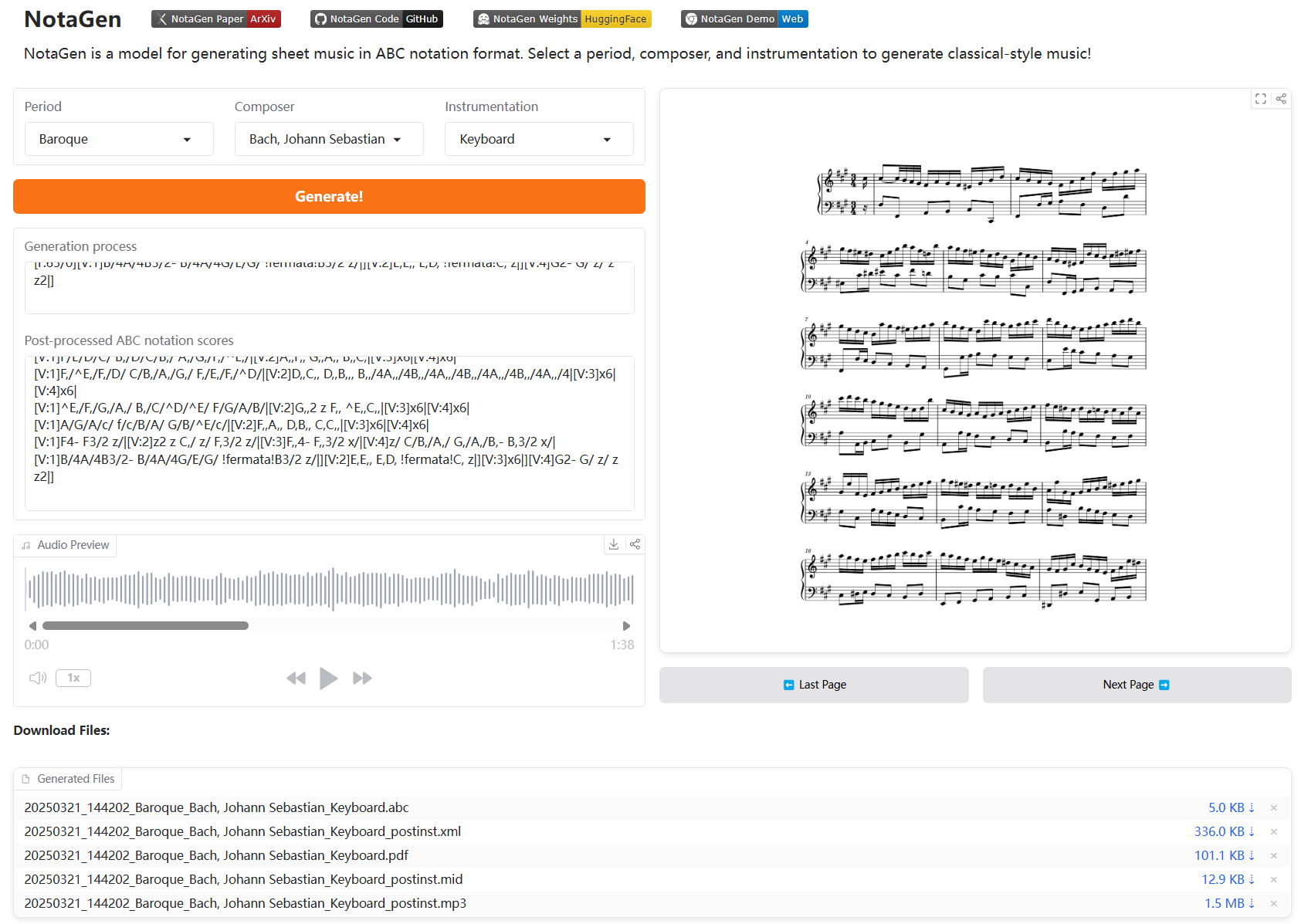
We developed an online gradio demo on Huggingface Space for NotaGen-X. You can input "Period-Composer-Instrumentation" as the prompt to have NotaGen generate music, preview the audio / pdf scores, and download them :D
Local Gradio Demo
We developed a local Gradio demo for NotaGen-X. You can input "Period-Composer-Instrumentation" as the prompt to have NotaGen generate music!
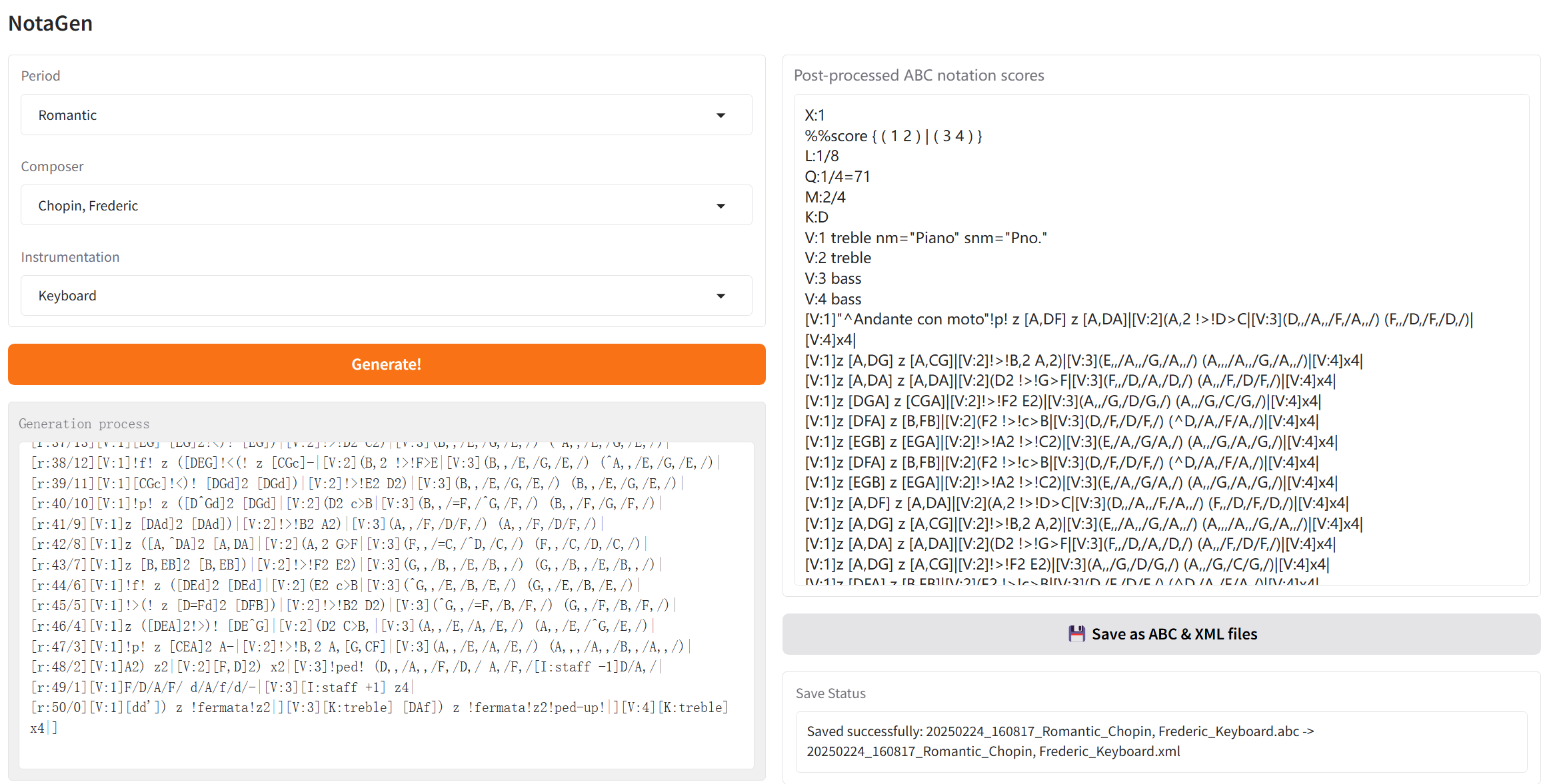
Deploying NotaGen-X inference locally may require 8GB of GPU memory. For implementation details, please view gradio/README.md. We are also working on developing an online demo.
Online Colab Notebook
Thanks for @deeplearn-art's contribution of a Google Colab notebook for NotaGen! You can run it and access to a Gradio public link to play with this demo. 🤩
ComfyUI
Thanks for @billwuhao's contribution of a ComfyUI node for NotaGen! It can automatically convert generated .abc to .xml, .mp3, and .png formats. You can listen to the generated music and see the sheet music too! Please visit the repository page for more information. 🤩

🛠️ Data Pre-processing & Post-processing
For converting ABC notation files from / to MusicXML files, please view data/README.md for instructions.
To illustrate the specific data format, we provide a small dataset of Schubert's lieder compositions from the OpenScore Lieder, which includes:
- 🗂️ Interleaved ABC folders
- 🗂️ Augmented ABC folders
- 📄 Data index files for training and evaluation
You can download it here and put it under data/.
In the instructions of Fine-tuning and Reinforcement Learning below, we will use this dataset as an example of our implementation. It won't include the "period-composer-instrumentation" conditioning, just for showing how to adapt the pretrained NotaGen to a specific music style.
🧠 Pre-train
If you want to use your own data to pre-train a blank NotaGen model, please:
- Preprocess the data and generate the data index files following the instructions in data/README.md
- Modify the parameters in
pretrain/config.py
Use this command for pre-training:
cd pretrain/
accelerate launch --multi_gpu --mixed_precision fp16 train-gen.py
🎯 Fine-tune
Here we give an example on fine-tuning NotaGen-large with the Schubert's lieder data mentioned above.
Notice: The use of NotaGen-large requires at least 24GB of GPU memory for training and inference. Alternatively, you may use NotaGen-small or NotaGen-medium and change the configuration of models in finetune/config.py.
Configuration
- In
finetune/config.py:- Modify the
DATA_TRAIN_INDEX_PATHandDATA_EVAL_INDEX_PATH:# Configuration for the data DATA_TRAIN_INDEX_PATH = "../data/schubert_augmented_train.jsonl" DATA_EVAL_INDEX_PATH = "../data/schubert_augmented_eval.jsonl" - Download pre-trained NotaGen weights, and modify the
PRETRAINED_PATH:PRETRAINED_PATH = "../pretrain/weights_notagen_pretrain_p_size_16_p_length_1024_p_layers_20_c_layers_6_h_size_1280_lr_0.0001_batch_4.pth" # Use NotaGen-large EXP_TAGis for differentiating the models. It will be integrated into the ckpt's name. Here we set it toschubert.- You can also modify other parameters like the learning rate.
- Modify the
Execution
Use this command for fine-tuning:
cd finetune/
CUDA_VISIBLE_DEVICES=0 python train-gen.py
🚀 Reinforcement Learning (CLaMP-DPO)
Here we give an example on how to use CLaMP-DPO to enhance the model fine-tuned with Schubert's lieder data.
⚙️ CLaMP 2 Setup
Download model weights and put them under the clamp2/folder:
🔍 Extract Ground Truth Features
Modify input_dir and output_dir in clamp2/extract_clamp2.py:
input_dir = '../data/schubert_interleaved'  # interleaved abc folder
output_dir = 'feature/schubert_interleaved'  # feature folder
Extract the features:
cd clamp2/
python extract_clamp2.py
🔄 CLaMP-DPO
Here we give an example of an iteration of CLaMP-DPO from the initial model fine-tuned on Schubert's lieder data.
1. Inference
- Modify the
INFERENCE_WEIGHTS_PATHto path of the fine-tuned weights andNUM_SAMPLESto generate ininference/config.py:INFERENCE_WEIGHTS_PATH = '../finetune/weights_notagen_schubert_p_size_16_p_length_1024_p_layers_20_c_layers_6_h_size_1280_lr_1e-05_batch_1.pth' NUM_SAMPLES = 1000 - Inference:
This will generate ancd inference/ python inference.pyoutput/folder with two subfolders:originalandinterleaved. Theoriginal/subdirectory stores the raw inference outputs from the model, while theinterleaved/subdirectory contains data post-processed with rest measure completion, compatible with CLaMP 2. Each of these subdirectories will contain a model-specific folder, named as a combination of the model's name and its sampling parameters.
2. Extract Generated Data Features
Modify input_dir and output_dir in clamp2/extract_clamp2.py:
input_dir = '../output/interleaved/weights_notagen_schubert_p_size_16_p_length_1024_p_layers_20_c_layers_6_h_size_1280_lr_1e-05_batch_1_k_9_p_0.9_temp_1.2'  # interleaved abc folder
output_dir = 'feature/weights_notagen_schubert_p_size_16_p_length_1024_p_layers_20_c_layers_6_h_size_1280_lr_1e-05_batch_1_k_9_p_0.9_temp_1.2'  # feature folder
Extract the features:
cd clamp2/
python extract_clamp2.py
3. Statistics on Averge CLaMP 2 Score (Optional)
If you're interested in the Average CLaMP 2 Score of the current model, modify the parameters in clamp2/statistics.py:
gt_feature_folder = 'feature/schubert_interleaved'
output_feature_folder = 'feature/weights_notagen_schubert_p_size_16_p_length_1024_p_layers_20_c_layers_6_h_size_1280_lr_1e-05_batch_1_k_9_p_0.9_temp_1.2'
Then run this script:
cd clamp2/
python statistics.py
4. Construct Preference Data
Modify the parameters in RL/data.py:
gt_feature_folder = '../clamp2/feature/schubert_interleaved'
output_feature_folder = '../clamp2/feature/weights_notagen_schubert_p_size_16_p_length_1024_p_layers_20_c_layers_6_h_size_1280_lr_1e-05_batch_1_k_9_p_0.9_temp_1.2'
output_original_abc_folder = '../output/original/weights_notagen_schubert_p_size_16_p_length_1024_p_layers_20_c_layers_6_h_size_1280_lr_1e-05_batch_1_k_9_p_0.9_temp_1.2'
output_interleaved_abc_folder = '../output/interleaved/weights_notagen_schubert_p_size_16_p_length_1024_p_layers_20_c_layers_6_h_size_1280_lr_1e-05_batch_1_k_9_p_0.9_temp_1.2'
data_index_path = 'schubert_RL1.json'  # Data for the first iteration of RL
data_select_portion = 0.1
In this script, the CLaMP 2 Score of each generated piece will be calculated and sorted. The portion of data in the chosen and rejected sets is determined by data_select_portion. Additionally, there are also three rules to exclude problematic sheets from the chosen set:
- Sheets with duration alignment problems are excluded;
- Sheets that may plagiarize from ground truth data (ld_sim>0.95) are excluded;
- Sheets where staves for the same instrument are not grouped together are excluded.
The prefence data file will be names as data_index_path, which records the file paths in chosen and rejected sets.
Run this script:
cd RL/
python data.py
5. DPO Training
Modify the parameters in RL/config.py:
DATA_INDEX_PATH = 'schubert_RL1.json'  # Preference data path
PRETRAINED_PATH = '../finetune/weights_notagen_schubert_p_size_16_p_length_1024_p_layers_20_c_layers_6_h_size_1280_lr_1e-05_batch_1.pth'  # The model to go through DPO optimization
EXP_TAG = 'schubert-RL1'              # Model tag for differentiation
You can also modify other parameters like OPTIMATION_STEPS and DPO hyper-parameters.
Run this script:
cd RL/
CUDA_VISIBLE_DEVICES=0 python train.py
After training, a model named weights_notagen_schubert-RL1_beta_0.1_lambda_10_p_size_16_p_length_1024_p_layers_20_c_layers_6_h_size_1280_lr_1e-06.pth will be saved under RL/. For the second round of CLaMP-DPO, please go back to the first inference stage, and let the new model to generate pieces.
For this small experiment on Schubert's lieder data, we post our Average CLaMP 2 Score here for the fine-tuned model and models after each iteration of CLaMP-DPO, as a reference:
| CLaMP-DPO Iteration (K) | Average CLaMP 2 Score |
|---|---|
| 0 (fine-tuned) | 0.324 |
| 1 | 0.579 |
| 2 | 0.778 |
If you are interested in this method, have a try on your own style-specific dataset :D
📚 Citation
If you find NotaGen or CLaMP-DPO useful in your work, please cite our paper.
@misc{wang2025notagenadvancingmusicalitysymbolic,
      title={NotaGen: Advancing Musicality in Symbolic Music Generation with Large Language Model Training Paradigms},
      author={Yashan Wang and Shangda Wu and Jianhuai Hu and Xingjian Du and Yueqi Peng and Yongxin Huang and Shuai Fan and Xiaobing Li and Feng Yu and Maosong Sun},
      year={2025},
      eprint={2502.18008},
      archivePrefix={arXiv},
      primaryClass={cs.SD},
      url={https://arxiv.org/abs/2502.18008},
}