A powerful 3B-parameter, LLM-based Reinforcement Learning audio edit model excels at editing emotion, speaking style, and paralinguistics, and features robust zero-shot text-to-speech.
[NeurIPS 2020] MCUNet: Tiny Deep Learning on IoT Devices; [NeurIPS 2021] MCUNetV2: Memory-Efficient Patch-based Inference for Tiny Deep Learning; [NeurIPS 2022] MCUNetV3: On-Device Training Under 256KB Memory.
MTR: Motion Transformer with Global Intention Localization and Local Movement Refinement, NeurIPS 2022.
Key parameters and specifications
Key parameters and specifications
Parameter
Value
Language
Python
Category
Models
Subcategory
Vision models, Domain-specific models
Keywords
3D, Inference optimization, Memory management, Model architecture
Stars
984
Forks
55
Contributors
3
Created date
2025-07-14
Updated date
2026-10-15
Stars in 1 day
1
Stars in 7 days
3
Rank
5,968
Previous rank
12,172
Rank change
6,204
7-day stars rank
7,124
Previous 7-day stars rank
7,152
7-day stars rank change
28
Total stars rank
11,288
Previous total stars rank
11,285
Total stars rank change
-3
Country
USA
README summary
Streaming 4D Visual Geometry Transformer Paper | Project Page | Online Demo >Streaming 4D Visual Geometry Transformer >Dong Zhuo \* , Wenzhao Zheng * $\dagger$, Jiahe Guo, Yuqi Wu, Jie Zhou, Jiwen Lu Equal contribution. **StreamVGGT**, a causal transformer architecture for **real-time streaming 4D visual geometry perception** compatiable with LLM-targeted attention mechanism (e. , FlashAttention), delivers both fast inference and high-quality 4D reconstruction. News **[2025/7/18]** Demo and checkpoints released on Hugging Face; demo code is available for local launch. **[2025/7
/15]** Paper released on arXiv. **[2025/7/14]** Release the code for **fine-tuning VGGT**. **[2025/7/13]** Check out Point3R for another streaming 3D reconstruction work of ours! **[2025/7/13]** Distillation code for VGGT is released. **[2025/7/13]** Inference code with FlashAttention-2 is released. **[2025/7/13]** Training/evaluation code release. Overview Given a sequence of images, unlike offline models that require reprocessing the entire sequence and reconstructing the entire scene upon receiving each new image
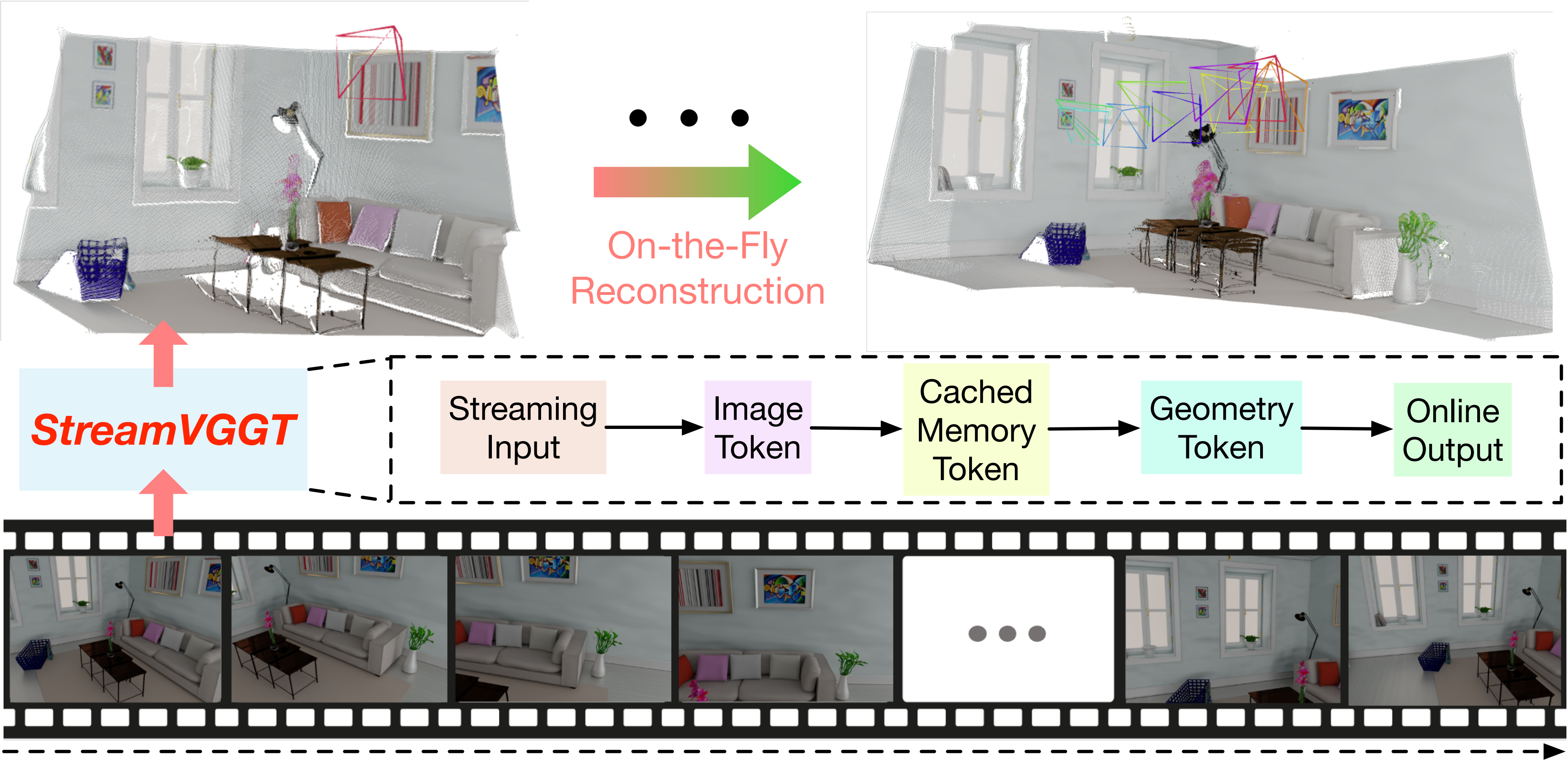
, our StreamVGGT employs temporal causal attention and leverages cached memory token to support efficient incremental on-the-fly reconstruction, enabling interative and real-time online applitions. On-the-Fly Online Reconstruction from Streaming Inputs Installation 1. Install requirements Download Checkpoints Please download pretrained teacher model from here. The checkpoint of StreamVGGT is also available at both Hugging Face and Tsinghua cloud. Data Preparation Training Datasets Our training data includes 14 datasets. Please download the datasets from their official sources and
refer to CUT3R for processing these datasets. ARKitScenes BlendedMVS CO3Dv2 MegaDepth MVS-Synth ScanNet++ ScanNet Spring Hypersim WildRGB-D WayMo Open dataset Virtual KITTI 2 OmniObject3D PointOdyssey Evaluation Datasets Please refer to MonST3R and Spann3R to prepare Sintel, Bonn, KITTI, NYU-v2, ScanNet, 7scenes and Neural-RGBD datasets. Folder Structure The overall folder structure should be organized as follows: Finetuning VGGT We also provide the following commands to fine-tune VGGT (excluding the track head) if you like. Training StreamVGGT
We provide the following commands for training. Evaluation The evaluation code follows MonST3R, CUT3R and VGGT. Multi-view Reconstruction Results will be saved in . Please refer to VGGT to prepare the co3d dataset. Run the evaluation code: Demo We provide a demo for StreamVGGT, based on the demo code from VGGT. You can follow the instructions below to launch it locally or try it out directly on Hugging Face. **Note**: While StreamVGGT typically reconstructs a scene in under one second
, 3D point visualization may take much longer due to slower third-party rendering. Acknowledgements Our code is based on the following brilliant repositories: DUSt3R MonST3R Spann3R CUT3R VGGT Point3R Many thanks to these authors! Citation If you find this project helpful, please consider citing the following paper:
Frequently asked questions
How many stars and forks are recorded?
wzzheng/StreamVGGT has 984 stars and 55 forks.
What is the repository rank?
wzzheng/StreamVGGT is ranked 5,968.
What language and category are recorded?
wzzheng/StreamVGGT has 984 stars, uses Python and belongs to Models.
Which repository is closest in rank?
wzzheng/StreamVGGT is compared with stepfun-ai/Step-Audio-EditX, ranked 5,964 with 985 stars.
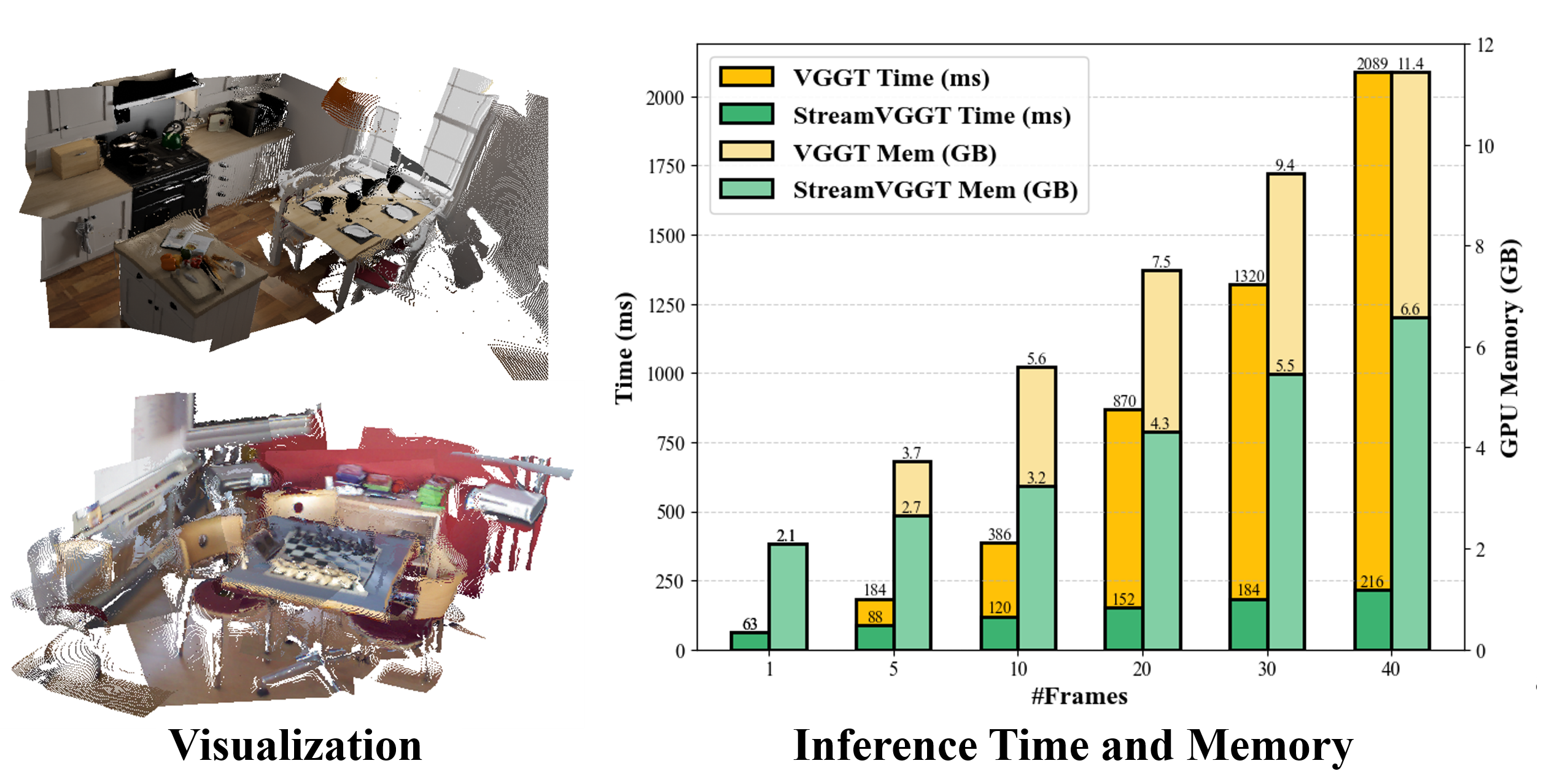
StreamVGGT, a causal transformer architecture for real-time streaming 4D visual geometry perception compatiable with LLM-targeted attention mechanism (e.g., FlashAttention), delivers both fast inference and high-quality 4D reconstruction.
News
[2025/7/18]Demo and checkpoints released on Hugging Face; demo code is available for local launch.
Given a sequence of images, unlike offline models that require reprocessing the entire sequence and reconstructing the entire scene upon receiving each new image, our StreamVGGT employs temporal
causal attention and leverages cached memory token to support efficient incremental on-the-fly reconstruction, enabling interative and real-time online applitions.
On-the-Fly Online Reconstruction from Streaming Inputs
Installation
Clone StreamVGGT
git clone https://github.com/wzzheng/StreamVGGT.git
cd StreamVGGT
We provide a demo for StreamVGGT, based on the demo code from VGGT. You can follow the instructions below to launch it locally or try it out directly on Hugging Face.
Note: While StreamVGGT typically reconstructs a scene in under one second, 3D point visualization may take much longer due to slower third-party rendering.
Acknowledgements
Our code is based on the following brilliant repositories:
If you find this project helpful, please consider citing the following paper:
@article{streamVGGT,
      title={Streaming 4D Visual Geometry Transformer},
      author={Dong Zhuo and Wenzhao Zheng and Jiahe Guo and Yuqi Wu and Jie Zhou and Jiwen Lu},
      journal={arXiv preprint arXiv:2507.11539},
      year={2025}
}