Efficient Learning of Augmentation Policy Schedules.
Key parameters and specifications
Key parameters and specifications
Parameter
Value
Language
Python
Category
Model Development
Subcategory
Architecture
Keywords
Autonomous vehicles, Computer vision
Stars
510
Forks
77
Contributors
1
Created date
2019-01-27
Updated date
2026-09-01
Stars in 1 day
0
Stars in 7 days
0
Rank
18,102
Previous rank
17,863
Rank change
-239
7-day stars rank
16,465
Previous 7-day stars rank
16,479
7-day stars rank change
14
Total stars rank
19,085
Previous total stars rank
19,060
Total stars rank change
-25
Country
UK
README summary
Sparse-Depth-Completion This repo contains the implementation of our paper Sparse and Noisy LiDAR Completion with RGB Guidance and Uncertainty by Wouter Van Gansbeke, Davy Neven, Bert De Brabandere and Luc Van Gool. If you find this interesting or relevant to your work, consider citing: License This software is released under a creative commons license which allows for personal and research use only. For a commercial license please contact the authors. You can view a license summary here Introduction
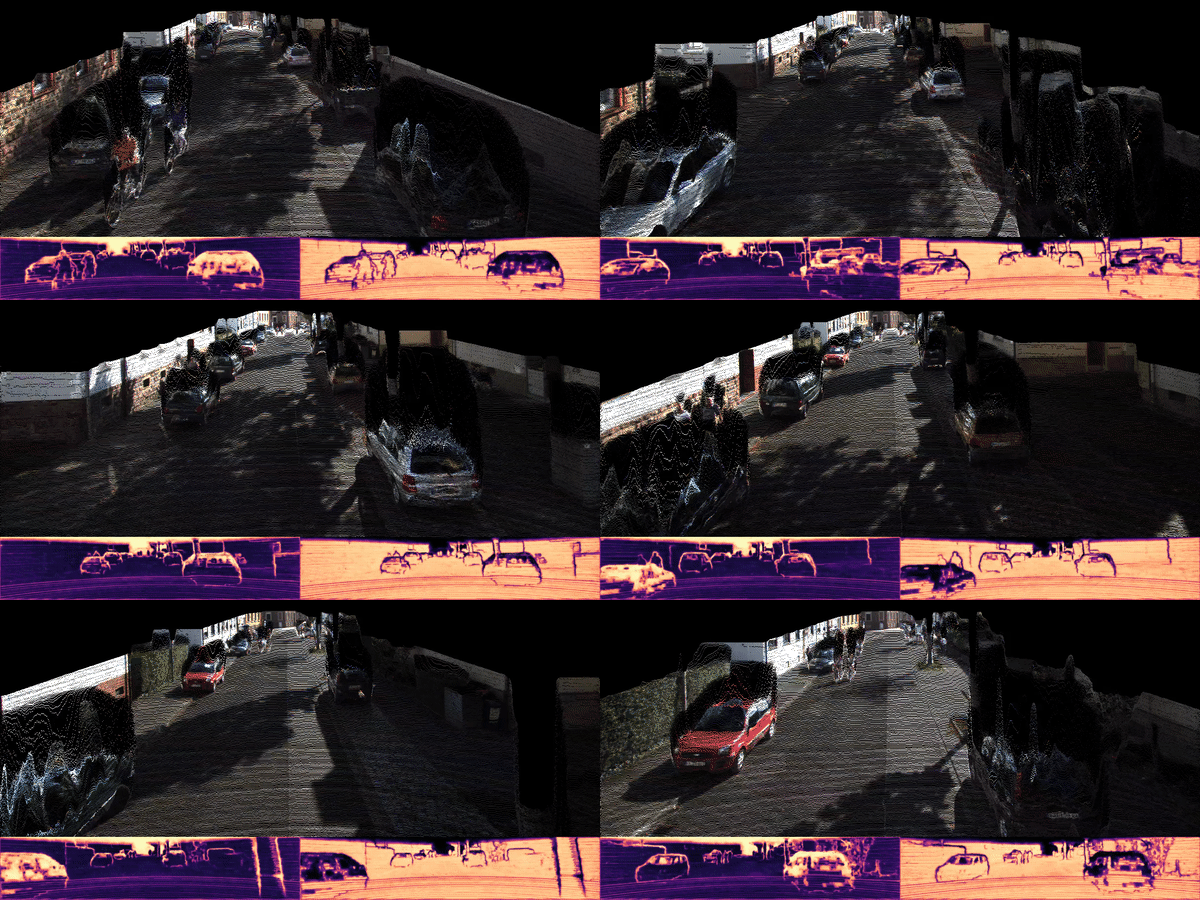
Monocular depth prediction methods fail to generate absolute and precise depth maps and stereoscopic approaches are still significantly outperformed by LiDAR based approaches. The goal of the depth completion task is to generate dense depth predictions from sparse and irregular point clouds. This project makes use of uncertainty to combine multiple sensor data in order to generate accurate depth predictions. Mapped lidar points together with RGB images (monocular) are used in this framework. This method holds the **1st place** entry
on the KITTI depth completion benchmark at the time of submission of the paper. The contribution of this paper is threefold: Global and local information are combined in order to accurately complete and correct the sparse and noisy LiDAR input. Monocular RGB images are used for the guidance of this depth completion task. Confidence maps are learned for the global branch and the local branch in an unsupervised manner. The predicted depth maps are weighted by their respective confidence map
. This is the late fusion technique used in our framework. This method ranks first on the KITTI depth completion benchmark without using additional data or postprocessing. The predictions of our model for the KITTI test set can be downloaded here. 7 The most important packages are pytorch, torchvision, numpy, pillow and matplotlib. 1) Dataset The Kitti dataset has been used. First download the dataset of the depth completion. Secondly, you'll need to unzip and download the camera images from kitti
. I used the file , but this is at your own risk. Make sure you understand it, otherwise don't use it. If you want to keep it safe, go to kitti's website. The complete dataset consists of 85898 training samples, 6852 validation samples, 1000 selected validation samples and 1000 test samples. Preprocessing This step is optional, but allows you to transform the images to jpgs and to downsample the original lidar frames. This will create a new dataset in $dest. You
can find the required preprocessing in: Run: (Firstly, I transformed the png's to jpg - images to save place. one for training and one for validation. See ) Dataset structure should look like this: Run Code To run the code: Flags: Set flag "input_type" to rgb or depth. Set flag "pretrained" to true or false to use a model pretrained on Cityscapes for the global branch. or checkout more details in the bash file. Trained models Our network architecture is based
on ERFNet. You can find the model pretrained on Cityscapes here. This model is used for the global network. You
Frequently asked questions
How many stars and forks are recorded?
wvangansbeke/Sparse-Depth-Completion has 510 stars and 77 forks.
What is the repository rank?
wvangansbeke/Sparse-Depth-Completion is ranked 18,102.
What language and category are recorded?
wvangansbeke/Sparse-Depth-Completion has 510 stars, uses Python and belongs to Model Development.
Which repository is closest in rank?
wvangansbeke/Sparse-Depth-Completion is compared with CrawlScript/tf_geometric, ranked 18,104 with 509 stars.
If you find this interesting or relevant to your work, consider citing:
@inproceedings{wvangansbeke_depth_2019,
    author={Van Gansbeke, Wouter and Neven, Davy and De Brabandere, Bert and Van Gool, Luc},
    booktitle={2019 16th International Conference on Machine Vision Applications (MVA)},
    title={Sparse and Noisy LiDAR Completion with RGB Guidance and Uncertainty},
    year={2019},
    pages={1-6},
    organization={IEEE}
}
License
This software is released under a creative commons license which allows for personal and research use only. For a commercial license please contact the authors. You can view a license summary here
Introduction
Monocular depth prediction methods fail to generate absolute and precise depth maps and stereoscopic approaches are still significantly outperformed by LiDAR based approaches. The goal of the depth completion task is to generate dense depth predictions from sparse and irregular point clouds. This project makes use of uncertainty to combine multiple sensor data in order to generate accurate depth predictions. Mapped lidar points together with RGB images (monocular) are used in this framework. This method holds the 1st place entry on the KITTI depth completion benchmark at the time of submission of the paper.
The contribution of this paper is threefold:
Global and local information are combined in order to accurately complete and correct the sparse and noisy LiDAR input. Monocular RGB images are used for the guidance of this depth completion task.
Confidence maps are learned for the global branch and the local branch in an unsupervised manner. The predicted depth maps are weighted by their respective confidence map. This is the late fusion technique used in our framework.
This method ranks first on the KITTI depth completion benchmark without using additional data or postprocessing.
See full demo on YouTube. The predictions of our model for the KITTI test set can be downloaded here.
Requirements
Python 3.7
The most important packages are pytorch, torchvision, numpy, pillow and matplotlib.
(Works with Pytorch 1.1)
Dataset
The Kitti dataset has been used. First download the dataset of the depth completion. Secondly, you'll need to unzip and download the camera images from kitti.
I used the file download_raw_files.sh, but this is at your own risk. Make sure you understand it, otherwise don't use it. If you want to keep it safe, go to kitti's website.
The complete dataset consists of 85898 training samples, 6852 validation samples, 1000 selected validation samples and 1000 test samples.
Preprocessing
This step is optional, but allows you to transform the images to jpgs and to downsample the original lidar frames. This will create a new dataset in $dest.
You can find the required preprocessing in:
Datasets/Kitti_loader.py
(Firstly, I transformed the png's to jpg - images to save place. Secondly, two directories are built i.e. one for training and one for validation. See Datasets/Kitti_loader.py)
You can find the model pretrained on Cityscapes here. This model is used for the global network.
You can find a fully trained model and its corresponding predictions for the KITTI test set here.
The RMSE is around 802 mm on the selected validation set for this model as reported in the paper.
To test it:
Save the model in a folder in the Saved directory.
(You might have to recompile the C files for testing, provided by KITTI, if your architecture is different from mine)
Results
Comparision with state-of-the-art:
Discussion
Practical discussion:
I recently increased the stability of the training process and I also made the convergence faster by adding some skip connections between the global and local networks.
Initially I only used guidance by multiplication with an attention map (=probability), but found out that it is less robust and that differences between a focal MSE and vanilla MSE loss function were now negligible.
Be aware that this change will alter the appearance of the confidence maps since fusion happens at mutliple stages now.
Feel free to experiment with different architectures for the global or local network. It is easy to add new architectures to Models/__init__.py
I used a Tesla V100 GPU for evaluation.
Acknowledgement
This work was supported by Toyota, and was carried out at the TRACE Lab at KU Leuven (Toyota Research on Automated Cars in Europe - Leuven)