
← Open Source
wayveai

Driving-with-LLMs

PyTorch implementation for the paper "Driving with LLMs: Fusing Object-Level Vector Modality for Explainable Autonomous Driving".

Model DevelopmentDomain-specific trainingPython
Open on GitHub
Momentum
+0stars in 24 hours0.0%
580
Stars
50
Forks
+0
This week
2
Contributors
Created 2023-05-23 · Updated 2026-09-28 · #16651 today
Top developers
melightsolegsinavski

wayveai/Driving-with-LLMs is ranked 16,651 with 580 stars.

Same-category comparison

wayveai/Driving-with-LLMs is ranked 16,651 among these 8 peers; beyretb/AnimalAI-Olympics is ranked 16,654.

Same-category comparison
NameRankMetrics
LatentActionPretraining/LAPA16,639
Language:
Python
Stars:
580
Forks:
45
Description:
[ICLR 2025] LAPA: Latent Action Pretraining from Videos.
OpenDriveLab/WholebodyVLA16,641
Stars:
580
Forks:
19
Description:
[ICLR 2026] Towards Unified Latent VLA for Whole-body Loco-manipulation Control.
clovaai/synthtiger16,645
Language:
Python
Stars:
580
Forks:
111
Description:
Official Implementation of SynthTIGER (Synthetic Text Image Generator), ICDAR 2021.
graykode/xlnet-Pytorch16,647
Language:
Jupyter Notebook
Stars:
580
Forks:
103
Description:
Simple XLNet implementation with Pytorch Wrapper.
beyretb/AnimalAI-Olympics16,654
Language:
Python
Stars:
579
Forks:
84
Description:
Code repository for the Animal AI Olympics competition.
bryanyzhu/two-stream-pytorch16,655
Language:
Python
Stars:
579
Forks:
149
Description:
PyTorch implementation of two-stream networks for video action recognition.
freud14/poutyne16,657
Language:
Python
Stars:
579
Forks:
63
Description:
A simplified framework and utilities for PyTorch.
kakao/buffalo16,659
Language:
Python
Stars:
579
Forks:
107
Description:
TOROS Buffalo: A fast and scalable production-ready open source project for recommender systems.
Key parameters and specifications
ParameterValue
LanguagePython
CategoryModel Development
SubcategoryDomain-specific training
KeywordsAutonomous vehicles, Multimodal
Stars580
Forks50
Contributors2
Created date2023-05-23
Updated date2026-09-28
Stars in 1 day0
Stars in 7 days0
Rank16,651
Previous rank16,442
Rank change-209
7-day stars rank15,649
Previous 7-day stars rank15,654
7-day stars rank change5
Total stars rank17,249
Previous total stars rank17,224
Total stars rank change-25
CountryUK
README summary

This is the PyTorch implementation for inference and training of the LLM-Driver described in: **Driving with LLMs: Fusing Object-Level Vector Modality for Explainable Autonomous Driving** >Long Chen, Oleg Sinavski, Jan Hünermann, Alice Karnsund, Andrew James Willmott, Danny Birch, Daniel Maund, Jamie Shotton *ICRA 2024* >[[preprint]]( [[arxiv]]( News ** ** Thrilled to share that our paper has been accepted by ICRA 2024! ** ** Please checkout our follow-up work : [[code]]( [[arxiv]]( ** ** The paper is now avaliable on [[arxiv]]( ** ** The paper and

code have been made available under the paper_code branch for anonymous submission. x pip Minimum of 20GB VRAM for running evaluations Minimum of 40GB VRAM for training (default setting) ⚙ Setup 1. **Set up a virtual environment (tested with Python 3. **Install required dependencies** Note: is generated with from original for reproducibility. **Set up WandB API key** 💿 Dataset **Training/testing data**: The datasets have already been checked into the codebase. To unarchive them, use the following commands: **Re-collect DrivingQA

data**: While the training and evaluation datasets already include pre-collected DrivingQA data, we also offer a script that illustrates how to collect DrivingQA data using the OpenAI ChatGPT API. If you wish to re-collect the DrivingQA data, simplely run the following command with your OpenAI API key: 🏄 Evaluation 1. **Evaluate for Perception and Action Prediction** 2. **Grade DrivingQA Results with GPT API** 🏊 Training 1. **Follow the previous section for evaluating LLM-Driver** 3. **[optional] Train and evaluate Perceiver

-BC** 📝 Citation If you find our work useful in your research, please consider citing: 🙌 Acknowledgements This project has drawn inspiration from the Alpaca LoRA repository. We would like to express our appreciation for their contributions to the open-source community.

Frequently asked questions

How many stars and forks are recorded?

wayveai/Driving-with-LLMs has 580 stars and 50 forks.

What is the repository rank?

wayveai/Driving-with-LLMs is ranked 16,651.

What language and category are recorded?

wayveai/Driving-with-LLMs has 580 stars, uses Python and belongs to Model Development.

Which repository is closest in rank?

wayveai/Driving-with-LLMs is compared with beyretb/AnimalAI-Olympics, ranked 16,654 with 579 stars.

README

https://github.com/user-attachments/assets/82a1993e-5948-4f5a-ad9b-849a21fe9a14

This is the PyTorch implementation for inference and training of the LLM-Driver described in:

Driving with LLMs: Fusing Object-Level Vector Modality for Explainable Autonomous Driving

Long Chen, Oleg Sinavski, Jan Hünermann, Alice Karnsund, Andrew James Willmott, Danny Birch, Daniel Maund, Jamie Shotton

ICRA 2024 [preprint] [arxiv]

  ![LLM-Driver](assets/main.png) 

The LLM-Driver utilises object-level vector input from our driving simulator to predict explanable actions using pretrained Language Models, providing a robust and interpretable solution for autonomous driving.
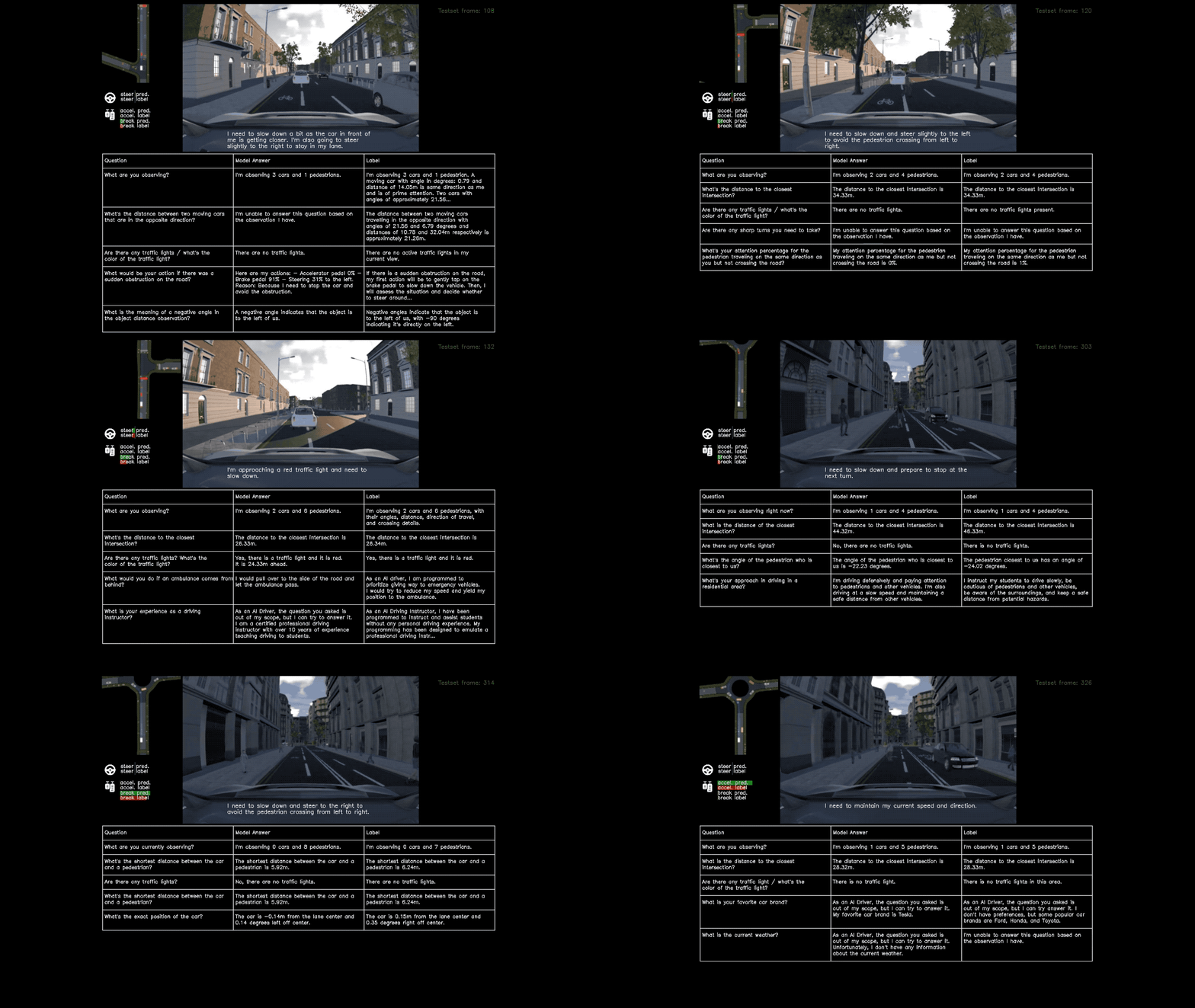
The LLM-Driver running in open-loop prediction using the vector inputs (top-left BEV view), with the results of action prediction (steering angles and acceleration/brake pedals), action justification (captions on the rendered video), Driving Question Answering (table at the bottom).

News

  • [2024/01/29] Thrilled to share that our paper has been accepted by ICRA 2024!
  • [2023/12/21] Please checkout our follow-up work LingoQA: [code] [arxiv]
  • [2023/10/03] The paper is now avaliable on [arxiv]
  • [2023/07/06] The paper and code have been made available under the paper_code branch for anonymous submission.

Getting Started

Prerequisites

  • Python 3.x
  • pip
  • Minimum of 20GB VRAM for running evaluations
  • Minimum of 40GB VRAM for training (default setting)

⚙ Setup

  1. Set up a virtual environment (tested with Python 3.8-3.11)

    python3 -m venv env
    source env/bin/activate
    
  2. Install required dependencies

    pip install -r requirements.txt.lock
    

Note: requirements.txt.lock is generated with pip-compile from original requirements.txt for reproducibility.

  1. Set up WandB API key

    Set up your WandB API key for training and evaluation logging.

    export WANDB_API_KEY=xxxxxxxxxxxxxxxxxxxxxxxxxxxxxxx
    

💿 Dataset

  • Training/testing data: The datasets have already been checked into the codebase. To unarchive them, use the following commands:

    tar -xzvf data/vqa_train_10k.tar.gz -C data/
    tar -xzvf data/vqa_test_1k.tar.gz -C data/
    
  • Re-collect DrivingQA data: While the training and evaluation datasets already include pre-collected DrivingQA data, we also offer a script that illustrates how to collect DrivingQA data using the OpenAI ChatGPT API. If you wish to re-collect the DrivingQA data, simplely run the following command with your OpenAI API key:

    python scripts/collect_vqa.py -i data/vqa_test_1k.pkl -o output_folder/ --openai_api xxxxxxxx
    

🏄 Evaluation

  1. Evaluate for Perception and Action Prediction

    Run the following command:

    python train.py \
        --mode eval \
        --resume_from_checkpoint models/weights/stage2_with_pretrained/ \
        --data_path data/vqa_train_10k.pkl \
        --val_data_path data/vqa_test_1k.pkl \
        --eval_items caption,action \
        --vqa
    
  2. Evaluate for DrivingQA

    Run the following command:

    python train.py \
        --mode eval \
        --resume_from_checkpoint models/weights/stage2_with_pretrained/ \
        --data_path data/vqa_train_10k.pkl \
        --val_data_path data/vqa_test_1k.pkl \
        --eval_items vqa \
        --vqa
    
  3. View Results

    The results can be viewed on the WandB project "llm-driver".

  4. Grade DrivingQA Results with GPT API

    To grade the results with GPT API, run the following command:

    python scripts/grade_vqa.py \
        -i data/vqa_test_1k.pkl \
        -o results/10k_ft.pkl \
        -r results/10k_ft.json \
        --openai_api xxxxxxxx
    

    Replace the results/10k_ft.json with the val_results.table.json downloaded from WandB to grade your results.

🏊 Training

  1. Run LLM-Driver Training

    Execute the following command to start training:

    python train.py \
        --mode train \
        --eval_steps 50 \
        --val_set_size 32 \
        --num_epochs 5 \
        --resume_from_checkpoint models/weights/stage1_pretrained_model/ \
        --data_path data/vqa_train_10k.pkl \
        --val_data_path data/vqa_test_1k.pkl \
        --vqa
    
  2. Follow the previous section for evaluating LLM-Driver

  3. [optional] Train and evaluate Perceiver-BC

    Execute the following command to start training and evaluation:

    python train_bc.py \
        --num_epochs 25 \
        --data_path data/vqa_train_10k.pkl \
        --val_data_path data/vqa_test_1k.pkl
    

📝 Citation

If you find our work useful in your research, please consider citing:

@inproceedings{chen2024drivingwithllms,
  title={Driving with LLMs: Fusing Object-Level Vector Modality for Explainable Autonomous Driving},
  author={Long Chen and Oleg Sinavski and Jan Hünermann and Alice Karnsund and Andrew James Willmott and Danny Birch and Daniel Maund and Jamie Shotton},
  booktitle={2024 IEEE International Conference on Robotics and Automation (ICRA)},
  year={2024}
}
@article{marcu2023lingoqa,
  title={LingoQA: Video Question Answering for Autonomous Driving}, 
  author={Ana-Maria Marcu and Long Chen and Jan Hünermann and Alice Karnsund and Benoit Hanotte and Prajwal Chidananda and Saurabh Nair and Vijay Badrinarayanan and Alex Kendall and Jamie Shotton and Oleg Sinavski},
  journal={arXiv preprint arXiv:2312.14115},
  year={2023},
}

🙌 Acknowledgements

This project has drawn inspiration from the Alpaca LoRA repository. We would like to express our appreciation for their contributions to the open-source community.

Nearby in the ranking
Similar items