Thorsten-Voice: A free to use, offline working, high quality german TTS voice should be available for every project without any license struggling.
Key parameters and specifications
Key parameters and specifications
Parameter
Value
Language
Python
Category
Model Development
Subcategory
Reinforcement Learning
Keywords
Embodied, Robotics
Stars
738
Forks
184
Contributors
5
Created date
2018-07-04
Updated date
2026-10-13
Stars in 1 day
0
Stars in 7 days
0
Rank
14,361
Previous rank
14,222
Rank change
-139
7-day stars rank
14,434
Previous 7-day stars rank
14,446
7-day stars rank change
12
Total stars rank
14,265
Previous total stars rank
14,237
Total stars rank change
-28
Country
Switzerland
README summary
CrowdNav ** | | ** This repository contains the codes for our ICRA 2019 paper. For more details, please refer to the paper Crowd-Robot Interaction: Crowd-aware Robot Navigation with Attention-based Deep Reinforcement Learning. Please find our more recent work in the following links Relational Graph Learning for Crowd Navigation, IROS, 2020. Social NCE: Contrastive Learning of Socially-aware Motion Representations, ICCV, 2021. Abstract Mobility in an effective and socially-compliant manner is an essential yet challenging task for robots operating in
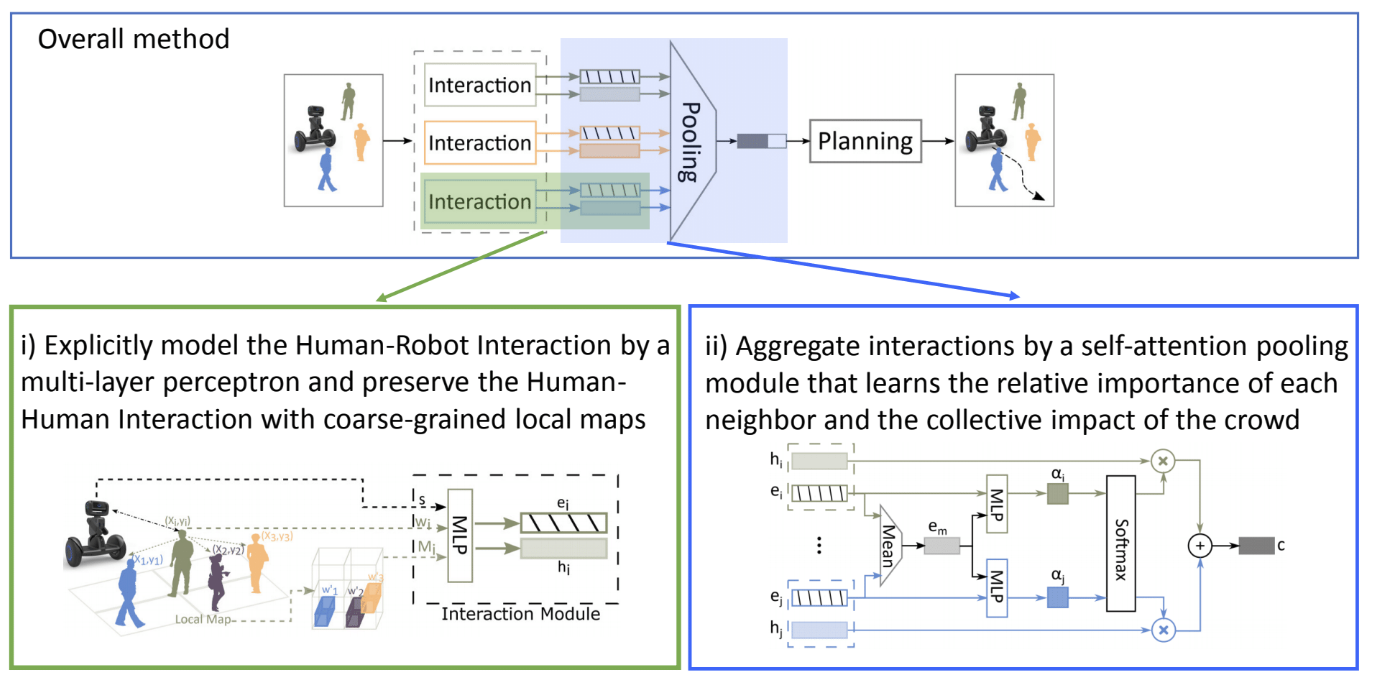
crowded spaces. Recent works have shown the power of deep reinforcement learning techniques to learn socially cooperative policies. However, their cooperation ability deteriorates as the crowd grows since they typically relax the problem as a one-way Human-Robot interaction problem. In this work, we want to go beyond first-order Human-Robot interaction and more explicitly model Crowd-Robot Interaction (CRI). We propose to (i) rethink pairwise interactions with a self-attention mechanism, and (ii) jointly model Human-Robot
as well as Human-Human interactions in the deep reinforcement learning framework. Our model captures the Human-Human interactions occurring in dense crowds that indirectly affects the robot's anticipation capability. Our proposed attentive pooling mechanism learns the collective importance of neighboring humans with respect to their future states. Various experiments demonstrate that our model can anticipate human dynamics and navigate in crowds with time efficiency, outperforming state-of-the-art methods. Install crowd_sim and crowd_nav into pip Getting
Started This repository is organized in two parts: gym_crowd/ folder contains the simulation environment and crowd_nav/ folder contains codes for training and testing the policies. Details of the simulation framework can be found here. Below are the instructions for training and testing policies, and they should be executed inside the crowd_nav/ folder. Run policy for one episode and visualize the result. Citation If you find the codes or paper useful for your research, please cite our paper
:
Frequently asked questions
How many stars and forks are recorded?
vita-epfl/CrowdNav has 738 stars and 184 forks.
What is the repository rank?
vita-epfl/CrowdNav is ranked 14,361.
What language and category are recorded?
vita-epfl/CrowdNav has 738 stars, uses Python and belongs to Model Development.
Which repository is closest in rank?
vita-epfl/CrowdNav is compared with LuxDL/Lux.jl, ranked 14,364 with 737 stars.
Mobility in an effective and socially-compliant manner is an essential yet challenging task for robots operating in crowded spaces.
Recent works have shown the power of deep reinforcement learning techniques to learn socially cooperative policies.
However, their cooperation ability deteriorates as the crowd grows since they typically relax the problem as a one-way Human-Robot interaction problem.
In this work, we want to go beyond first-order Human-Robot interaction and more explicitly model Crowd-Robot Interaction (CRI).
We propose to (i) rethink pairwise interactions with a self-attention mechanism, and
(ii) jointly model Human-Robot as well as Human-Human interactions in the deep reinforcement learning framework.
Our model captures the Human-Human interactions occurring in dense crowds that indirectly affects the robot's anticipation capability.
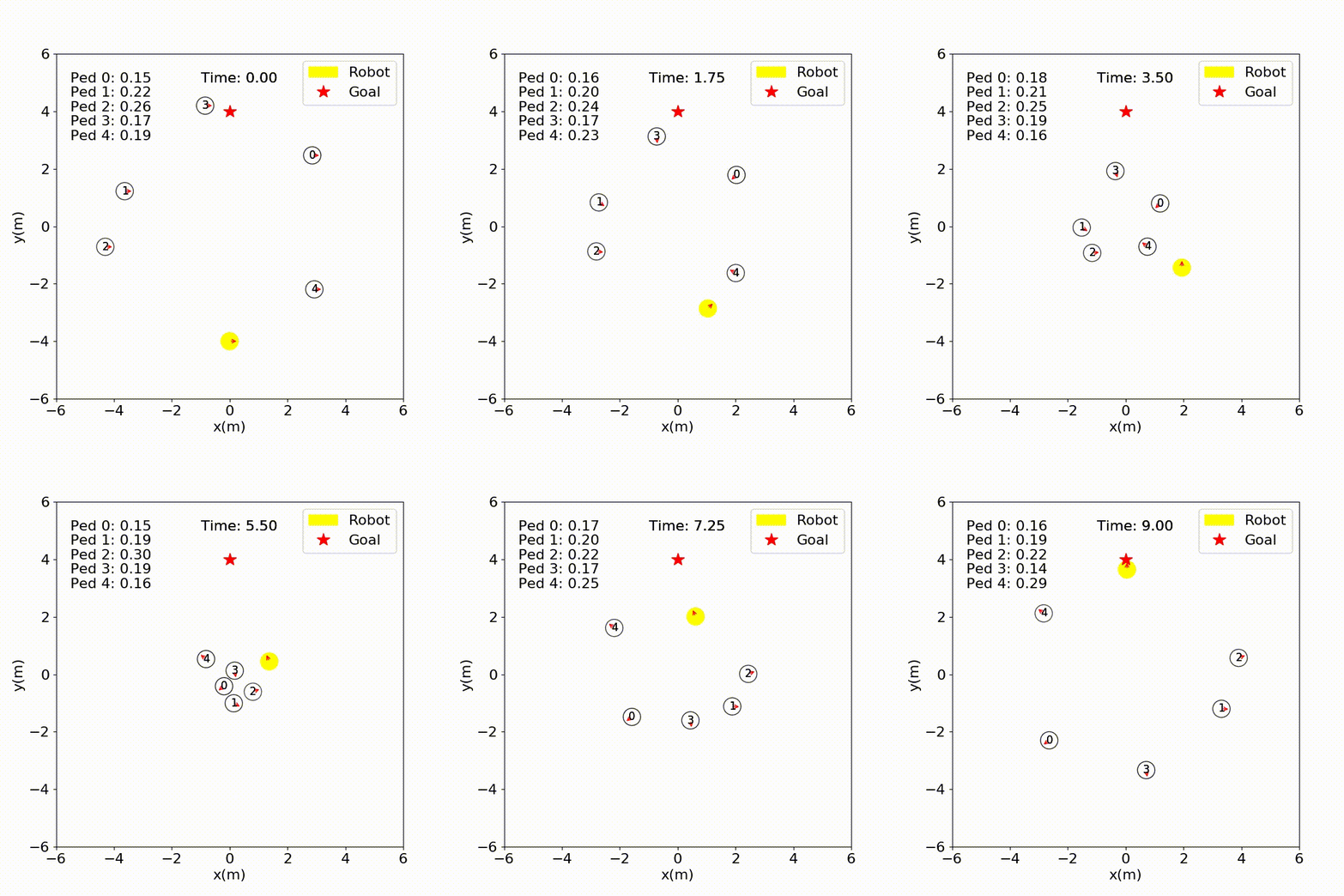
Our proposed attentive pooling mechanism learns the collective importance of neighboring humans with respect to their future states.
Various experiments demonstrate that our model can anticipate human dynamics and navigate in crowds with time efficiency,
outperforming state-of-the-art methods.
This repository is organized in two parts: gym_crowd/ folder contains the simulation environment and
crowd_nav/ folder contains codes for training and testing the policies. Details of the simulation framework can be found
here. Below are the instructions for training and testing policies, and they should be executed
inside the crowd_nav/ folder.
Train a policy.
python train.py --policy sarl
Test policies with 500 test cases.
python test.py --policy orca --phase test
python test.py --policy sarl --model_dir data/output --phase test
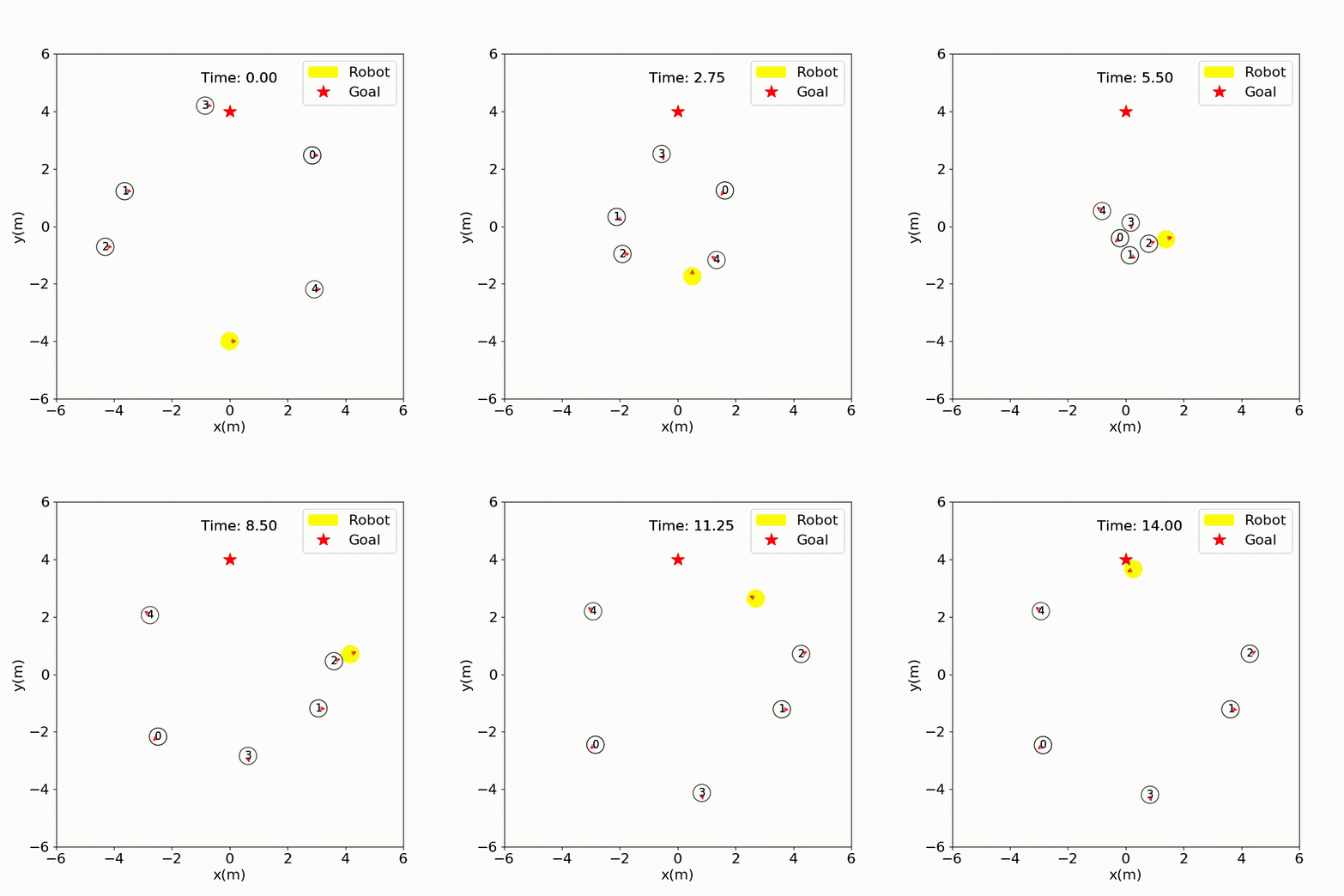
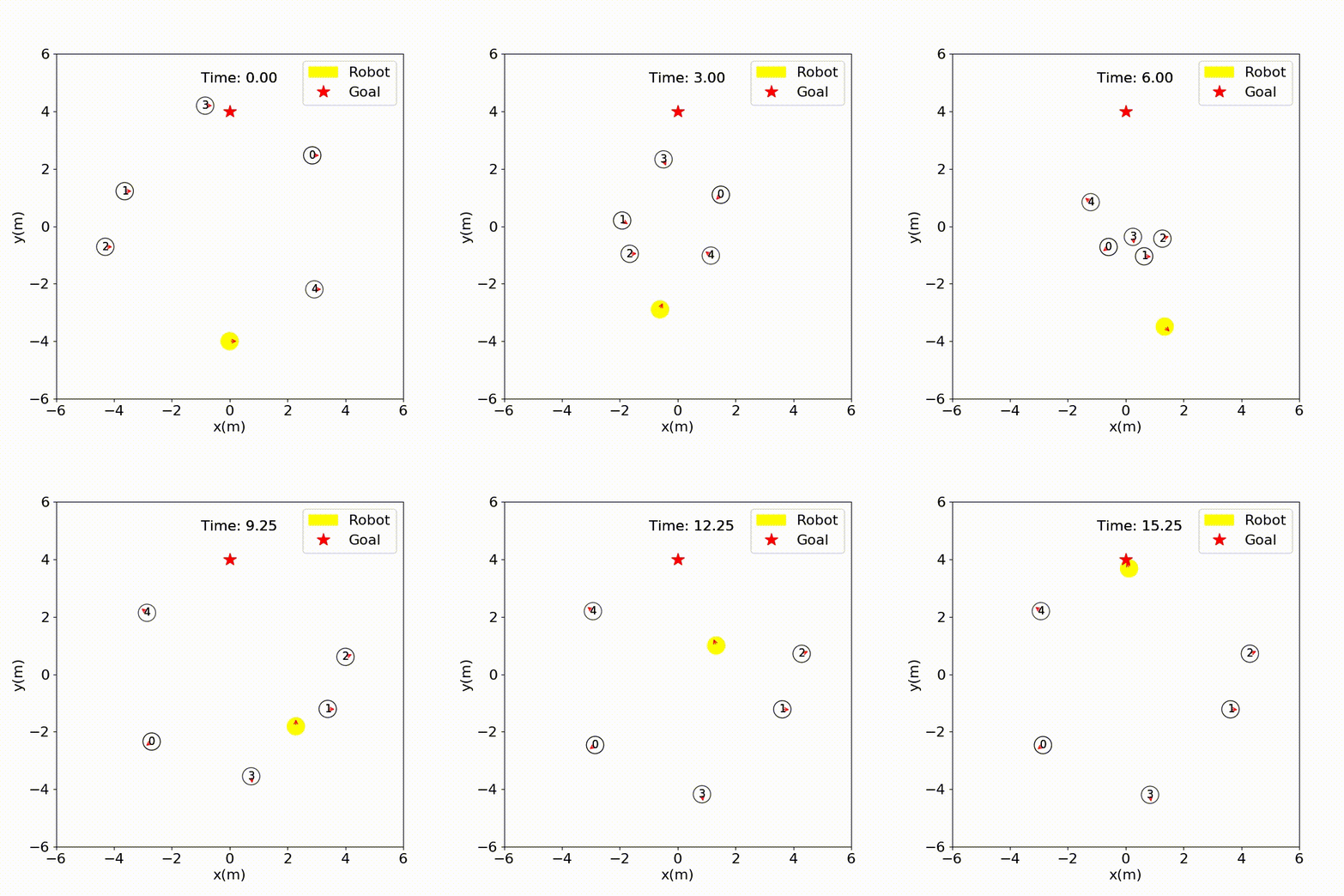
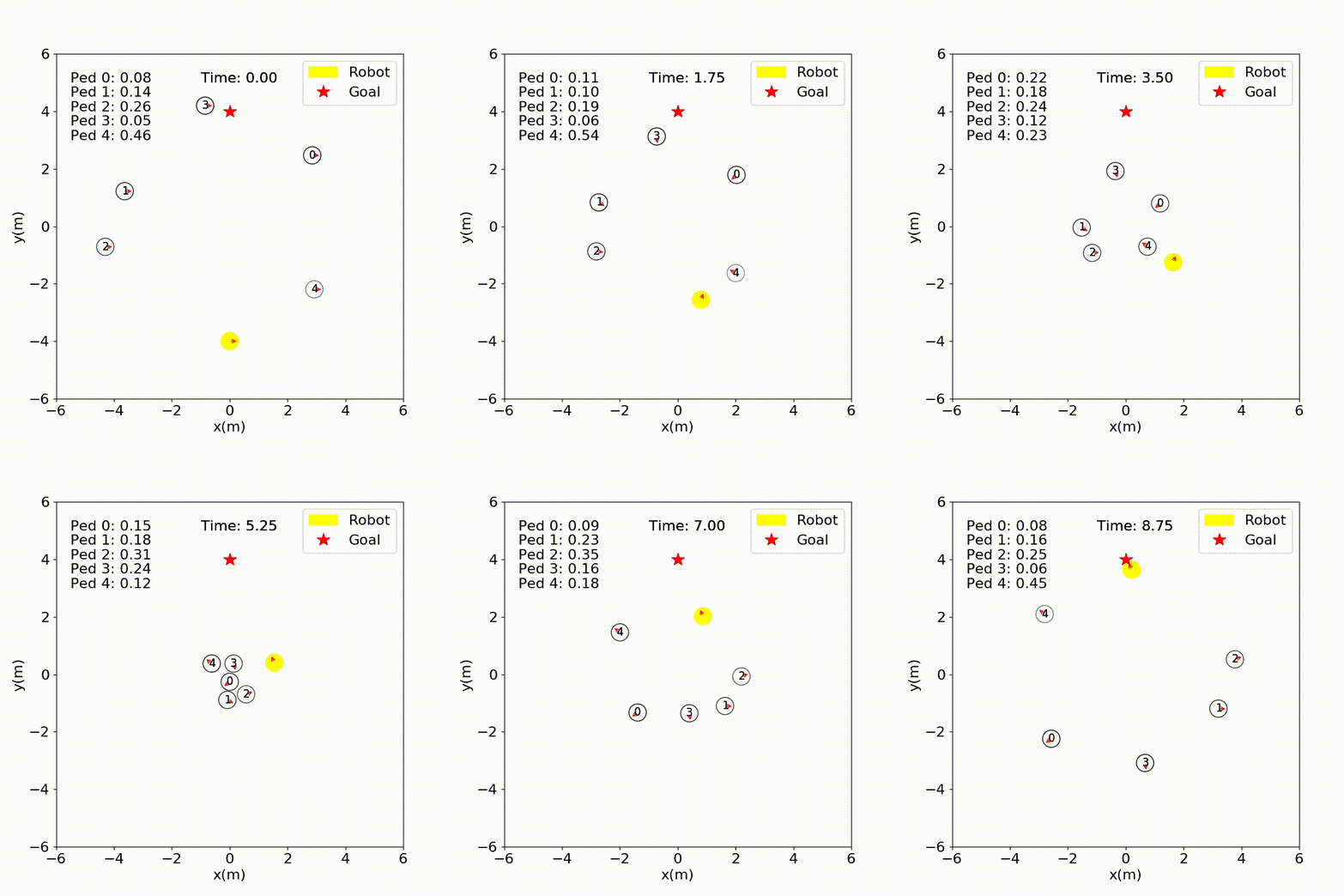
Run policy for one episode and visualize the result.
python test.py --policy orca --phase test --visualize --test_case 0
python test.py --policy sarl --model_dir data/output --phase test --visualize --test_case 0
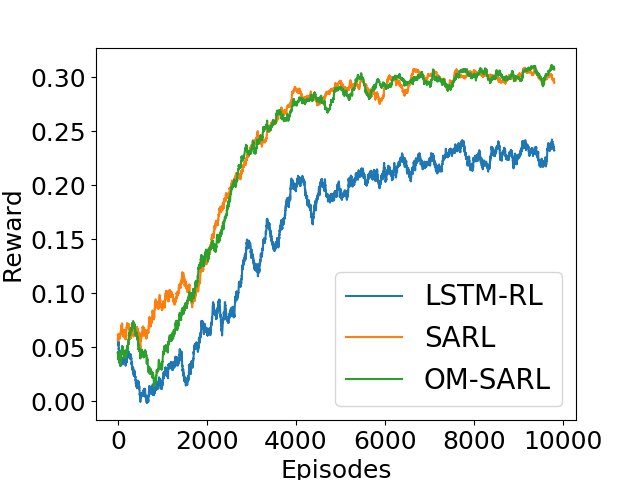
Learning curve comparison between different methods in an invisible setting.
Citation
If you find the codes or paper useful for your research, please cite our paper:
@inproceedings{chen2019crowd,
  title={Crowd-robot interaction: Crowd-aware robot navigation with attention-based deep reinforcement learning},
  author={Chen, Changan and Liu, Yuejiang and Kreiss, Sven and Alahi, Alexandre},
  booktitle={2019 International Conference on Robotics and Automation (ICRA)},
  pages={6015--6022},
  year={2019},
  organization={IEEE}
}