
Open Source Self-improving Layer for AI Agents

⭐ Help us reach more developers and grow the TraceRoot community. Star this repo!
TraceRoot
TraceRoot turns production traces into actionable feedback and evals, closing the self-improving loop with your coding agent.
https://github.com/user-attachments/assets/2ecf21ce-93b3-41cb-8749-e02b77467357
Core Features
Turn production failures into tested improvements
Trace production runs, use detectors to evaluate behavior, and surface recurring patterns as improvement signals. Your coding agent uses the TraceRoot CLI to investigate those signals and make local changes, then verifies them with offline evals. After you ship, new production traces feed the next round of detection, signals, and verification—closing a continuous improvement loop.
| Step | Description |
|---|---|
| Trace | See each model call, tool call, and response, with inputs, outputs, latency, and cost. |
| Detect | Define what good behavior looks like. Automatically flag production runs that miss the mark. |
| Signals | Surface recurring patterns from judge outputs, review the supporting traces, and identify what to change. |
| Verify | Run evals against your datasets and compare versions to measure improvements and catch regressions. |
Built for your coding agent
Give your coding agent read and write access to TraceRoot through an agent-native CLI. Explore traces, signals, and the home workspace; create and update detectors, datasets, evals, dashboards, and alerts—all from your coding agent.

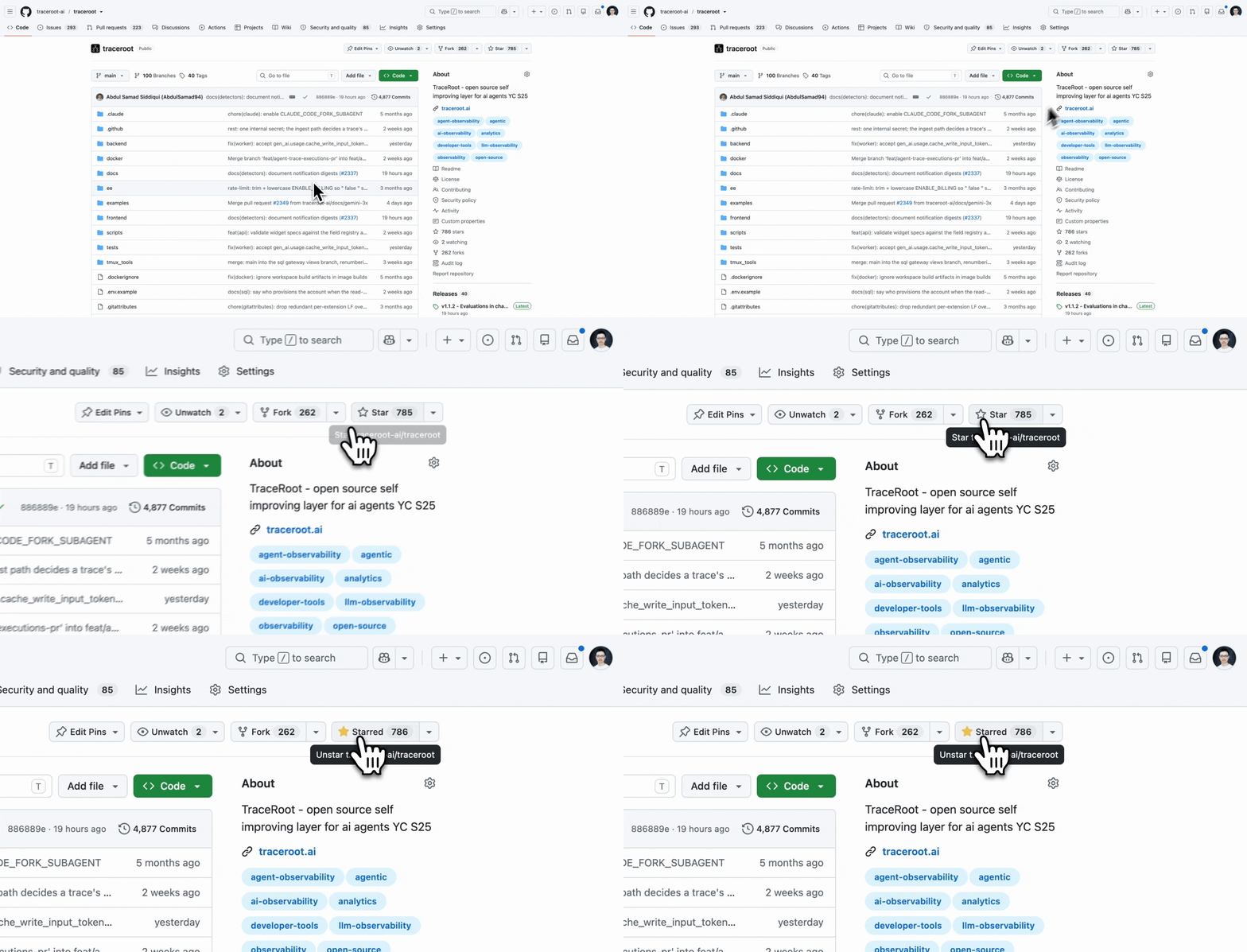
⭐ Star the Repository
If you like what we’re building, give TraceRoot a star ⭐ to help more developers discover it.
Getting Started With TraceRoot
TraceRoot Cloud
Create an account to get started without running the platform yourself.
Self-Hosting
With Git, Docker Compose, and Make installed, run locally:
git clone https://github.com/traceroot-ai/traceroot.git
cd traceroot
cp .env.example .env
make prod-lite
Open localhost:3000. See the self-hosting guide for configuration and deployment details.
Setting up TraceRoot
Once you have a TraceRoot instance, create a project in your dashboard and choose how to send your first trace: let your coding agent set up instrumentation through the CLI, or configure an SDK manually.
With your coding agent
Install the TraceRoot CLI and log in:
npm install -g traceroot-cli
traceroot login
Then ask your coding agent:
Use the TraceRoot CLI to set up tracing for this application.
Manually with an SDK
Prefer to configure instrumentation yourself? Use the Python SDK or TypeScript SDK. The example below sends one traced model call from a TypeScript application.
Run a minimal TypeScript example
You need Node.js and npm, a TraceRoot project API key, and an OpenAI API key. For self-hosting, replace the cloud host URL below with your instance URL.
1. Install the SDK in your TypeScript project:
npm install @traceroot-ai/traceroot openai
2. Set your API keys:
export TRACEROOT_API_KEY="your-project-api-key"
export TRACEROOT_HOST_URL="https://app.traceroot.ai"
export OPENAI_API_KEY="your-openai-api-key"
3. Trace an agent call. Save this as example.ts:
import OpenAI from 'openai';
import { TraceRoot, observe } from '@traceroot-ai/traceroot';

TraceRoot.initialize({ instrumentModules: { openAI: OpenAI } });
const openai = new OpenAI();

const myAgent = observe({ name: 'my_agent', type: 'agent' }, async (query: string) => {
  const response = await openai.chat.completions.create({
    model: 'gpt-4o',
    messages: [{ role: 'user', content: query }],
  });
  return response.choices[0].message.content;
});

async function main() {
  try {
    await myAgent("What's the weather in SF?");
  } finally {
    await TraceRoot.shutdown();
  }
}

main().catch(console.error);
4. Run it with npx tsx example.ts, then open your project's Traces page to inspect the agent run. This example makes one OpenAI API call.
Integrations
Native SDKs
| Language | Repository |
|---|---|
| Python | traceroot-py |
| TypeScript | traceroot-ts |
Supported frameworks and model providers
Agent Frameworks
| Integration | Supports | Description |
|---|---|---|
| Agno | Python | Automated instrumentation of agent runs, tool calls, and multi-step reasoning. |
| AutoGen | Python | Automated instrumentation of multi-agent conversations, agent loops, and tool calls. |
| Claude Agent SDK | Python, JS/TS | Automated instrumentation of agent invocations, subagent delegations, tool calls, and token usage. |
| CrewAI | Python | Automated instrumentation of multi-agent collaborative workflows and task executions. |
| DSPy | Python | Automated instrumentation of module executions, signature predictions, and underlying LLM calls. |
| Google ADK | Python | Automated instrumentation of agent runs, tool executions, and the multi-turn agent loop. |
| LangChain & LangGraph | Python, JS/TS | Automated instrumentation by passing callback handler to LangChain application. |
| LangChain DeepAgents | Python, JS/TS | Automated instrumentation by passing callback handler to DeepAgents pipeline. |
| LlamaIndex | Python | Automated instrumentation of RAG pipelines, document ingestion, retrieval, and LLM synthesis. |
| Microsoft Agent Framework | Python | Automated instrumentation of agent runs, model calls, and tool executions via Agent Framework's built-in OpenTelemetry emission. |
| Mastra | JS/TS | Automated instrumentation via the TraceRoot OTLP exporter. |
| OpenAI Agents SDK | Python, JS/TS | Automated instrumentation of agent runs, tool executions, and handoff transitions. |
| Pydantic AI | Python | Automated instrumentation of agent runs, LLM calls, and tool invocations via pydantic-ai's native OpenTelemetry support. |
| Vercel AI SDK | JS/TS | Native OpenTelemetry tracing — no instrumentModules config required. AI SDK 7 needs @ai-sdk/otel; AI SDK 6 (legacy) uses experimental_telemetry. |
Model Providers
| Integration | Supports | Description |
|---|---|---|
| Anthropic | Python, JS/TS | Automated instrumentation of the Messages API. |
| Google Gemini | Python | Automated instrumentation via the Google GenAI SDK. |
| Mistral | Python | Automated instrumentation of Mistral chat completions, tool calls, and streaming responses. |
| OpenAI | Python, JS/TS | Automated instrumentation of Chat Completions and Responses API. |
| OpenRouter | Python, JS/TS | OpenAI-compatible tracing via the OpenAI SDK base URL; see the Python and TypeScript examples. |
Don't see your framework or provider? Request an integration.
Security & Privacy
Your data security and privacy are our top priorities. Learn more in our Security and Privacy documentation.
Community
Special thanks to pi-mono, which powers our agent runtime.
Contributing 🤝: Help with code, documentation, integrations, or runnable examples. Start with the contribution guide and unassigned beginner issues that do not need approval.
Support 💬: If you need any type of support, we're typically most responsive on our Discord channel, but feel free to email us [email protected] too!
License
TraceRoot uses Apache 2.0 for code outside directories named ee. Those directories are covered by the Enterprise License.
Star History
Contributors
⭐ Star us on GitHub to support TraceRoot!