

An orchestration and validation framework enabling AI agents to generate structurally precise and aesthetically standardized draw.io diagrams, optimized for AWS, Azure & GCP architectures.
It mitigates common AI agent hallucinations (such as generating non-existent stencil IDs that result in empty shapes) using three key components:
- Declarative Catalog — A single source of truth mapping draw.io stencil IDs (
mxgraph.aws4.*) to their respective taxonomies and canonical color palettes. - Design Principles — Codified architectural and layout rules (
skills/drawio/references/principles.md). - Structural Validator — A static analysis engine that audits diagram XML to guarantee stencil references are valid and design principles are satisfied prior to serialization.
Exposed to the AI via the self-contained drawio-ai CLI (one bundled file, nothing extra to install).
Showcase
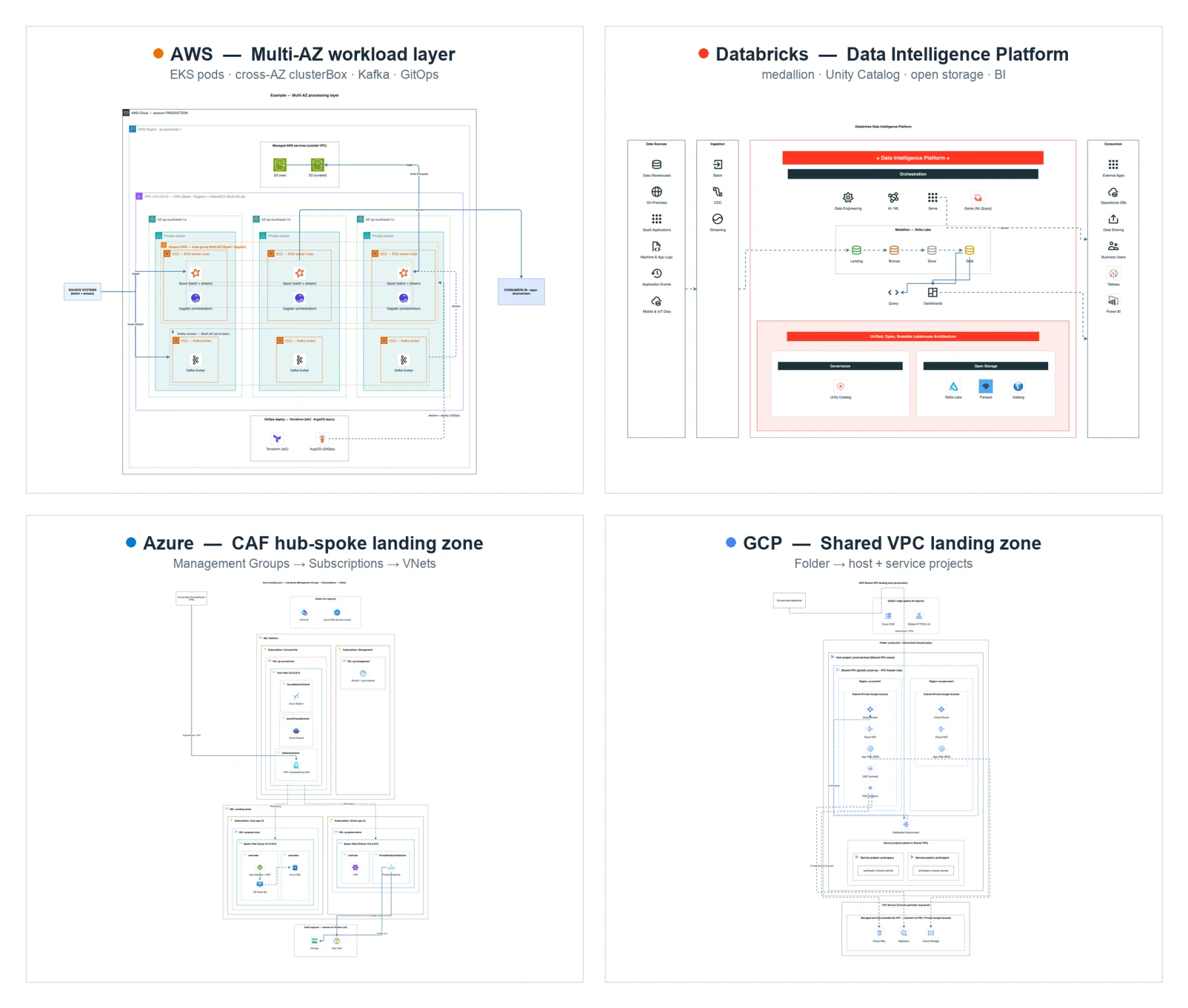
One diagram per platform — all generated end-to-end by the kit: no hand-placed coordinates, real stencils, validated, vision-checked. Full set in examples/.
Quick start
Requirements: Node.js ≥20.6 or Bun 1.4+. Nothing else to install.
Bun-only machine (no
node)? The CLI's shebang is#!/usr/bin/env node(the Windows-safe standard), soinstall.shwrites~/.local/bin/drawio-aias a wrapper that runsbun /dist/cli.mjs. Re-runinstall.shafterbun update -g. With a manualbun add -g, runbun $(bun pm bin -g)/../install/global/node_modules/drawio-ai-kit/dist/cli.mjsor install Node.
1. One-liner (CLI + skill)
curl -fsSL https://raw.githubusercontent.com/sparklabx/drawio-ai-kit/refs/heads/main/install.sh | sh
It installs drawio-ai-kit@latest globally with Bun (if present) or npm, links the drawio-ai command into
~/.local/bin (pick another dir with BIN_DIR=/dir or --bin-dir /dir; pin a version with --version 2.0.1), then registers the drawio skill with every
agent it finds. It never installs a runtime and needs no sudo. Prefer to read it first? Download
install.sh, open it, then run sh install.sh (--dry-run prints the commands only; --help lists options).
Re-run it to upgrade. It first removes old installs so exactly one copy remains:
- any global copy from npm or Bun, including old git installs
- the old skills (
drawio-aws,drawio-cloud-architect, …) and their leftover folders - the pre-1.0 MCP entry
Pass --no-clean to keep them.
2. Manual (npm or Bun)
npm i -g drawio-ai-kit && drawio-ai skill install      # npm
bun add -g drawio-ai-kit && drawio-ai skill install    # Bun
About 2 MB from the npm registry, so it takes seconds. drawio-ai skill install registers the skill straight
from the installed package, with no second download. Restart your agent, then try: "draw an AWS 3-tier web app".
3. As a project dependency (scripts and types)
npm i drawio-ai-kit # or: bun add drawio-ai-kit
import { Diagram, group, icon, renderTree } from "drawio-ai-kit"; // full TypeScript types included
Run such a script with plain node build.mjs or bun build.mjs. Without a local install, use the global CLI:
drawio-ai run build.mjs (it resolves "drawio-ai-kit" to the installed CLI).
The global install puts the drawio-ai binary on PATH (see INSTALL.md to pin a version).
Install only from the npm registry; installing from git or GitHub is not supported. The CLI ships as a Bun-minified production bundle (dist/)
that runs on Node or Bun. Its one library (icon search) is bundled inside, so users install nothing extra.
The skill step uses the skills CLI, which auto-detects Claude Code, Codex, Gemini CLI, … —
without it the agent never picks the kit up on its own.
One skill covers every domain: it asks you what's missing (which cloud? what to draw?), then loads just that domain's reference. It is written in short, explicit steps so small fast models (e.g. Claude Haiku) can drive it end-to-end.
- Optional, for the full experience: the draw.io desktop app enables
drawio-ai render(the vision self-check); Graphviz enablesvendor/autolayout.pyfor large graphs. Details in INSTALL.md.
Is it safe to install?
Short answer: yes — and you don't have to take my word for it.
- No hidden code. No
postinstall(or any lifecycle) hooks — nothing runs onnpm install. No dependencies are installed alongside it. Nosudo, no runtime installs, no remote code at run time. The optional one-line installer is a short POSIX script you can read first. The shippeddist/is minified, but it is a reproducible build of the readablesrc/: it is never committed; CI builds it on every PR (and checks the build is deterministic), and the release job builds the published copy from the tagged source. - Self-contained. The package has no runtime
dependencies. The one library it uses (minisearch, for icon search) is a devDependency that Bun bundles intodist/, andnpm audit --omit=devruns in CI. - Runs locally, no telemetry. The CLI only reads/writes local files. The single optional outbound call is icon-logo fetching from public CDNs (lobe-icons), and it's opt-in.
- Easy to undo:
npm uninstall -g drawio-ai-kit              # remove the CLI (Bun: bun remove -g drawio-ai-kit)
npx skills remove drawio                  # remove the skill (Bun: bunx skills remove drawio)
- Updating — two independent channels:
npm i -g drawio-ai-kit@latest && drawio-ai skill install # CLI + skill (Bun: bun add -g drawio-ai-kit@latest)
The skill drives drawio-ai at runtime, so engine fixes reach you the moment you update the
CLI. Re-running drawio-ai skill install refreshes the skill's docs from the same version. Pin a release with
drawio-ai-kit@2.0.0.
To report a security issue, see SECURITY.md.
Build a diagram — declarative, no hardcoded coordinates
Define a diagram topology (pipeline/hierarchy/network/hubspoke/hybrid/mesh/sequence), declare the nested structure, and the layout engine programmatically computes spatial coordinates (x/y/w/h) — frames auto-size to fit their children, while rows and columns auto-space. You define the logical topology, not raw pixels.
import { Diagram, group, icon, box, renderTree } from "drawio-ai-kit";   // run: drawio-ai run build.mjs (or plain node/bun where drawio-ai-kit is installed)

const d = new Diagram("network");
const tree = group("region", "group_region", "Region", { dir: "row" }, [
  group("vpc", "group_vpc", "VPC", { dir: "col" }, [
    icon("alb", "elastic_load_balancing", "ALB"),
    icon("ec2", "ec2", "EC2"),
  ]),
]);
renderTree(d, tree);                 // engine lays everything out + sizes the page
d.title("My VPC");
d.link("alb", "ec2");                // edges by id; router picks straight/corridor
const res = d.validate();            // names real? colors/nesting/labels clean?
// d.mxfile("My VPC")  → write to .drawio, export PNG, then vision self-check
Icon names are retrieved from drawio-ai search to prevent name fabrication (it tolerates typos, aliases like k8s/pg/es, and multi-keyword queries); edge routing, container sizing, alignment, and contextual corner styles are dynamically computed. The AI agent defines the logical layout and iterates via a render-analyze-rectify loop (vision-based self-correction). Example: examples/aws/build_mesh.mjs (zero manual coordinates).
Migration (from 1.x)
At 2.0.0 the 5 domain skills (drawio-aws, drawio-azure, drawio-gcp, drawio-databricks,
drawio-bpmn) were merged into ONE drawio skill, and the CLI became a Bun-minified bundle in dist/.
- Easiest: re-run
install.sh. It removes the old skills and the old CLI, then installs fresh. - Skills (manual):
npx skills remove drawio-aws drawio-azure drawio-gcp drawio-databricks drawio-bpmn, thendrawio-ai skill install. - CLI (manual):
npm i -g drawio-ai-kit(from the npm registry; the bin points atdist/cli.mjs). - Your build scripts: import everything from
"drawio-ai-kit"(the package no longer shipssrc/). Re-scaffold, or replace the/src/builder.ts/layout-engine.ts/bpmn.tsimports with that one name. Run withdrawio-ai run build.mjs. drawio-ai principles --mode …anddrawio-ai workflowstill work; they now print the skill'sreferences/andworkflows/build.md.
Migration (from <1.0)
At 1.0.0 the MCP server and bespoke installer were removed. To migrate:
- Install: run
install.sh. It removes thedrawio-ai-kitMCP entry and the olddrawio-cloud-architect/drawio-aws-architectskill folders, then installs the CLI from npm and thedrawioskill. - Manual:
claude mcp remove drawio-ai-kit --scope user, delete the old skill folders (e.g.~/.agents/skills/drawio-cloud-architect), thennpm i -g drawio-ai-kit && drawio-ai skill install. - Vision self-check: the inline image was replaced by
drawio-ai render→ PNG →Read. - Uninstall:
npm uninstall -g drawio-ai-kit+ remove each skill via the skills tooling.
Template library (examples/)
Each file builds one common architecture via the layout engine (zero hardcoded coordinates) — copy one as a starting point. Examples are organized into domain subfolders — see examples/README.md for the full index. Copy one out of the kit and run it: drawio-ai scaffold -o /build.mjs --name .drawio && drawio-ai run /build.mjs (the .drawio lands next to the script; never run examples inside the kit folder).
examples/aws/
| Example | Type | Architecture |
|---|---|---|
build_pipeline.mjs |
pipeline | Layered data analytics pipeline (ingest → process → store → serve) + cross-cutting band |
build_landingzone.mjs |
hierarchy | AWS Landing Zone / Control Tower org & OUs |
build_vpc.mjs |
network | VPC Multi-AZ 3-tier (ALB spanning AZs) |
build_vpc_routing.mjs |
network | Subnets + route tables + VPC Endpoint (Gateway) → S3 |
build_vpc_eks.mjs |
network | VPC with Bastion, NAT, EKS, Auto Scaling worker nodes |
build_vpc_efs.mjs |
network | VPC with Amazon EFS (a mount target per AZ) |
build_web3tier.mjs |
network | 3-tier web app (Edge → Web → App → Data) |
build_eventdriven.mjs |
hubspoke | Serverless event bus (EventBridge hub → consumers) |
build_serverless.mjs |
sequence | Serverless web app, numbered request walkthrough |
build_hybrid.mjs |
hybrid | On-prem ↔ AWS over Direct Connect + VPN, mirrored DR |
build_mesh.mjs |
mesh | Multi-account connectivity / service mesh |
build_iam_accounts.mjs |
hierarchy | Multi-account IAM + cross-account assume-role |
examples/azure/ · gcp/ · databricks/ · multicloud/ · bpmn/
| Example | Type | Architecture |
|---|---|---|
azure/build_azure_vnet.mjs |
network | Azure N-tier: Subscription → Resource Group → VNet → Subnet tiers |
azure/build_azure_hub_spoke_lz.mjs |
network | CAF hub-spoke landing zone (Management Groups, hub + spoke VNets, reserved subnets, peering, private endpoints) |
gcp/build_gcp_vpc.mjs |
network | GCP global VPC across two regions (Project → global VPC → regional Subnets) |
gcp/build_gcp_shared_vpc_landing_zone.mjs |
network | Shared VPC landing zone (host/service projects, regional Cloud Router/NAT, Interconnect, PSC, VPC-SC) |
databricks/build_lakehouse.mjs |
pipeline | Databricks lakehouse medallion (Bronze/Silver/Gold) + Unity Catalog |
databricks/build_platform.mjs |
hybrid | Databricks control-plane vs data-plane deployment topology |
databricks/build_data_intelligence_platform.mjs |
pipeline | Databricks Data Intelligence Platform reference (signature bands, medallion, foundation) |
databricks/build_mlops.mjs |
pipeline | Databricks MLOps — Git provider + Dev/Staging/Prod workspaces + Unity Catalog + Lakehouse |
multicloud/build_multicloud.mjs |
hybrid | On-prem + AWS + Azure composed through a neutral interconnect |
bpmn/build_bpmn.mjs |
bpmn | BPMN swimlane process (pool → lanes × phases) |
Runtime architecture
- Node ≥20.6 or Bun — runs the shipped
dist/bundle (CLI, validator, library). The source insrc/is TypeScript (.nvmrc= 22 for development). - Bun 1.4+ — maintainers only:
bun testruns the suites,bun run buildbundlessrc/(and devDependencies such as minisearch) into the minifieddist/that ships. Users need Node or Bun, not both. - Python 3.11 (
.python-version) — data ingestion and compilation pipeline: catalog generator + icon-pack builder (scripts/build_pack.py, stdlib only).
Install the dependencies:
nvm install --lts && nvm use --lts    # or: brew install node
brew install python@3.11              # then: python3.11 --version
CLI commands
| Command | Purpose |
|---|---|
search |
Find a stencil by keyword/category → returns the exact name + ready-to-paste draw.io style (verbatim from the index: real names, official colors, connection points). |
style |
Get the full style for one stencil by exact name. |
validate |
Lint XML: unknown stencils, dangling edges, missing aspect=fixed, recolored AWS icons, broken AWS group nesting, geometry (overlap / child spills its frame / stacked arrowheads), plus an aesthetic audit (font/palette/fan-out/icon-size). |
audit |
Aesthetic audit only (font/palette/fan-out/icon-size). |
render |
Render the XML to PNG (drawio-ai render -o out.png). Needs the draw.io desktop CLI; set DRAWIO_CLI to override the path. |
logo |
Logo for non-AWS brands (AI/LLM + some) as an image style, via vendor/aiicons.py (lobe-icons). Needs python3. |
categories |
List all catalog categories. |
types |
List supported diagram topologies. |
principles |
Design rules + architecture preset + catalog categories (from the skill's references/). Pass `--mode aws |
run [args] |
Run a script whose import "drawio-ai-kit" resolves to this CLI's own install (Node >=20.6, Bun). |
root |
Print the installed Kit's absolute path. |
skill install |
Register the bundled drawio skill with your agents through the skills CLI (-g, -a , -y pass through). No extra download. |
workflow |
Print the build → validate → render → write workflow (skills/drawio/workflows/build.md). |
scaffold |
Copy a template as a runnable build script: scaffold build_vpc.mjs -o /build.mjs --name vpc.drawio (--list shows all). |
The drawio skill wraps these commands into a full build-with-engine → validate → render + vision self-check → final-export workflow. Vendored helpers in vendor/: autolayout.py (Graphviz layout for >15-node graphs), aiicons.py, repair_png.py, encode_drawio_url.py (browser fallback).
The skill
One skill, skills/drawio/, covers every domain — installed with drawio-ai skill install:
skills/drawio/
├── SKILL.md              4 steps: check CLI → ask what's missing → pick the domain reference → build
├── references/           read on demand — the agent loads only its domain's file
│   ├── api.md            the whole engine API on one page
│   ├── principles.md     layout rules (dense grids, flow, no overlap)
│   ├── aws-architecture.md · azure-architecture.md · gcp-architecture.md
│   ├── databricks-architecture.md · bpmn.md
│   └── diagram-types.md · style-guide.md
└── workflows/
    ├── build.md          scaffold → run → fix-all-issues → look once → deliver
    ├── from-iac.md       Terraform/Terramate inventory before drawing
    └── delegate.md       hand the build loop to a (cheap) subagent
Small-model friendly by design: every step names the exact file to read and the exact command
to run, templates are scaffolded runnable (--name sets the output), and the validator's
messages say what to change.
Other hosts (Coworker AI, Agent SDK, …)
The kit isn't tied to one app — the "brains" live in the CLI + repo + rules, so
any Claude host that can run shell commands can use it. Point the agent at the
CLI: drawio-ai principles, drawio-ai search, drawio-ai validate, plus the
template index & reproduction loop in skills/drawio/references/diagram-types.md. (draw.io CLI is
only needed for PNG render / vision-check.)
CLI usage
drawio-ai search s3
drawio-ai search "k8s, pg, es"          # one call, one best hit per service
drawio-ai search "alb ec2 rds s3"       # spaces work too
drawio-ai search kubenetes              # typos are fine
drawio-ai search kubernetes --category Containers
drawio-ai search "aws cloud" --kind group
drawio-ai style s3
drawio-ai validate ../4_oncloud.drawio
drawio-ai categories
drawio-ai principles --mode aws
drawio-ai render out.drawio -o out.png
Catalog (2106 icons — 983 AWS + 626 Azure + 216 GCP + 281 across 8 OSS packs)
loadCatalog merges every catalog/*.json, so all icons are searchable together via drawio-ai search.
catalog/aws.json is generated from data/shape-index.json.gz (10,446-shape index from jgraph/drawio-mcp, Apache-2.0) — real stencil names (s3, eks, identity_and_access_management, ...), official per-icon colors, connection points, and aspect=fixed, all verbatim. No hand-guessing.
Regenerate after refreshing the index:
python3.11 scripts/ingest_index.py # data/shape-index.json.gz → catalog/aws.json (983 icons, 19 groups)
Icon packs (non-AWS)
Brand/tech icons for the tools people draw alongside AWS — searchable by name (spark, kafka, postgres, kubernetes, argocd, prometheus, pytorch, …) as square tiles in the same house style:
| Pack | Icons | Examples |
|---|---|---|
database |
66 | postgres, mysql, mongodb, redis, clickhouse, snowflake |
bigdata |
48 | spark, kafka, airflow, flink, trino, dbt, minio |
cicd |
42 | jenkins, argocd, terraform, ansible, sonarqube |
aiml |
26 | pytorch, tensorflow, huggingface, ollama, langchain |
containers |
26 | kubernetes, docker, helm, istio, linkerd |
observability |
26 | datadog, prometheus, grafana, opentelemetry |
databricks |
24 | unity catalog, delta sharing, mosaic ai |
network |
15 | nginx, kong, traefik, haproxy, cloudflare |
The prebuilt catalog/*.json are committed — using the kit needs no rebuild. To add or refresh a pack, edit packs//manifest.json and:
python3 scripts/build_pack.py # devicon → vectorlogo.zone → gilbarbara → simple-icons → text (needs macOS qlmanage)
See THIRD_PARTY_NOTICES.md for attributions.
Tests
bun test            # the node:test suites, run by Bun (fast)
npm test            # the same suites on plain Node — must also pass
bun run build       # bun → dist/ (gitignored; CI and release build it; run before tests)
bun run build:check # rebuild into a temp dir and fail if dist/ differs
Notes & licensing
- The code is MIT (see
LICENSE). Bundled icons/logos (AWS Architecture Icons + third-party project logos) are trademarks of their owners and are not covered by MIT — seeNOTICE. - Prefer native stencils (this catalog) over base64 — smaller files, crisp vectors, cleaner licensing.
- Use base64 (
custom-icons.json) only for icons draw.io lacks (Confluent, Starburst, OpenMetadata, MinIO, Dagster, internal/brand logos) or when rendering outside draw.io. - The official AWS Architecture Icons have their own usage terms — review before redistributing a base64 bundle publicly.
- Category colors in the seed are approximate; the generator can refresh them.