
MatMul-Free LM
If you like our project, please give us a star ⭐ on GitHub for the latest updates.
This repo is adapted from flash-linear-attention.




Introduction
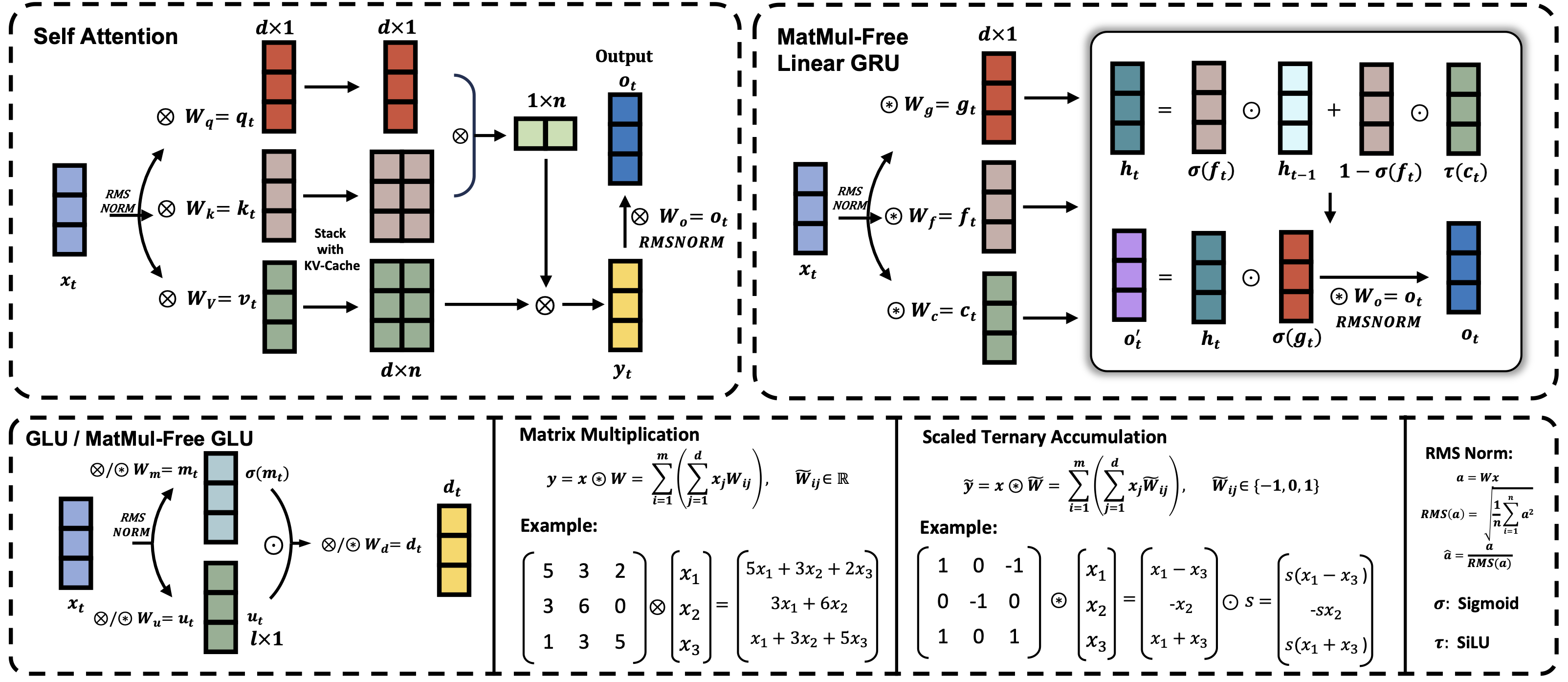
MatMul-Free LM is a language model architecture that eliminates the need for Matrix Multiplication (MatMul) operations. This repository provides an implementation of MatMul-Free LM that is compatible with the 🤗 Transformers library.
Scaling Law
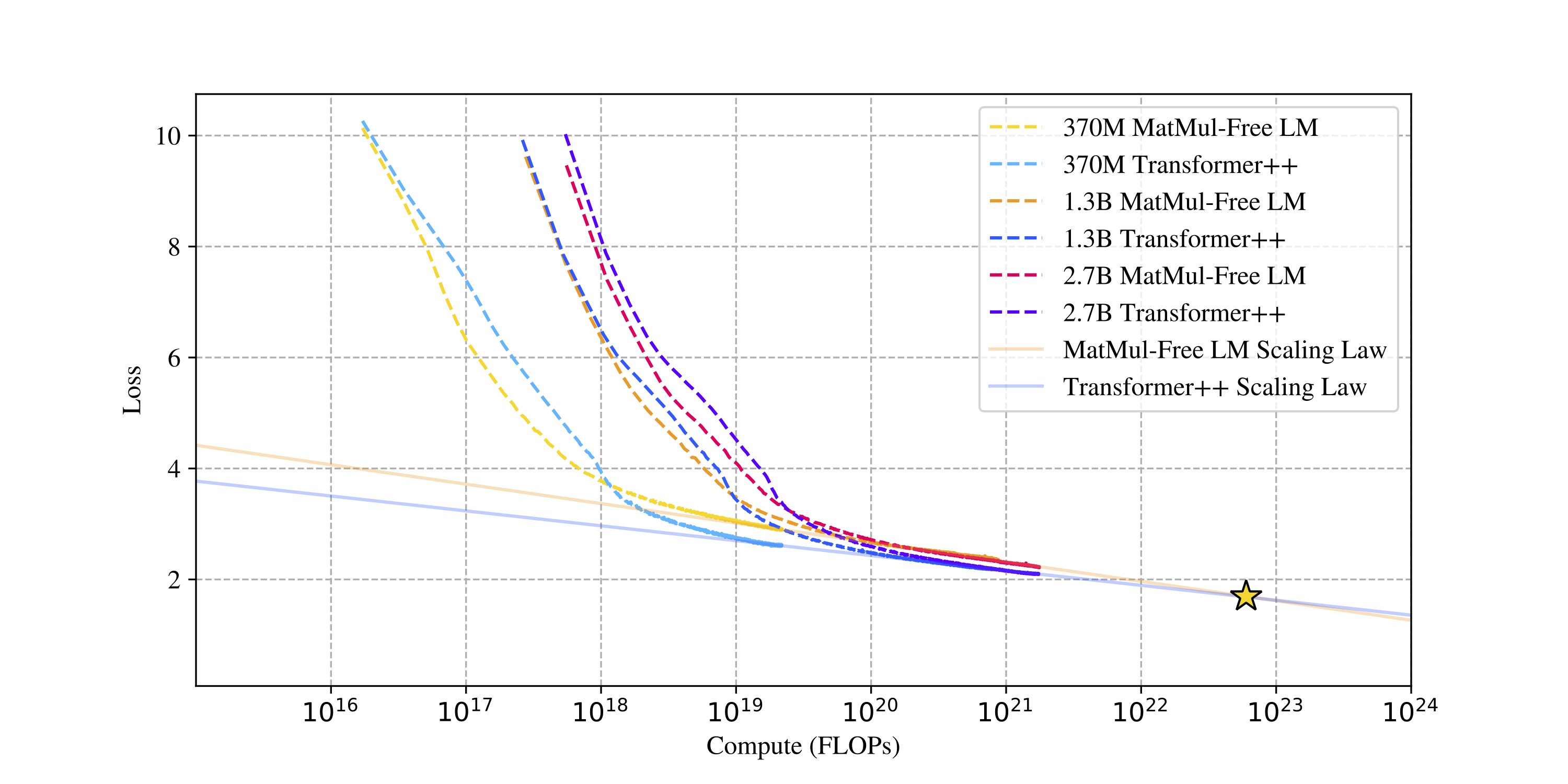
We evaluate how the scaling law fits to the 370M, 1.3B and 2.7B parameter models in both Transformer++ and our model. For a fair comparison, each operation is treated identically, though our model uses more efficient ternary weights in some layers. Interestingly, the scaling projection for our model exhibits a steeper descent compared to Transformer++, suggesting our architecture is more efficient in leveraging additional compute to improve performance.
Installation
The following requirements should be satisfied
pip install -U git+https://github.com/ridgerchu/matmulfreellm
Usage
Pre-trained Model Zoo
| Model Size | Layer | Hidden dimension | Trained tokens |
|---|---|---|---|
| 370M | 24 | 1024 | 15B |
| 1.3B | 24 | 2048 | 100B |
| 2.7B | 32 | 2560 | 100B |
Model
We provide the implementations of models that are compatible with 🤗 Transformers library.
Here's an example of how to initialize a model from the default configs in matmulfreelm:
This is a huggingface-compatible library that you can use such command to initialize the model with huggingface AutoModel:
>>> from mmfreelm.models import HGRNBitConfig
>>> from transformers import AutoModel
>>> config = HGRNBitConfig()
>>> AutoModel.from_config(config)
HGRNBitModel(
  (embeddings): Embedding(32000, 2048)
  (layers): ModuleList(
    (0): HGRNBitBlock(
      (attn_norm): RMSNorm(2048, eps=1e-06)
      (attn): HGRNBitAttention(
        (i_proj): FusedBitLinear(
          in_features=2048, out_features=2048, bias=False
          (norm): RMSNorm(2048, eps=1e-08)
        )
        (f_proj): FusedBitLinear(
          in_features=2048, out_features=2048, bias=False
          (norm): RMSNorm(2048, eps=1e-08)
        )
        (g_proj): FusedBitLinear(
          in_features=2048, out_features=2048, bias=False
          (norm): RMSNorm(2048, eps=1e-08)
        )
        (g_norm): FusedRMSNormSwishGate()
        (o_proj): FusedBitLinear(
          in_features=2048, out_features=2048, bias=False
          (norm): RMSNorm(2048, eps=1e-08)
        )
      )
      (mlp_norm): RMSNorm(2048, eps=1e-06)
      (mlp): HGRNBitMLP(
        (gate_proj): FusedBitLinear(
          in_features=2048, out_features=11264, bias=False
          (norm): RMSNorm(2048, eps=1e-08)
        )
        (down_proj): FusedBitLinear(
          in_features=5632, out_features=2048, bias=False
          (norm): RMSNorm(5632, eps=1e-08)
        )
        (act_fn): SiLU()
      )
    )

)
>>>
Generation
Upon successfully pretraining a model, it becomes accessible for generating text using the 🤗 text generation APIs.
In the following, we give a generation example in generate.py:
import os
os.environ["TOKENIZERS_PARALLELISM"] = "false"
import mmfreelm
from transformers import AutoModelForCausalLM, AutoTokenizer
#Change here to our open-sourced model
name = ''
tokenizer = AutoTokenizer.from_pretrained(name)
model = AutoModelForCausalLM.from_pretrained(name).cuda().half()
input_prompt = "In a shocking finding, scientist discovered a herd of unicorns living in a remote, "
input_ids = tokenizer(input_prompt, return_tensors="pt").input_ids.cuda()
outputs = model.generate(input_ids, max_length=32,  do_sample=True, top_p=0.4, temperature=0.6)
print(tokenizer.batch_decode(outputs, skip_special_tokens=True)[0])
Reproducible release
Version v0.1.0 is the archival software release associated with the Nature Computational Science manuscript. Its runtime code is based on commit f24cfe5, with citation, version, and license metadata added for the release.
Citation
If you use this software, please cite both the archived software release (see CITATION.cff) and the associated paper.
Software release:
@software{zhu2026matmulfree,
  title={MatMul-Free LM: Code for Scalable MatMul-free Language Modeling on Neuromorphic Hardware},
  author={Zhu, Rui-Jie and Zhang, Yu and Abreu, Steven and Sifferman, Ethan and Sheaves, Tyler and Wang, Yiqiao and Richmond, Dustin and Shrestha, Sumit Bam and Zhou, Peng and Eshraghian, Jason K.},
  year={2026},
  version={0.1.0},
  publisher={Zenodo},
  doi={10.5281/zenodo.22501850},
  url={https://doi.org/10.5281/zenodo.22501850}
}
Associated paper:
@article{zhu2024scalable,
  title={Scalable MatMul-free Language Modeling},
  author={Zhu, Rui-Jie and Zhang, Yu and Abreu, Steven and Sifferman, Ethan and Sheaves, Tyler and Wang, Yiqiao and Richmond, Dustin and Shrestha, Sumit Bam and Zhou, Peng and Eshraghian, Jason K.},
  journal={arXiv preprint arXiv:2406.02528},
  year={2024},
  doi={10.48550/arXiv.2406.02528},
  url={https://arxiv.org/abs/2406.02528}
}
License
The software is released under the Apache License 2.0.