Gated Attention: Implementation and Visualization
This repository contains the implementation of gated attention mechanisms based on Qwen3 model architecture, along with tools for visualizing attention maps. Our modifications are based on findings from recent research that demonstrate how applying sparse, head-specific gating after Scaled Dot-Product Attention (SDPA) can significantly improve performance, training stability, and long-context generalization. More details are in our paper Gated Attention for Large Language Models: Non-linearity, Sparsity, and Attention-Sink-Free.
🆕 Updates
2025-12-20 — We will release additional analyses and case studies on the effectiveness of Gated Attention, including visualizations and quantitative investigations into the model’s internal mechanisms to offer more intuitive insights into how and why gating works.
2025-11-26 — Our paper, Gated Attention for Large Language Models: Non-linearity, Sparsity, and Attention-Sink-Free, has been awarded the NeurIPS 2025 Best Paper Award! 🎉
This prestigious honor recognizes only 4 papers out of 5,290 accepted submissions, highlighting the foundational impact of our work on attention mechanism design.
Official announcement: NeurIPS 2025 Best Paper Awards
2025-09-18 — Our paper, Gated Attention for Large Language Models: Non-linearity, Sparsity, and Attention-Sink-Free, has been selected as an Oral Presentation at NeurIPS 2025, placing among the top 1.5% of submissions (77 out of 5,290 accepted papers). This recognition underscores the significance and novelty of our findings in rethinking attention gating for scalable, stable, and long-context LLMs.
2025-09-10 — Gated Attention has been successfully integrated into the official Qwen3-Next architecture, as featured in Qwen’s latest research blog (Read Here) and deployed in the Qwen3-Next-80B-A3B-Instruct model. This real-world adoption validates our core hypothesis: gating mechanisms significantly enhance training stability and ultra-long-context performance (up to 1M tokens).
📚 Introduction
Gating mechanisms have long been a cornerstone of neural network design, enabling dynamic control over information flow. In this work, we focus on integrating and evaluating these mechanisms within standard softmax attention layers of transformer models.
We introduce a query-dependent sparse gate after the SDPA output (G1), which modulates each attention head independently using a sigmoid function. This simple yet effective change:
- Introduces non-linearity into the low-rank transformation formed by value and output projections.
- Enables input-dependent sparsity, preventing the "attention sink" phenomenon where early tokens dominate attention distributions.
- Improves training stability, allowing larger learning rates.
- Enhances long-context extrapolation, showing significant gains on benchmarks like RULER.
📦 Models
We provide models follow Qwen3's architecture with different gating configurations:
baseline: Standard attention without any gating.gate_headwise: Headwise gating applied after SDPA.gate_elementwise: Elementwise gating applied after SDPA.
These models are available at huggingface repo.
🧪 Demo Usage
A demo script is included to load a trained model and visualize attention maps with gating enabled.
Requirements
pip install transformers matplotlib numpy torch
Run Demo
python demo.py
This will produce a file named {model_name}_selected_layer_attention_maps.png, showing attention maps for four key layers.
Attention Maps Comparison
Below are the attention maps from Layer 1, Layer 7, Layer 21, and Layer 28 of three different model variants: baseline, gate_headwise, and gate_elementwise. These visualizations help illustrate how gating mechanisms affect attention patterns, especially in relation to the "attention sink" phenomenon.
In the baseline model, we observe a strong "attention sink" effect — the first token consistently receives disproportionately high attention scores across multiple layers. This indicates that the model overly relies on the initial token, potentially limiting its ability to distribute attention meaningfully across other positions.
Baseline Model

Observation: Strong diagonal dominance with significant focus on the first token (attention sink). This pattern persists across multiple layers.
Gate Headwise Model

Observation: Gating applied headwise reduces the attention sink effect. Attention becomes more distributed and context-dependent.
Gate Elementwise Model
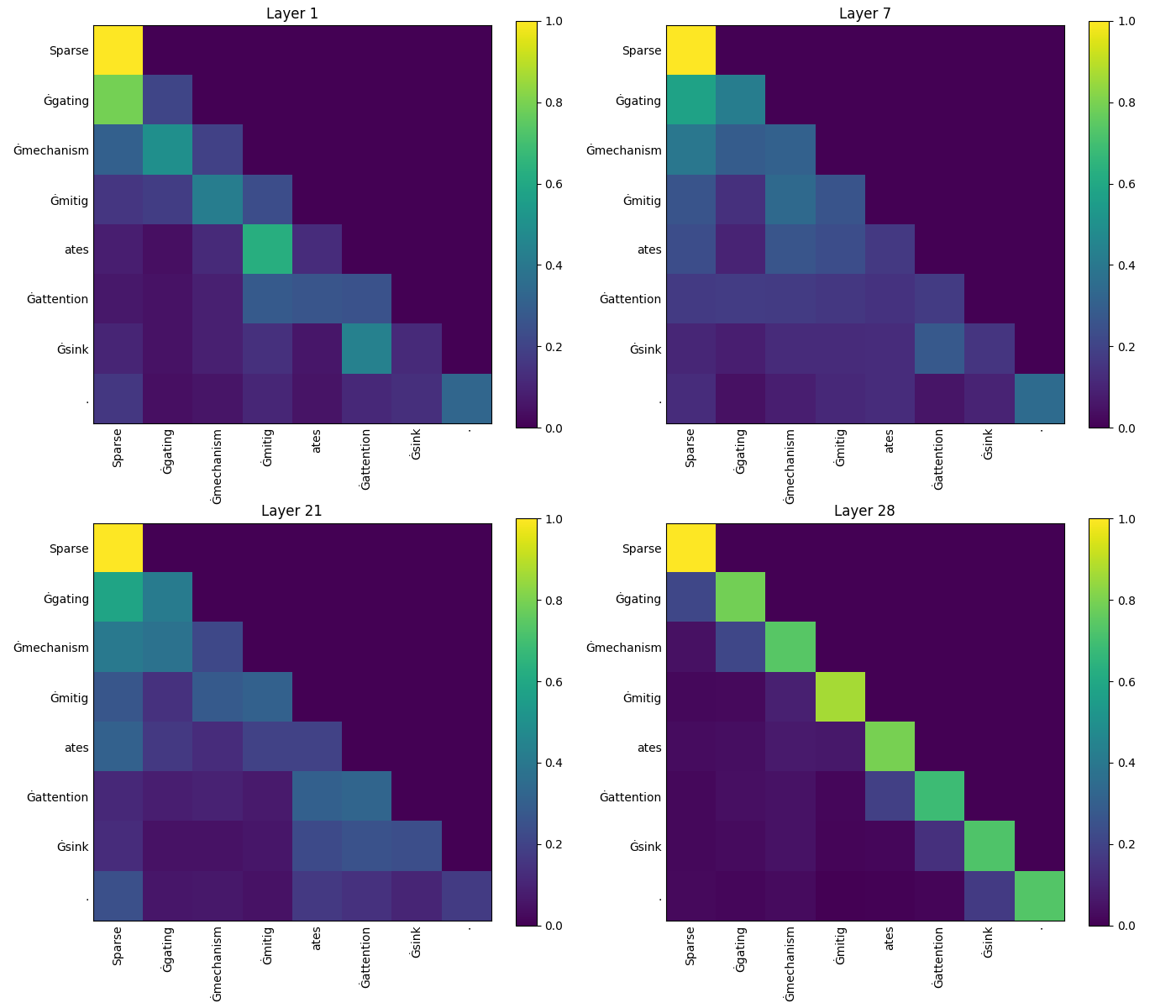
Observation: Elementwise gating further enhances sparsity and selectivity in attention patterns, leading to cleaner and more structured attention maps.
📁 Repository Structure
qwen3-gated/
├── figs/                    # used figs in the paper
├── modeling_qwen3.py        # Modified Qwen3 model with gated attention
├── configuration_qwen3.py   # Model configuration with gating flags
├── demo.py                  # Simple demo for loading model and extracting
└── README.md                # You are here
🔧 Implementation Details
The core changes to implement gated attention are found in the Qwen3Attention class in the provided code.
🧠 Gating Variants
We support two main types of gating:
1. Headwise Gating
Each attention head has its own gate scalar.
self.headwise_attn_output_gate = True
These options can be configured in the model config under:
{
  "headwise_attn_output_gate": true,
  "elementwise_attn_output_gate": false
}
2. Elementwise Gating
Each element of the attention output is modulated independently.
self.elementwise_attn_output_gate = True
These options can be configured in the model config under:
{
  "headwise_attn_output_gate": false,
  "elementwise_attn_output_gate": true
}
📝 Citation
If you use this code or models in your research, please cite our paper:
@misc{qiu2025gatedattentionlargelanguage,
      title={Gated Attention for Large Language Models: Non-linearity, Sparsity, and Attention-Sink-Free},
      author={Zihan Qiu and Zekun Wang and Bo Zheng and Zeyu Huang and Kaiyue Wen and Songlin Yang and Rui Men and Le Yu and Fei Huang and Suozhi Huang and Dayiheng Liu and Jingren Zhou and Junyang Lin},
      year={2025},
      eprint={2505.06708},
      archivePrefix={arXiv},
      primaryClass={cs.CL},
      url={https://arxiv.org/abs/2505.06708},
}
📬 Contact
For questions or collaboration opportunities, feel free to reach out at .