PyPose: A Library for Robot Learning with Physics-based Optimization

Deep learning has had remarkable success in robotic perception, but its data-centric nature suffers when it comes to generalizing to ever-changing environments. By contrast, physics-based optimization generalizes better, but it does not perform as well in complicated tasks due to the lack of high-level semantic information and the reliance on manual parametric tuning. To take advantage of these two complementary worlds, we present PyPose: a robotics-oriented, PyTorch-based library that combines deep perceptual models with physics-based optimization techniques. Our design goal for PyPose is to make it user-friendly, efficient, and interpretable with a tidy and well-organized architecture. Using an imperative style interface, it can be easily integrated into real-world robotic applications.
Current Features
LieTensor
Modules
- System:
LTI,LTV,NLS - Filter:
EKF,UKF,PF - PnP Solver:
EPnP - Linear Quadratic Regulator:
LQR - IMU Preintegration:
IMUPreintegrator - ......
Second-order Optimizers
GaussNewtonLevenbergMarquardt- ......
Want more features? Create an issue here to request new features.
PyPose is highly efficient and supports parallel computing for Jacobian of Lie group and Lie algebra. See following comparison.
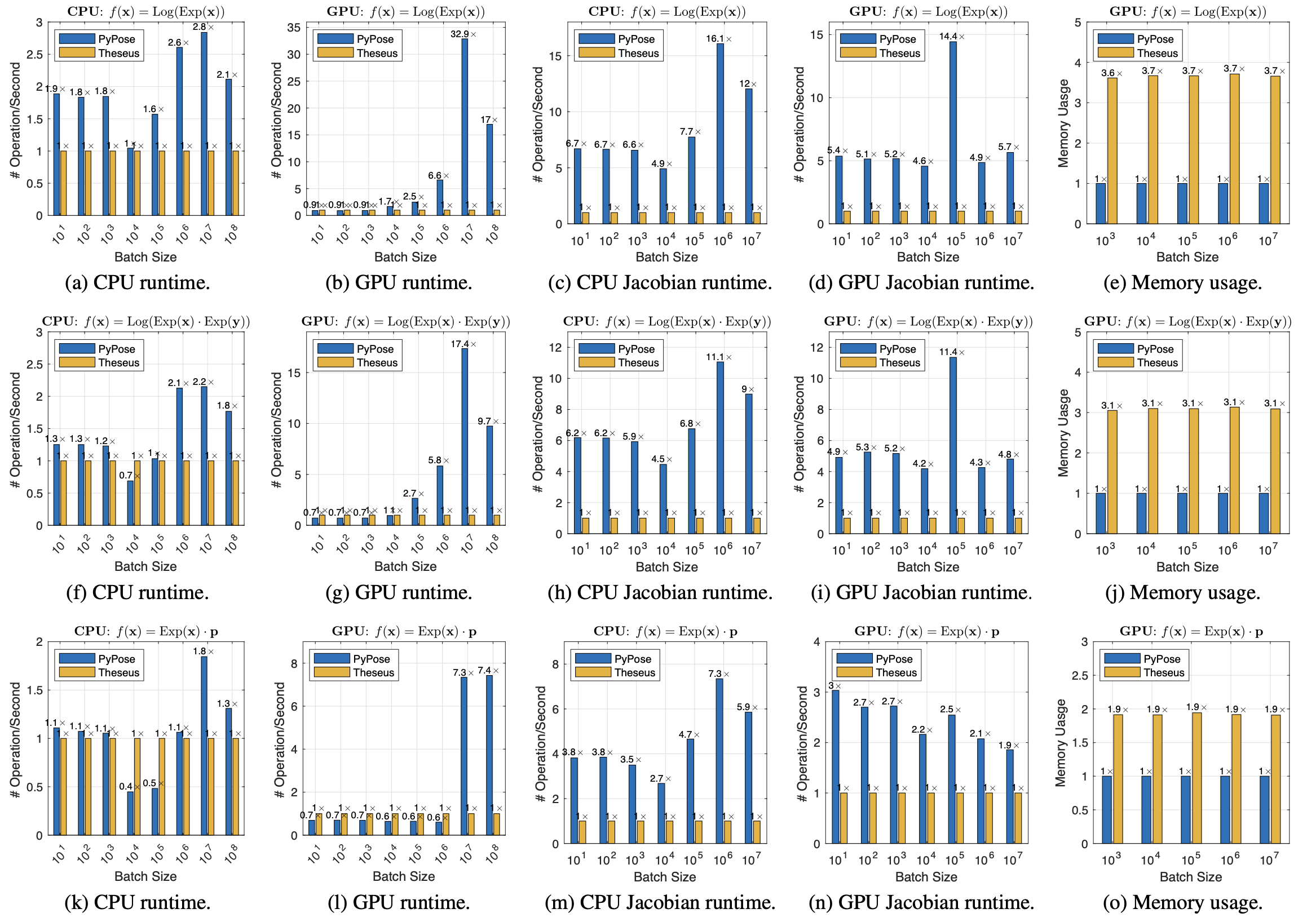
Efficiency and memory comparison of batched Lie group operations (we take Theseus performance as 1×).
More information about efficiency comparison goes to our paper for PyPose.
Getting Started
Installation
Install from pypi
pip install pypose
Install from source
- Requirement:
On Ubuntu, macOS, or Windows, install PyTorch, then run:
pip install -r requirements/runtime.txt
- Install locally:
git clone  https://github.com/pypose/pypose.git
cd pypose && pip install -e .
- Run tests
pytest
For contributors
-
Make sure the above installation is correct.
-
Go to CONTRIBUTING.md
Examples
- The following code sample shows how to rotate random points and compute the gradient of batched rotation.
>>> import torch, pypose as pp

>>> # A random so(3) LieTensor
>>> r = pp.randn_so3(2, requires_grad=True)
    so3Type LieTensor:
    tensor([[ 0.1606,  0.0232, -1.5516],
            [-0.0807, -0.7184, -0.1102]], requires_grad=True)

>>> R = r.Exp() # Equivalent to: R = pp.Exp(r)
    SO3Type LieTensor:
    tensor([[ 0.0724,  0.0104, -0.6995,  0.7109],
            [-0.0395, -0.3513, -0.0539,  0.9339]], grad_fn=)

>>> p = R @ torch.randn(3) # Rotate random point
    tensor([[ 0.8045, -0.8555,  0.5260],
            [ 0.3502,  0.8337,  0.9154]], grad_fn=)

>>> p.sum().backward()     # Compute gradient
>>> r.grad                 # Print gradient
    tensor([[-0.7920, -0.9510,  1.7110],
            [-0.2659,  0.5709, -0.3855]])
- This example shows how to estimate batched inverse of transform by a second-order optimizer. Two usage options for a
schedulerare provided, each of which can work independently.
>>> from torch import nn
>>> import torch, pypose as pp
>>> from pypose.optim import LM
>>> from pypose.optim.strategy import Constant
>>> from pypose.optim.scheduler import StopOnPlateau

>>> class InvNet(nn.Module):
...
...     def __init__(self, *dim):
...         super().__init__()
...         init = pp.randn_SE3(*dim)
...         self.pose = pp.Parameter(init)
...
...     def forward(self, input):
...         error = (self.pose @ input).Log()
...         return error.tensor()

>>> device = torch.device("cuda")
>>> input = pp.randn_SE3(2, 2, device=device)
>>> invnet = InvNet(2, 2).to(device)
>>> strategy = Constant(damping=1e-4)
>>> optimizer = LM(invnet, strategy=strategy)
>>> scheduler = StopOnPlateau(optimizer, steps=10, patience=3, decreasing=1e-3, verbose=True)

>>> # 1st option, full optimization
>>> scheduler.optimize(input=input)

>>> # 2nd option, step optimization
>>> while scheduler.continual():
...     loss = optimizer.step(input)
...     scheduler.step(loss)

>>> # Note: remove one of the above options for usage!
- May 2026: PyPose v0.9.5 integrates the sparse Jacobian tracing and sparse second-order optimization methods developed in Bundle Adjustment in the Eager Mode to accelerate applications such as bundle adjustment.
>>> import torch
>>> import pypose as pp
>>> from torch import nn
>>> from pypose.optim import LM
>>> from pypose.optim.solver import PCG
>>> from pypose.optim.strategy import TrustRegion
>>> from pypose.optim.scheduler import StopOnPlateau
>>> from pypose.autograd.function import psjac

>>> class ReprojErr(nn.Module):
...     def __init__(self, poses, points):
...         super().__init__()
...         # sjac: enabling tracing of sparse Jacobian
...         self.poses = pp.Parameter(poses, sjac=True)
...         self.points = pp.Parameter(points, sjac=True)
...
...     @psjac  # parallelize assembly of sparse Jacobian
...     def project(poses, points):
...         points = poses.Act(points)
...         return - points[..., :2] / points[..., [2]]
...
...     def forward(self, pixels, cidx, pidx):
...         poses = self.poses[cidx]
...         points = self.points[pidx]
...         return ReprojErr.project(poses, points) - pixels

>>> torch.set_default_device("cuda")
>>> npts, poses = 8, pp.randn_SE3(1)
>>> points = torch.randn(npts, 3)
>>> points[:, 2] += 4  # positive depth
>>> cidx = torch.zeros(npts, dtype=torch.long)
>>> pidx = torch.arange(npts)
>>> pixels = torch.randn(npts, 2)
>>> inputs = (pixels, cidx, pidx)

>>> model = ReprojErr(poses, points)
>>> solver = PCG(tol=1e-4, maxiter=250)
>>> strategy = TrustRegion(up=2.0, down=0.5**4)
>>> optimizer = LM(model, solver, strategy, sparse=True)
>>> scheduler = StopOnPlateau(optimizer, steps=5, verbose=True)

>>> while scheduler.continual():
...     loss = optimizer.step(inputs)
...     scheduler.step(loss)
For more usage, see Documentation. For more applications, see Examples.
Citing PyPose
If you use PyPose, please cite the papers below.
PyPose: A Library for Robot Learning with Physics-based Optimization
@inproceedings{wang2023pypose,
  title = {{PyPose}: A Library for Robot Learning with Physics-based Optimization},
  author = {Wang, Chen and Gao, Dasong and Xu, Kuan and Geng, Junyi and Hu, Yaoyu and Qiu, Yuheng and Li, Bowen and Yang, Fan and Moon, Brady and Pandey, Abhinav and Aryan and Xu, Jiahe and Wu, Tianhao and He, Haonan and Huang, Daning and Ren, Zhongqiang and Zhao, Shibo and Fu, Taimeng and Reddy, Pranay and Lin, Xiao and Wang, Wenshan and Shi, Jingnan and Talak, Rajat and Cao, Kun and Du, Yi and Wang, Han and Yu, Huai and Wang, Shanzhao and Chen, Siyu and Kashyap, Ananth  and Bandaru, Rohan and Dantu, Karthik and Wu, Jiajun and Xie, Lihua and Carlone, Luca and Hutter, Marco and Scherer, Sebastian},
  booktitle = {IEEE/CVF Conference on Computer Vision and Pattern Recognition (CVPR)},
  year = {2023}
}
Bundle Adjustment in the Eager Mode
@article{zhan2026bundle,
  title = {Bundle Adjustment in the Eager Mode},
  author = {Zhan, Zitong and Xu, Huan and Fang, Zihang and Wei, Xinpeng and Hu, Yaoyu and Wang, Chen},
  journal = {IEEE Transactions on Robotics (T-RO)},
  year = {2026},
  url = {https://arxiv.org/abs/2409.12190}
}
PyPose v0.6: The Imperative Programming Interface for Robotics
@inproceedings{zhan2023pypose,
  title = {{PyPose} v0.6: The Imperative Programming Interface for Robotics},
  author = {Zitong Zhan and Xiangfu Li and Qihang Li and Haonan He and Abhinav Pandey and Haitao Xiao and Yangmengfei Xu and Xiangyu Chen and Kuan Xu and Kun Cao and Zhipeng Zhao and Zihan Wang and Huan Xu and Zihang Fang and Yutian Chen and Wentao Wang and Xu Fang and Yi Du and Tianhao Wu and Xiao Lin and Yuheng Qiu and Fan Yang and Jingnan Shi and Shaoshu Su and Yiren Lu and Taimeng Fu and Karthik Dantu and Jiajun Wu and Lihua Xie and Marco Hutter and Luca Carlone and Sebastian Scherer and Daning Huang and Yaoyu Hu and Junyi Geng and Chen Wang},
  year = {2023},
  booktitle = {IEEE/RSJ International Conference on Intelligent Robots and Systems (IROS) Workshop},
}
If you use the bundle adjustment or pose graph optimization functions, or its components such as sparse Jacobian, GPU sparse linear algebra, conjugate gradient solver, or sparse LM optimizer, you must cite Bundle Adjustment in the Eager Mode.
Point of Contact
For any questions, please contact @zitongzhan with a copy to @wang-chen.