Dense Text-to-Image Generation with Attention Modulation
ICCV 2023 [Paper] [Demo on HF 🤗] [Colab Demo]
Authors Yunji Kim1, Jiyoung Lee1, Jin-Hwa Kim1, Jung-Woo Ha1, Jun-Yan Zhu2
1NAVER AI Lab, 2Carnegie Mellon University
Abstract
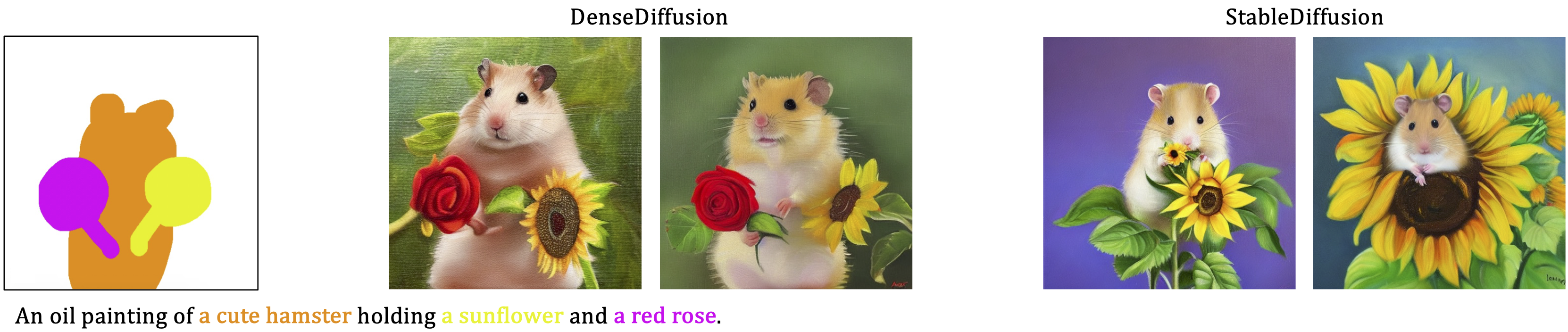
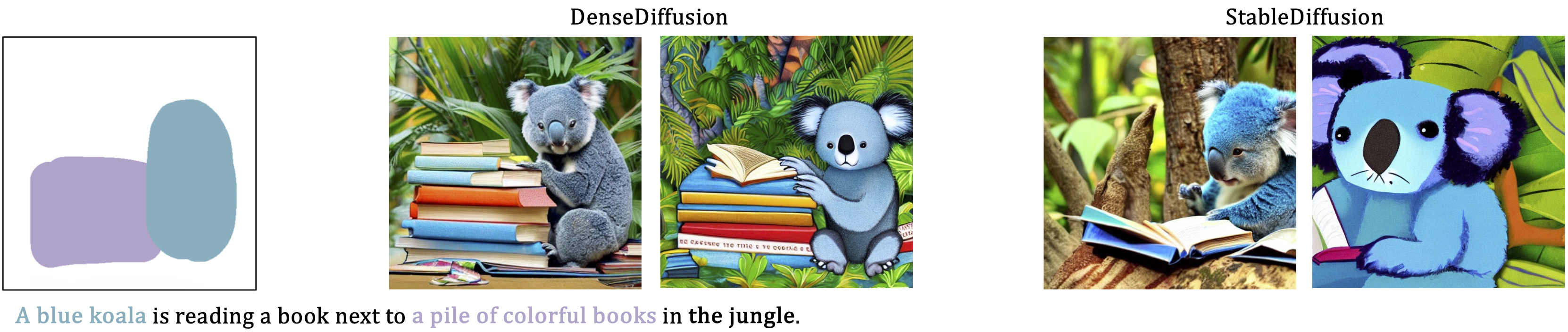
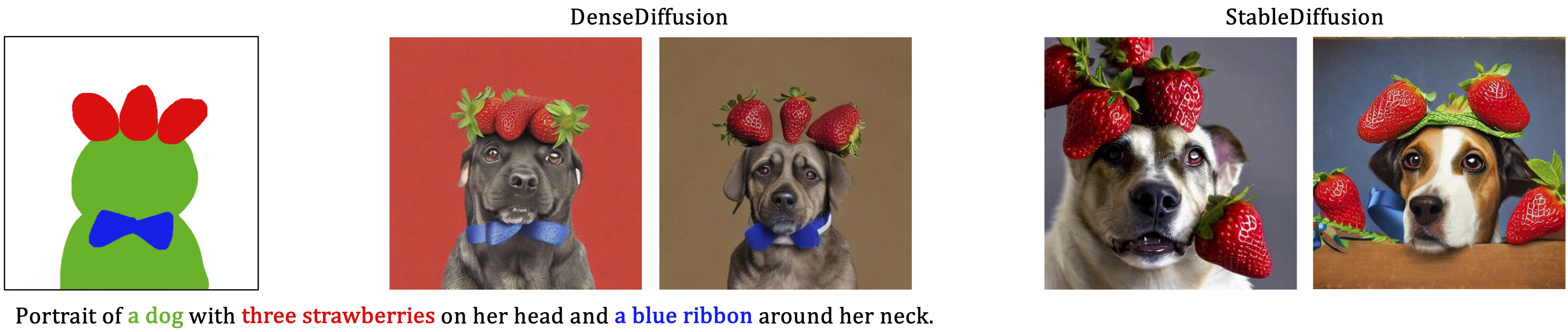
Existing text-to-image diffusion models struggle to synthesize realistic images given dense captions, where each text prompt provides a detailed description for a specific image region. To address this, we propose DenseDiffusion, a training-free method that adapts a pre-trained text-to-image model to handle such dense captions while offering control over the scene layout. We first analyze the relationship between generated images' layouts and the pre-trained model's intermediate attention maps. Next, we develop an attention modulation method that guides objects to appear in specific regions according to layout guidance. Without requiring additional fine-tuning or datasets, we improve image generation performance given dense captions regarding both automatic and human evaluation scores. In addition, we achieve similar-quality visual results with models specifically trained with layout conditions.
Method

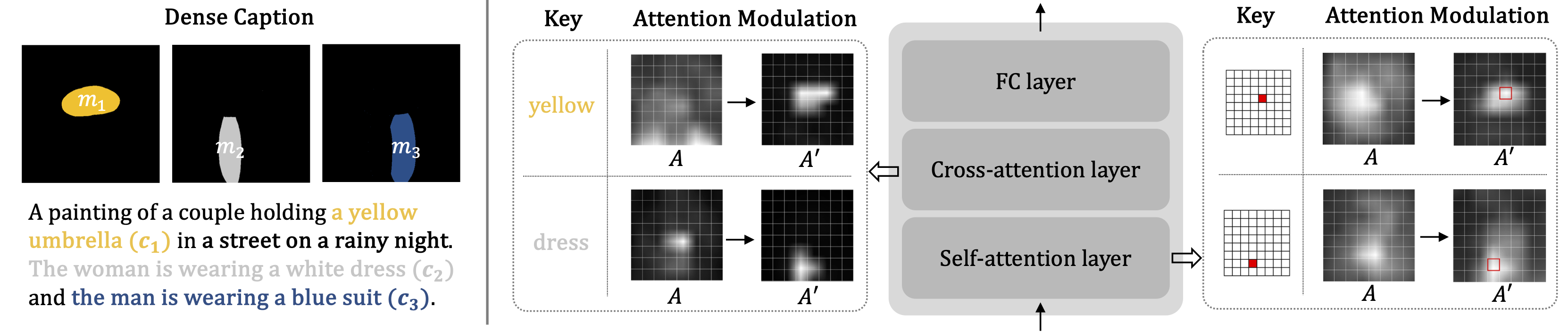
Our goal is to improve the text-to-image model's ability to reflect textual and spatial conditions without fine-tuning. We formally define our condition as a set of $N$ segments ${\lbrace(c_{n},m_{n})\rbrace}^{N}_{n=1}$, where each segment $(c_n,m_n)$ describes a single region. Here $c_n$ is a non-overlapping part of the full-text caption $c$, and $m_n$ denotes a binary map representing each region. Given the input conditions, we modulate attention maps of all attention layers on the fly so that the object described by $c_n$ can be generated in the corresponding region $m_n$. To maintain the pre-trained model's generation capacity, we design the modulation to consider original value range and each segment's area.
Examples
How to launch a web interface
-
Put your access token to Hugging Face Hub here.
-
Run the Gradio app.
python gradio_app.py
Getting Started
-
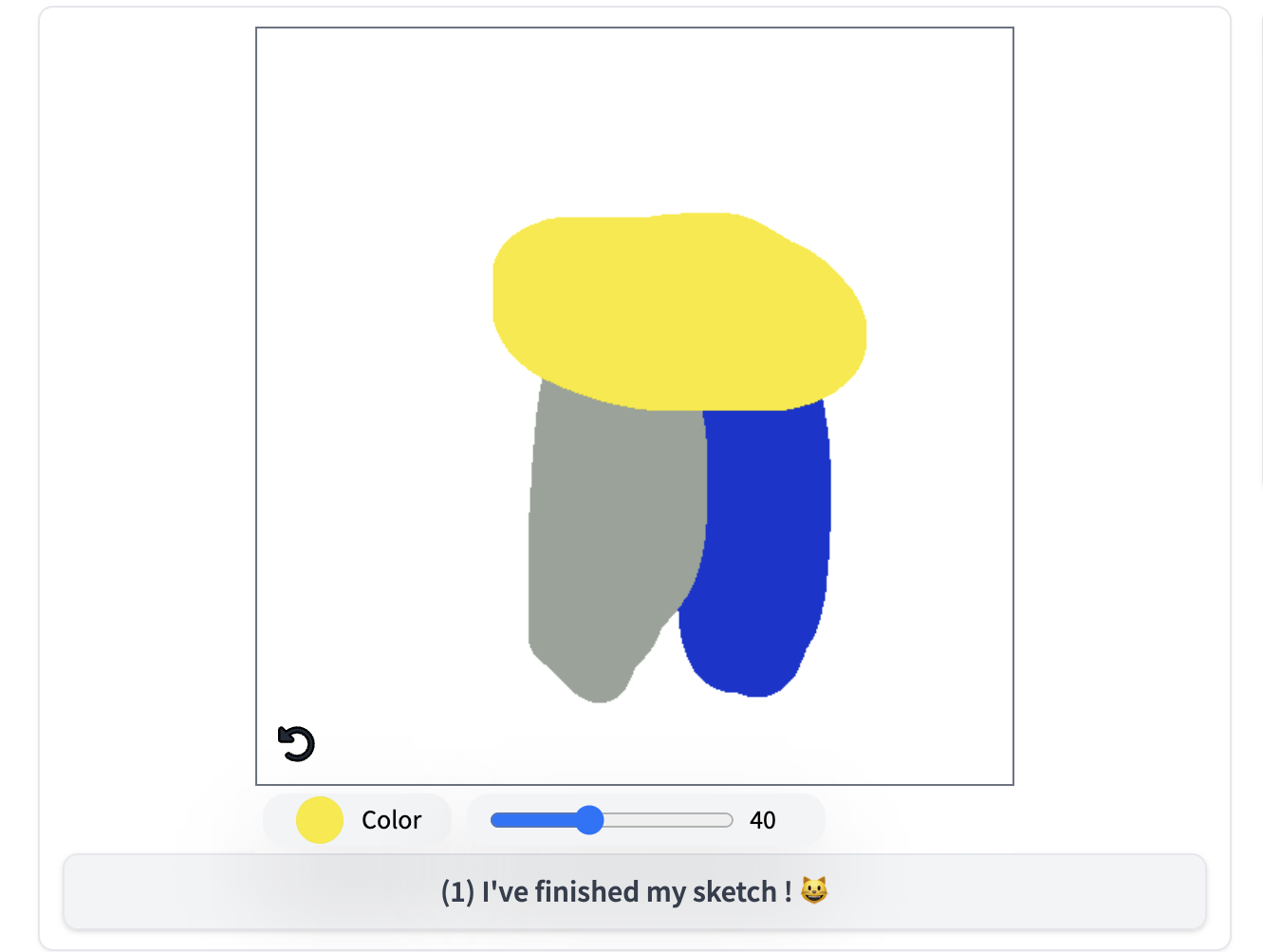
Create the image layout.
-
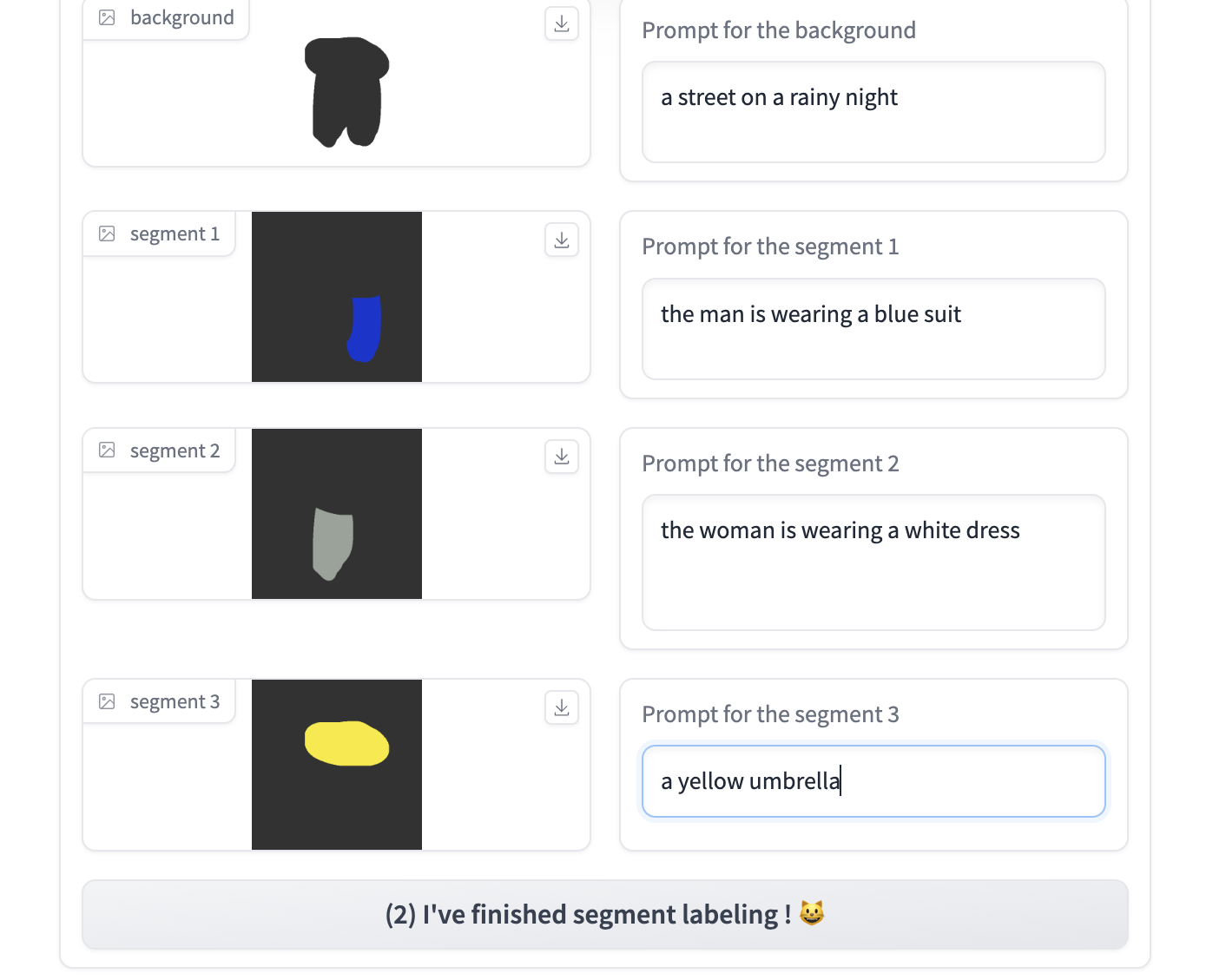
Label each segment with a text prompt.
-
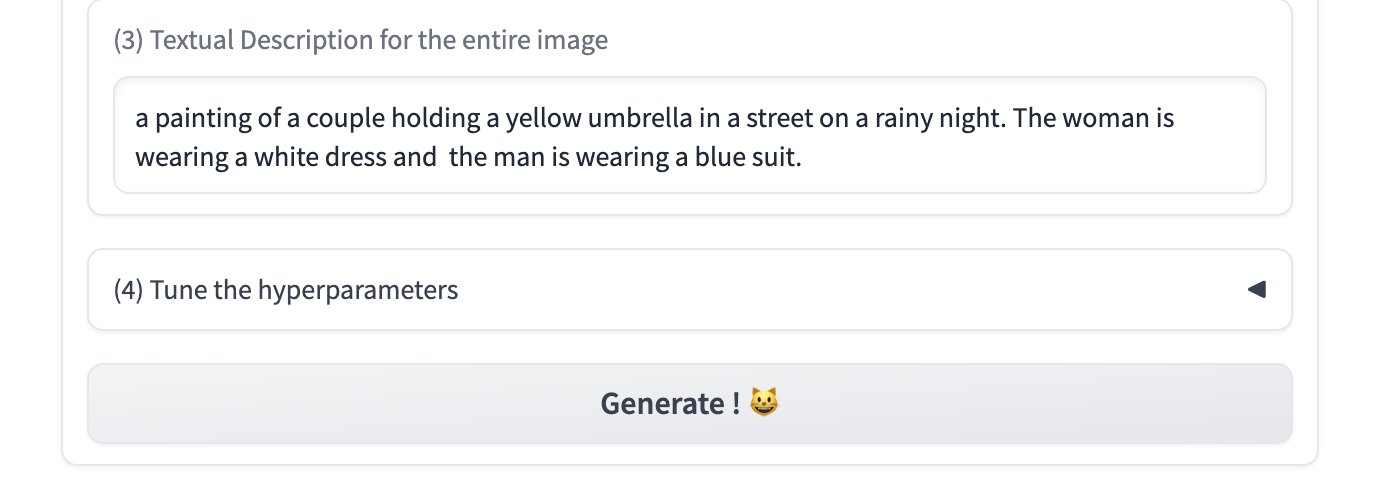
Adjust the full text. The default full text is automatically concatenated from each segment's text. The default one works well, but refineing the full text will further improve the result.

-
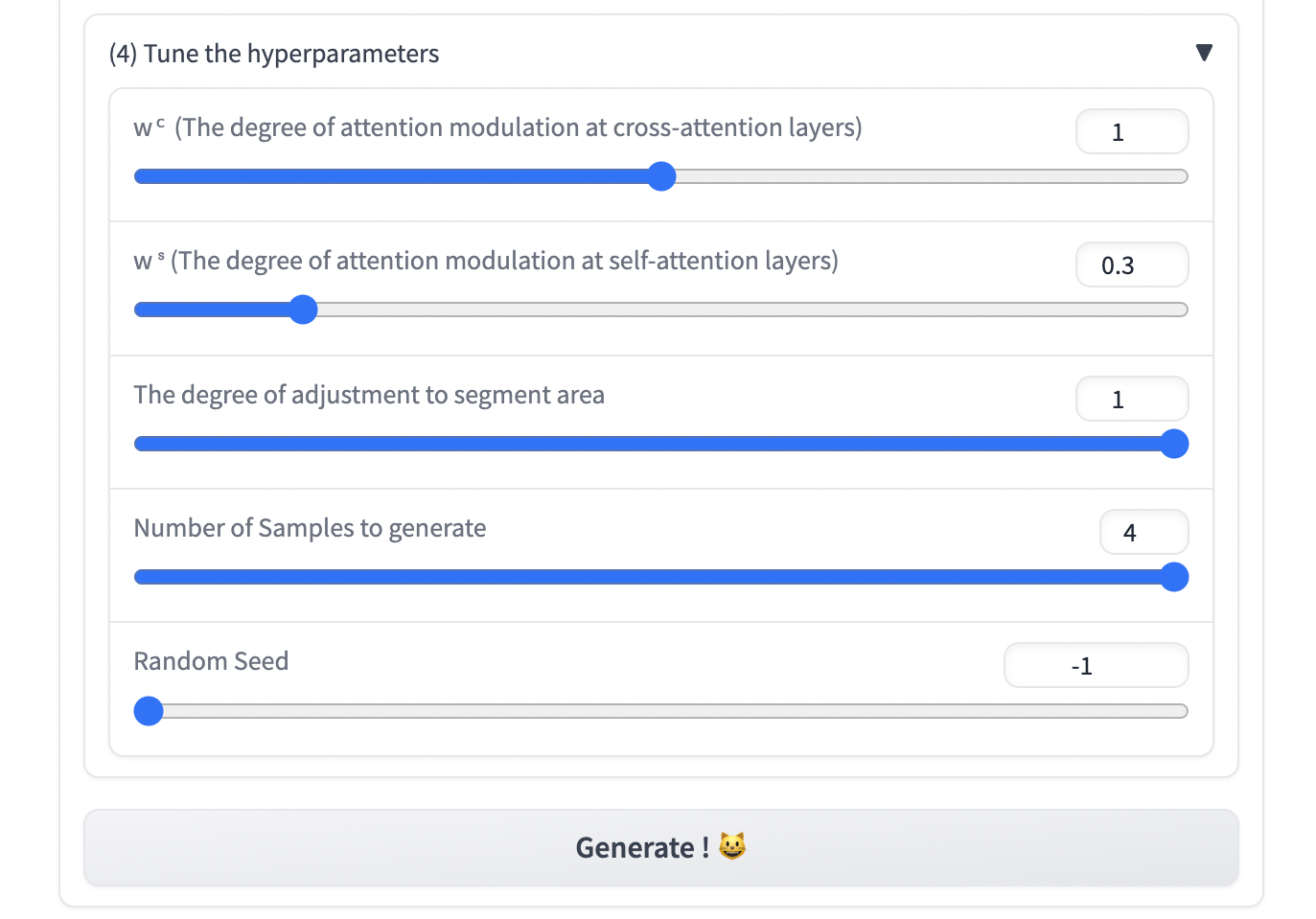
Check the generated images, and tune the hyperparameters if needed.
wc : The degree of attention modulation at cross-attention layers.
ws : The degree of attention modulation at self-attention layers.

Benchmark
We share the benchmark used in our model development and evaluation here. The code for preprocessing segment conditions is in here.
BibTeX
@inproceedings{densediffusion,
  title={Dense Text-to-Image Generation with Attention Modulation},
  author={Kim, Yunji and Lee, Jiyoung and Kim, Jin-Hwa and Ha, Jung-Woo and Zhu, Jun-Yan},
  year={2023},
  booktitle = {ICCV}
}
Acknowledgment
The demo was developed referencing this source code. Thanks for the inspiring work! 🙏