pytorch_forward_forward
Implementation of forward-forward (FF) training algorithm - an alternative to back-propagation
Below is my understanding of the FF algorithm presented at Geoffrey Hinton's talk at NeurIPS 2022.
The conventional backprop computes the gradients by successive applications of the chain rule, from the objective function to the parameters. FF, however, computes the gradients locally with a local objective function, so there is no need to backpropagate the errors.
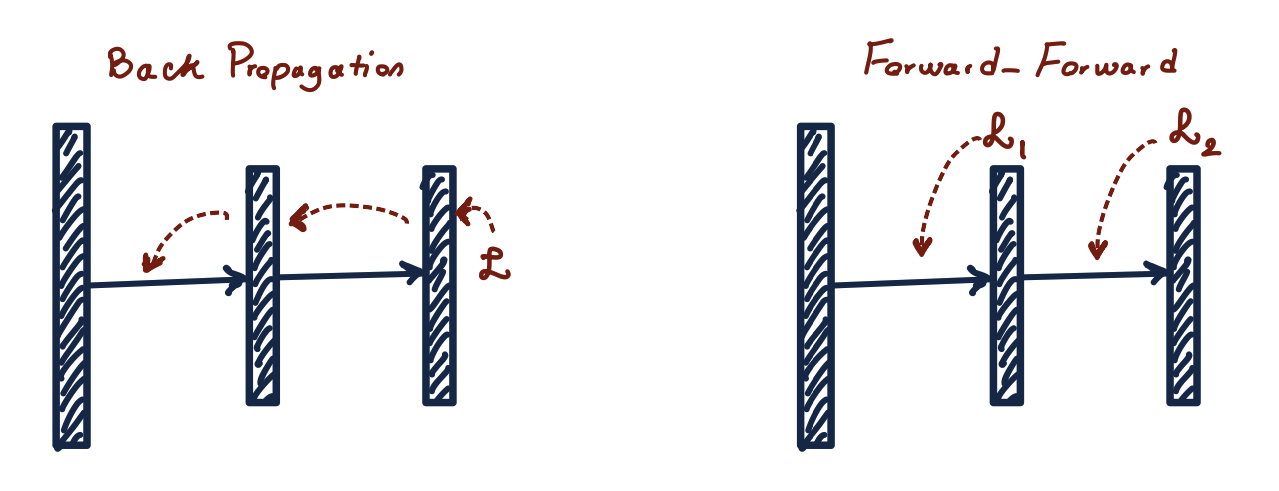
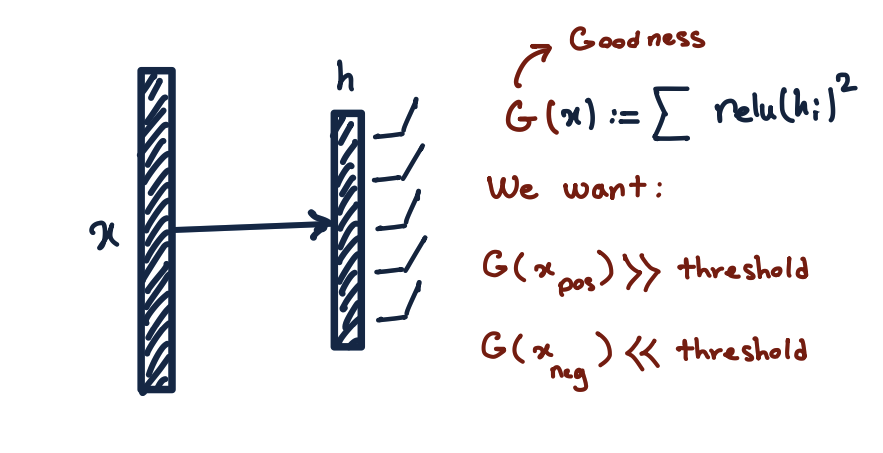
The local objective function is designed to push a layer's output to values larger than a threshold for positive samples and to values smaller than a threshold for negative samples.
A positive sample $s$ is a real datapoint with a large $P(s)$ under the training distribution.
A negative sample $s'$ is a fake datapoint with a small $P(s')$ under the training distribution.
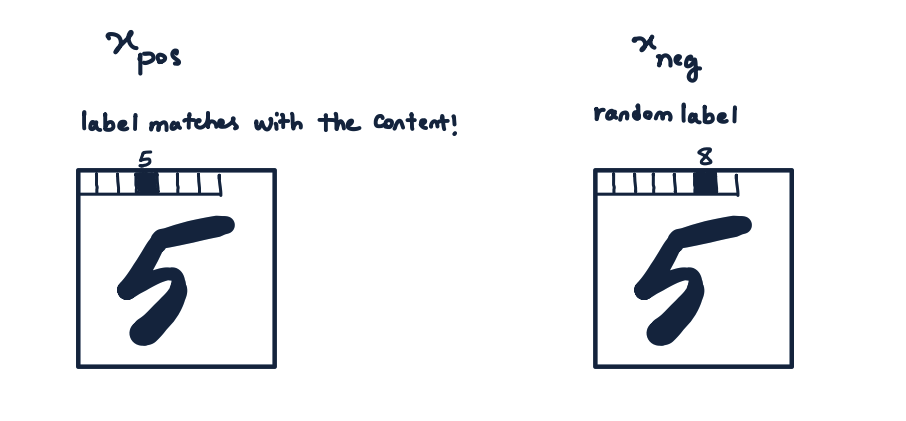
Among the many ways of generating the positive/negative samples, for MNIST, we have:
Positive sample $s = merge(x, y)$, the image and its label
Negative sample $s' = merge(x, y_{random})$, the image and a random label
After training all the layers, to make a prediction for a test image $x$, we find the pair $s = (x, y)$ for all $0 \leq y < 10$ that maximizes the network's overall activation.
With this implementation, the training and test errors on MNIST are:
> python main.py
train error: 0.06754004955291748
test error: 0.06840002536773682