Deep Reinforcement Learning for mobile robot navigation in ROS Gazebo simulator. Using Twin Delayed Deep Deterministic Policy Gradient (TD3) neural network, a robot learns to navigate to a random goal point in a simulated environment while avoiding obstacles.
Artificial Intelligence framework for games based on libGDX or not. Features: Steering Behaviors, Formation Motion, Pathfinding, Behavior Trees and Finite State Machines.
PyTorch Re-Implementation of "The Sparsely-Gated Mixture-of-Experts Layer" by Noam Shazeer et al. https://arxiv.org/abs/1701.06538.
Key parameters and specifications
Key parameters and specifications
Parameter
Value
Language
Python
Category
Model Development
Subcategory
Dataset engineering, Architecture
Keywords
Image production
Stars
1,309
Forks
173
Contributors
4
Created date
2020-06-15
Updated date
2026-10-16
Stars in 1 day
-1
Stars in 7 days
0
Rank
18,895
Previous rank
10,732
Rank change
-8,163
7-day stars rank
12,746
Previous 7-day stars rank
10,010
7-day stars rank change
-2,736
Total stars rank
9,046
Previous total stars rank
9,026
Total stars rank change
-20
Country
USA
README summary
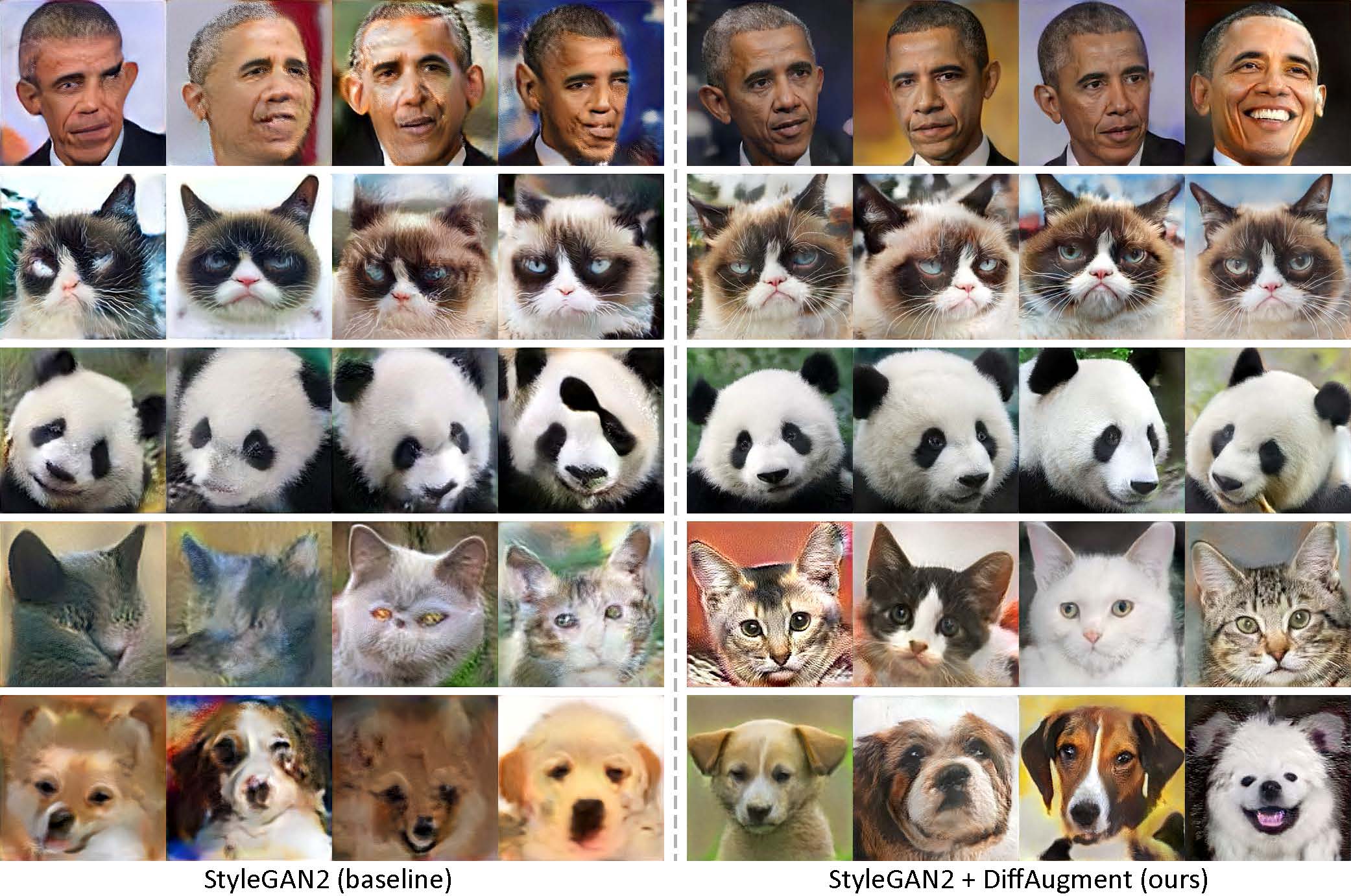
Data-Efficient GANs with DiffAugment project | paper | datasets | video | slides *Generated using only 100 images of Obama, grumpy cats, pandas, the Bridge of Sighs, the Medici Fountain, the Temple of Heaven, without pre-training. ]** PyTorch training with DiffAugment-stylegan2-pytorch is now available! ]** Time to generate 100-shot interpolation videos with generate_gif. ]** Our DiffAugment-biggan-imagenet repo (for TPU training) is released! ]** Our DiffAugment-biggan-cifar PyTorch repo is released! This repository contains our implementation of Differentiable Augmentation (DiffAugment
) in both PyTorch and TensorFlow. It can be used to significantly improve the data efficiency for GAN training. We have provided DiffAugment-stylegan2 (TensorFlow) and DiffAugment-stylegan2-pytorch, DiffAugment-biggan-cifar (PyTorch) for GPU training, and DiffAugment-biggan-imagenet (TensorFlow) for TPU training. *Low-shot generation without pre-training. With DiffAugment, our model can generate high-fidelity images using only 100 Obama portraits, grumpy cats, or pandas from our collected 100-shot datasets, 160 cats or 389 dogs from the
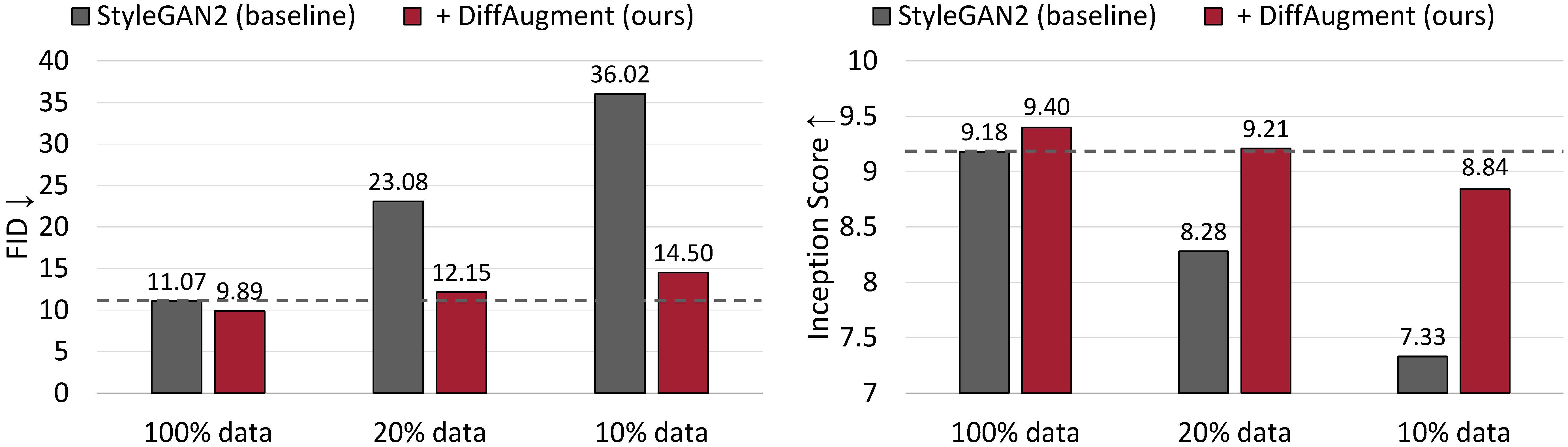
AnimalFace dataset at 256×256 resolution. * *Unconditional generation results on CIFAR-10. StyleGAN2’s performance drastically degrades given less training data. With DiffAugment, we are able to roughly match its FID and outperform its Inception Score (IS) using only **20%** training data. * Differentiable Augmentation for Data-Efficient GAN Training Shengyu Zhao, Zhijian Liu, Ji Lin, Jun-Yan Zhu, and Song Han MIT, Tsinghua University, Adobe Research, CMU arXiv Overview *Overview of DiffAugment for updating D (left) and G (right). DiffAugment
applies the augmentation T to both the real sample x and the generated output G(z). When we update G, gradients need to be back-propagated through T (iii), which requires T to be differentiable w. * To generate an interpolation video using our pre-trained models: or to train a new model: You may also try out , , , , , , or the folder containing your own training images. Please refer to the DiffAugment-stylegan2 README for the dependencies and details. ]** PyTorch training is
now available: DiffAugment for StyleGAN2 To run *StyleGAN2 + DiffAugment* for unconditional generation on the 100-shot datasets, CIFAR, FFHQ, or LSUN, please refer to the DiffAugment-stylegan2 README or DiffAugment-stylegan2-pytorch for the PyTorch version. DiffAugment for BigGAN Please refer to the DiffAugment-biggan-cifar README to run *BigGAN + DiffAugment* for conditional generation on CIFAR (using GPUs), and the DiffAugment-biggan-imagenet README to run on ImageNet (using TPUs). Using DiffAugment for Your Own Training To help you use
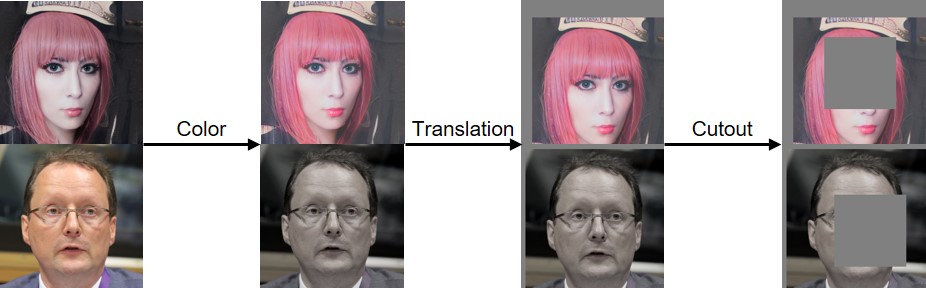
DiffAugment in your own codebase, we provide portable DiffAugment operations of both TensorFlow and PyTorch versions in DiffAugment_tf. Generally, DiffAugment can be easily adopted in any model by substituting every *D(x)* with *D(T(x))*, where *x* can be real images or fake images, *D* is the discriminator, and *T* is the DiffAugment operation. For example, We have implemented Color, Translation, and Cutout DiffAugment as visualized below: Citation If you find this code helpful, please cite our paper
: Acknowledgements We thank NSF Career Award #1943349, MIT-IBM Watson AI Lab, Google, Adobe, and Sony for supporting this research.
Frequently asked questions
How many stars and forks are recorded?
mit-han-lab/data-efficient-gans has 1,309 stars and 173 forks.
What is the repository rank?
mit-han-lab/data-efficient-gans is ranked 18,895.
What language and category are recorded?
mit-han-lab/data-efficient-gans has 1,309 stars, uses Python and belongs to Model Development.
Which repository is closest in rank?
mit-han-lab/data-efficient-gans is compared with Alibaba-NLP/ZeroSearch, ranked 18,894 with 1,311 stars.
Low-shot generation without pre-training. With DiffAugment, our model can generate high-fidelity images using only 100 Obama portraits, grumpy cats, or pandas from our collected 100-shot datasets, 160 cats or 389 dogs from the AnimalFace dataset at 256×256 resolution.
Unconditional generation results on CIFAR-10. StyleGAN2’s performance drastically degrades given less training data. With DiffAugment, we are able to roughly match its FID and outperform its Inception Score (IS) using only 20% training data.
Differentiable Augmentation for Data-Efficient GAN Training
Overview of DiffAugment for updating D (left) and G (right). DiffAugment applies the augmentation T to both the real sample x and the generated output G(z). When we update G, gradients need to be back-propagated through T (iii), which requires T to be differentiable w.r.t. the input.
Training and Generation with 100 Images
To generate an interpolation video using our pre-trained models:
cd DiffAugment-stylegan2
python generate_gif.py -r mit-han-lab:DiffAugment-stylegan2-100-shot-obama.pkl -o obama.gif
You may also try out 100-shot-grumpy_cat, 100-shot-panda, 100-shot-bridge_of_sighs, 100-shot-medici_fountain, 100-shot-temple_of_heaven, 100-shot-wuzhen, or the folder containing your own training images. Please refer to the DiffAugment-stylegan2 README for the dependencies and details.
[NEW!] PyTorch training is now available:
cd DiffAugment-stylegan2-pytorch
python train.py --outdir=training-runs --data=https://data-efficient-gans.mit.edu/datasets/100-shot-obama.zip --gpus=1
DiffAugment for StyleGAN2
To run StyleGAN2 + DiffAugment for unconditional generation on the 100-shot datasets, CIFAR, FFHQ, or LSUN, please refer to the DiffAugment-stylegan2 README or DiffAugment-stylegan2-pytorch for the PyTorch version.
DiffAugment for BigGAN
Please refer to the DiffAugment-biggan-cifar README to run BigGAN + DiffAugment for conditional generation on CIFAR (using GPUs), and the DiffAugment-biggan-imagenet README to run on ImageNet (using TPUs).
Using DiffAugment for Your Own Training
To help you use DiffAugment in your own codebase, we provide portable DiffAugment operations of both TensorFlow and PyTorch versions in DiffAugment_tf.py and DiffAugment_pytorch.py. Generally, DiffAugment can be easily adopted in any model by substituting every D(x) with D(T(x)), where x can be real images or fake images, D is the discriminator, and T is the DiffAugment operation. For example,
from DiffAugment_pytorch import DiffAugment
# from DiffAugment_tf import DiffAugment
policy = 'color,translation,cutout' # If your dataset is as small as ours (e.g.,
# hundreds of images), we recommend using the strongest Color + Translation + Cutout.
# For large datasets, try using a subset of transformations in ['color', 'translation', 'cutout'].
# Welcome to discover more DiffAugment transformations!

...
# Training loop: update D
reals = sample_real_images() # a batch of real images
z = sample_latent_vectors()
fakes = Generator(z) # a batch of fake images
real_scores = Discriminator(DiffAugment(reals, policy=policy))
fake_scores = Discriminator(DiffAugment(fakes, policy=policy))
# Calculating D's loss based on real_scores and fake_scores...
...

...
# Training loop: update G
z = sample_latent_vectors()
fakes = Generator(z) # a batch of fake images
fake_scores = Discriminator(DiffAugment(fakes, policy=policy))
# Calculating G's loss based on fake_scores...
...
We have implemented Color, Translation, and Cutout DiffAugment as visualized below:
Citation
If you find this code helpful, please cite our paper:
@inproceedings{zhao2020diffaugment,
  title={Differentiable Augmentation for Data-Efficient GAN Training},
  author={Zhao, Shengyu and Liu, Zhijian and Lin, Ji and Zhu, Jun-Yan and Han, Song},
  booktitle={Conference on Neural Information Processing Systems (NeurIPS)},
  year={2020}
}
Acknowledgements
We thank NSF Career Award #1943349, MIT-IBM Watson AI Lab, Google, Adobe, and Sony for supporting this research. Research supported with Cloud TPUs from Google's TensorFlow Research Cloud (TFRC). We thank William S. Peebles and Yijun Li for helpful comments.