
Pluggable Python and C++ multi-object tracking modules for axis-aligned and oriented bounding box detections from any model.





Docs • Installation • Modes • API Reference • Trackers • Contributing
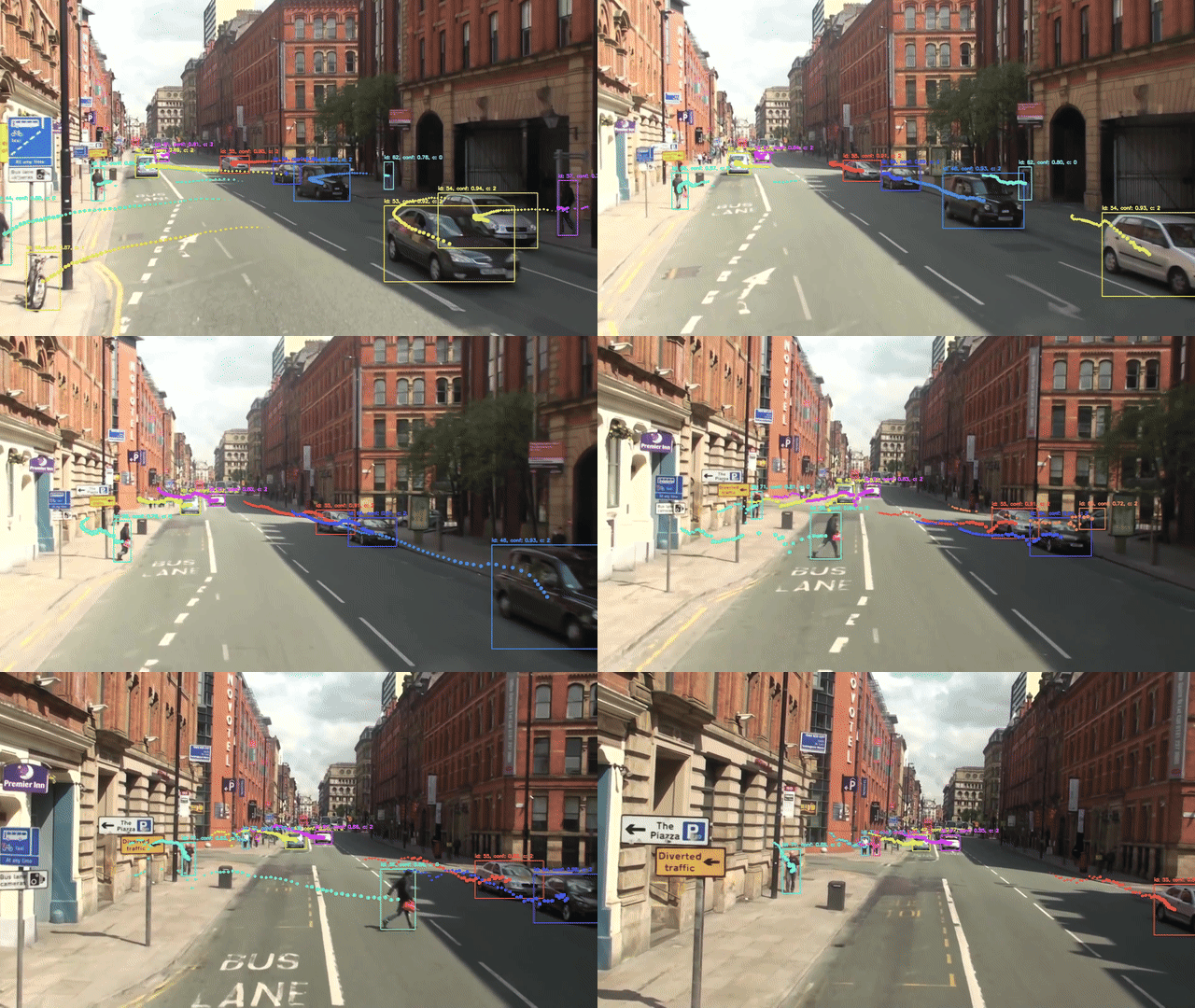
BoxMOT provides independent detector, segmentor, appearance-encoder, and tracker components built around validated Torch structures. Pipelines compose those components; the CLI owns sources, outputs, materialized datasets, evaluation, tuning, research, and ReID workflows.
Why BoxMOT
- One interface for
track,materialize,materialize --time-variant,eval,tune,research,train-reid,eval-reid,compare-reid,export,export-edgetam,install, and nativebuildworkflows. - Swappable components with explicit capabilities and requirements.
- Immutable, keyed Parquet builds with reusable detections, masks, and embeddings.
- Support for both AABB and OBB tracking paths.
- Optional production-ready native C++ tracker implementations with the same metrics as the Python path, opted into via
--tracker-backend cppand embeddable in standalone C++ projects via CMake (see Native C++ Integration). - A structured Python API for embedding components and pipelines in applications.
Installation
BoxMOT supports Python 3.10 through 3.13.
pip install boxmot
boxmot --help
The default package uses the standard PyPI PyTorch build. Source checkouts and
CI can explicitly select the lockfile-backed cpu or cu130 profile. For
those profiles and mode-specific extras such as yolo, service, evolve,
research, onnx, openvino, and tflite, see the
installation guide.
Benchmark Results
Tracker key
Status
MOT17 ablation
SportsMOT val
MMOT OBB test
OBB
HOTA
MOTA
IDF1
HOTA
MOTA
IDF1
HOTA
MOTA
IDF1
occluboost
✅
71.10
(71.10)
78.50
(78.50)
85.28
(85.28)
83.17
97.48
89.36
49.84
(49.84)
39.41
(39.41)
58.60
(58.60)
✅
✅
69.68
(69.74)
78.23
(78.27)
82.33
(82.55)
76.93
98.11
78.30
52.31
(52.40)
45.43
(45.53)
61.42
(61.42)
✅
✅
69.25
(—)
75.91
(—)
83.20
(—)
76.32
97.08
77.82
48.39
(—)
41.36
(—)
56.36
(—)
✅
✅
68.05
(—)
76.19
(—)
80.76
(—)
79.80
97.31
80.27
49.76
(—)
43.70
(—)
57.32
(—)
✅
✅
67.95
(—)
75.83
(—)
80.54
(—)
79.51
97.94
79.59
50.84
(—)
44.21
(—)
59.33
(—)
✅
✅
67.68
(67.68)
78.04
(78.04)
79.16
(79.16)
67.93
97.25
76.90
33.97
(33.97)
33.72
(33.72)
39.74
(39.74)
✅
✅
67.31
(—)
74.09
(—)
78.87
(—)
81.14
98.07
81.88
54.64
(—)
47.50
(—)
64.67
(—)
✅
✅
66.44
(66.44)
74.55
(74.55)
77.90
(77.90)
76.34
96.60
75.64
28.64
(28.64)
26.17
(26.17)
30.06
(30.06)
✅
✅
62.65
(62.65)
76.87
(76.87)
69.18
(69.18)
75.73
98.39
72.99
47.83
(47.83)
45.42
(45.42)
52.09
(52.09)
✅
Scores are Python first and C++ in parentheses.
MMOT reported metrics are 'class average'. See Experiment Workflows for details.
Related guides:
Minimal Usage
CLI:
boxmot track --detector yolo26n --reid lmbn_n_duke --tracker occluboost \
  --source 0 --save --show
Evaluate a tracker:
boxmot eval \
  --dataset mot17 \
  --split ablation \
  --detector yolox-x-mot17 \
  --reid lmbn-n-duke \
  --tracker botsort
See the evaluation guide for --fps and
--calibrate-kf usage.
For saved KITTI predictions, choose the inputs your tracker needs:
boxmot eval --experiment kitti-mots/2d \
  --data-root ./kitti-mots --tracker ocsort --cache-inputs
boxmot eval --experiment kitti-mots/full \
  --data-root ./kitti-mots --tracker eagermot --cache-inputs
Both experiments reference the same kitti-mots.yaml inventory. The first
selects 2D boxes; the second adds masks, 3D boxes,
calibration, and camera poses. See KITTI experiments.
Use NumPy detections and BGR images directly:
import numpy as np

from boxmot import OccluBoost

tracker = OccluBoost()
dets = np.array([[100, 200, 300, 400, 0.9, 0]])
frame = np.zeros((480, 640, 3), dtype=np.uint8)  # BGR image
tracks = tracker.update(dets, frame)
print(tracks[:, 4].astype(int))  # track IDs

# OBB: (cx, cy, w, h, angle in radians, confidence, class_id)
# tracker = OccluBoost(is_obb=True)
# dets = np.array([[200, 300, 200, 100, np.pi / 6, 0.9, 0]])
# tracks = tracker.update(dets, frame)
# print(tracks[:, 5].astype(int))  # track IDs
Contributing
Start with CONTRIBUTING.md and the contributor docs.
Contributors
Support and Citation
- Bugs and feature requests: GitHub Issues
- Questions and discussion: GitHub Discussions or Discord
- Limited free consulting is available for nonprofit nature conservation projects using BoxMOT. Contact
box-mot@outlook.comto discuss your project. - Citation metadata: CITATION.cff
- Commercial support:
box-mot@outlook.com