AlpaSim is an open-source autonomous vehicle simulation platform designed for development and testing of end-to-end AV policies.
Key parameters and specifications
Key parameters and specifications
Parameter
Value
Language
Python
Category
Model Development
Subcategory
Architecture
Stars
1,272
Forks
220
Contributors
5
Created date
2017-09-30
Updated date
2026-09-29
Stars in 1 day
0
Stars in 7 days
0
Rank
10,880
Previous rank
10,850
Rank change
-30
7-day stars rank
12,804
Previous 7-day stars rank
12,827
7-day stars rank change
23
Total stars rank
9,240
Previous total stars rank
9,229
Total stars rank change
-11
Country
France
README summary
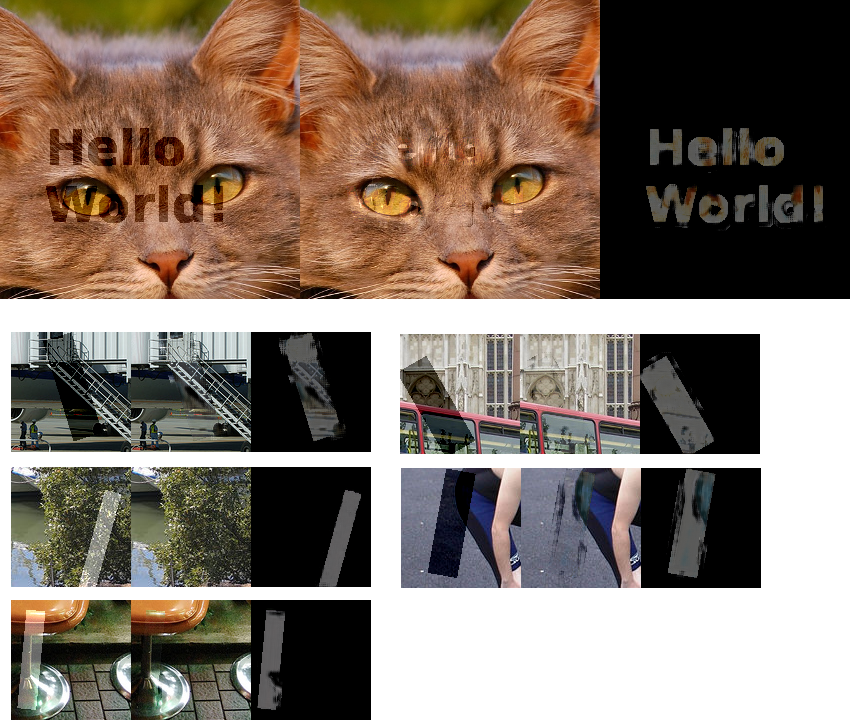
** The architecture used in this project **does not generalize well**. You may want to check ** This inpainting technique will likely give you better results. Fully convolutional watermark removal attack Deep learning architecture to remove transparent overlays from images. ***Top:** left is with watermark, middle is reconstruction and right is the mask the algo predicts (the neural net was never trained using text or this image)* ***Bottom:** Pascal dataset image reconstructions. When the watermarked area is saturated, the reconstruction tends to
produce a gray color. * Design choices At train time, I generate a mask. It is a rectangle with randomly generated parameters (height, width, opacity, black/white, rotation). The mask is applied to a picture and the network is trained to find what was added. The loss is abs(prediction, image_perturbations)**1/2. An area around the mask is used to make the problem more tractable. The network architecture does not down-sample the image. The prediction with a down
-sampling network were not accurate enough. To have a large enough receptive field and not blow up the compute, I use dilated convolution. So concretely, I have a densenet style block, a bunch of dilated convolutions and final convolution to output a picture (3 channels). I did not spend much time doing hyper-parameters optimization. There's room to get better results using the current architecture. Limitations: this architectures does not generalize to watermarks that are too different from the one
generated with and it produces decent results only when the overlay is applied in an additive fashion. Install packages with You will need the jpeg library to compile Pillow from source: You will also need to **download the pascal dataset** (used by default) from or CIFAR10 python version from (use flag ). Make sure the extract the pascal dataset under a directory called . The project directory should then have the directory and/or . If you want to use your own images
, place them in . It starts to produce some interesting results after 12000 steps. To use the network for inference, you can run this will create a new image . Pretrained weights Here you can find the weights: put them in /tmp/
Frequently asked questions
How many stars and forks are recorded?
marcbelmont/cnn-watermark-removal has 1,272 stars and 220 forks.
What is the repository rank?
marcbelmont/cnn-watermark-removal is ranked 10,880.
What language and category are recorded?
marcbelmont/cnn-watermark-removal has 1,272 stars, uses Python and belongs to Model Development.
Which repository is closest in rank?
marcbelmont/cnn-watermark-removal is compared with luo3300612/Visualizer, ranked 10,879 with 1,272 stars.
README
Warning! The architecture used in this project does not generalize well. You may want to check https://dmitryulyanov.github.io/deep_image_prior. This inpainting technique will likely give you better results.
Fully convolutional watermark removal attack
Deep learning architecture to remove transparent overlays from images.
Top: left is with watermark, middle is reconstruction and right is the mask the algo predicts (the neural net was never trained using text or this image)
Bottom: Pascal dataset image reconstructions. When the watermarked area is saturated, the reconstruction tends to produce a gray color.
Design choices
At train time, I generate a mask. It is a rectangle with randomly generated parameters (height, width, opacity, black/white, rotation). The mask is applied to a picture and the network is trained to find what was added. The loss is abs(prediction, image_perturbations)**1/2. It is not on the entire picture. An area around the mask is used to make the problem more tractable.
The network architecture does not down-sample the image. The prediction with a down-sampling network were not accurate enough. To have a large enough receptive field and not blow up the compute, I use dilated convolution. So concretely, I have a densenet style block, a bunch of dilated convolutions and final convolution to output a picture (3 channels). I did not spend much time doing hyper-parameters optimization. There's room to get better results using the current architecture.
Limitations: this architectures does not generalize to watermarks that are too different from the one generated with create_mask and it produces decent results only when the overlay is applied in an additive fashion.
Usage
This project uses Tensorflow. Install packages withpip install -r requirements.txt
You will need the jpeg library to compile Pillow from source: sudo apt-get install libjpeg-dev zlib1g-dev
You will also need to download the pascal dataset (used by default) from http://host.robots.ox.ac.uk/pascal/VOC/voc2012/ or CIFAR10 python version from https://www.cs.toronto.edu/~kriz/cifar.html (use flag --dataset=dataset_cifar). Make sure the extract the pascal dataset under a directory called data. The project directory should then have the directory cifar-10-batches-py and/or data/VOCdevkit/VOC2012/JPEGImages. If you want to use your own images, place them in data/VOCdevkit/VOC2012/JPEGImages/.
To train the network python3 watermarks.py --logdir=save/. It starts to produce some interesting results after 12000 steps.
To use the network for inference, you can run python watermarks.py --image assets/cat.png --selection assets/cat-selection.png this will create a new image output.png.