Diffusion Convolutional Recurrent Neural Network: Data-Driven Traffic Forecasting
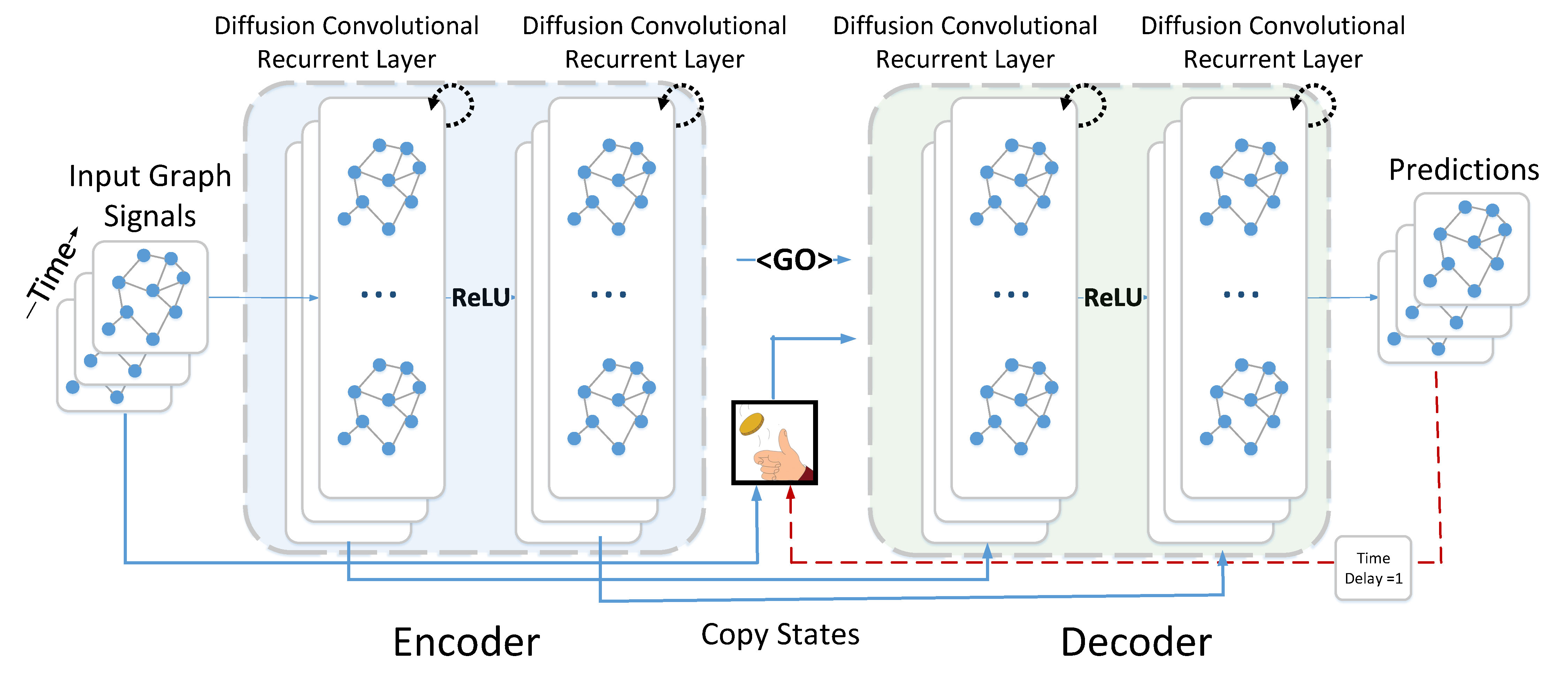
This is a TensorFlow implementation of Diffusion Convolutional Recurrent Neural Network in the following paper:
Yaguang Li, Rose Yu, Cyrus Shahabi, Yan Liu, Diffusion Convolutional Recurrent Neural Network: Data-Driven Traffic Forecasting, ICLR 2018.
Requirements
- scipy>=0.19.0
- numpy>=1.12.1
- pandas>=0.19.2
- pyaml
- statsmodels
- tensorflow>=1.3.0
Dependency can be installed using the following command:
pip install -r requirements.txt
Environment update
You can install the environment using conda.
1. Create an environment to install dcrnn
a. GPU
conda env create -f env.gpu.yml
b. CPU
conda env create -f env.cpu.yml
2. Activate the environment
conda activate dcrnn
Data Preparation
The traffic data files for Los Angeles (METR-LA) and the Bay Area (PEMS-BAY), i.e., metr-la.h5 and pems-bay.h5, are available at Google Drive or Baidu Yun, and should be
put into the data/ folder.
The *.h5 files store the data in panads.DataFrame using the HDF5 file format. Here is an example:
| sensor_0 | sensor_1 | sensor_2 | sensor_n | |
|---|---|---|---|---|
| 2018/01/01 00:00:00 | 60.0 | 65.0 | 70.0 | ... |
| 2018/01/01 00:05:00 | 61.0 | 64.0 | 65.0 | ... |
| 2018/01/01 00:10:00 | 63.0 | 65.0 | 60.0 | ... |
| ... | ... | ... | ... | ... |
Here is an article about Using HDF5 with Python.
Run the following commands to generate train/test/val dataset at data/{METR-LA,PEMS-BAY}/{train,val,test}.npz.
# Create data directories
mkdir -p data/{METR-LA,PEMS-BAY}

# METR-LA
python -m scripts.generate_training_data --output_dir=data/METR-LA --traffic_df_filename=data/metr-la.h5

# PEMS-BAY
python -m scripts.generate_training_data --output_dir=data/PEMS-BAY --traffic_df_filename=data/pems-bay.h5
Graph Construction
As the currently implementation is based on pre-calculated road network distances between sensors, it currently only
supports sensor ids in Los Angeles (see data/sensor_graph/sensor_info_201206.csv).
python -m scripts.gen_adj_mx  --sensor_ids_filename=data/sensor_graph/graph_sensor_ids.txt --normalized_k=0.1\
    --output_pkl_filename=data/sensor_graph/adj_mx.pkl
Besides, the locations of sensors in Los Angeles, i.e., METR-LA, are available at data/sensor_graph/graph_sensor_locations.csv, and the locations of sensors in PEMS-BAY are available at data/sensor_graph/graph_sensor_locations_bay.csv.
Run the Pre-trained Model on METR-LA
# METR-LA
python run_demo.py --config_filename=data/model/pretrained/METR-LA/config.yaml

# PEMS-BAY
python run_demo.py --config_filename=data/model/pretrained/PEMS-BAY/config.yaml
The generated prediction of DCRNN is in data/results/dcrnn_predictions.
Model Training
Here are commands for training the model on METR-LA and PEMS-BAY respectively.
# METR-LA
python dcrnn_train.py --config_filename=data/model/dcrnn_la.yaml

# PEMS-BAY
python dcrnn_train.py --config_filename=data/model/dcrnn_bay.yaml
Training details and tensorboard links
With a single GTX 1080 Ti, each epoch takes around 5min for METR-LA, and 13 min for PEMS-BAY respectively. Here are example tensorboard links for DCRNN on METR-LA, DCRNN on PEMS-BAY, including training details and metrics over time.
Note that, there is a chance of training loss explosion, one temporary workaround is to restart from the last saved model before the explosion, or to decrease the learning rate earlier in the learning rate schedule.
Metric for different horizons and datasets
The following table summarizes the performance of DCRNN on two dataset with regards to different metrics and horizons (numbers are better than those reported in the paper due to bug fix in commit 2e4b8c8 on Oct 1, 2018).
| Dataset | Metric | 5min | 15min | 30min | 60min |
|---|---|---|---|---|---|
| METR-LA | MAE | 2.18 | 2.67 | 3.08 | 3.56 |
| MAPE | 5.17% | 6.84% | 8.38% | 10.30% | |
| RMSE | 3.77 | 5.17 | 6.3 | 7.52 | |
| PEMS-BAY | MAE | 0.85 | 1.31 | 1.66 | 1.98 |
| MAPE | 1.63% | 2.74% | 3.76% | 4.74% | |
| RMSE | 1.54 | 2.76 | 3.78 | 4.62 |
Eval baseline methods
# METR-LA
python -m scripts.eval_baseline_methods --traffic_reading_filename=data/metr-la.h5
More details are being added ...
Deploying DCRNN on Large Graphs with graph partitioning
With graph partitioning, DCRNN has been successfully deployed to forecast the traffic of the entire California highway network with 11,160 traffic sensor locations simultaneously. The general idea is to partition the large highway network into a number of small networks, and trained them with a share-weight DCRNN simultaneously. The training process takes around 3 hours in a moderately sized GPU cluster, and the real-time inference can be run on traditional hardware such as CPUs.
See the paper, slides, and video by Tanwi Mallick et al. from Argonne National Laboratory for more information.
DCRNN Applications
In addition to vehicle traffic forecasting, DCRNN and its variants have been applied in many important domains, including:
- Neuroimaging: causal inference in brain networks. S. Wein et al. A graph neural network framework for causal inference in brain networks. Scientific Reports, 2021, GitHub Repo.
- Air quality forecasting: Y Lin et al. Exploiting spatiotemporal patterns for accurate air quality forecasting using deep learning. ACM SIGSPATIAL 2018.
- Internet traffic forecasting: D. Andreoletti et al. Network traffic prediction based on diffusion convolutional recurrent neural networks, INFOCOM 2019.
Third-party re-implementations
The Pytorch implementaion by chnsh@ is available at DCRNN-Pytorch.
Citation
If you find this repository, e.g., the code and the datasets, useful in your research, please cite the following paper:
@inproceedings{li2018dcrnn_traffic,
  title={Diffusion Convolutional Recurrent Neural Network: Data-Driven Traffic Forecasting},
  author={Li, Yaguang and Yu, Rose and Shahabi, Cyrus and Liu, Yan},
  booktitle={International Conference on Learning Representations (ICLR '18)},
  year={2018}
}