 TorchLens


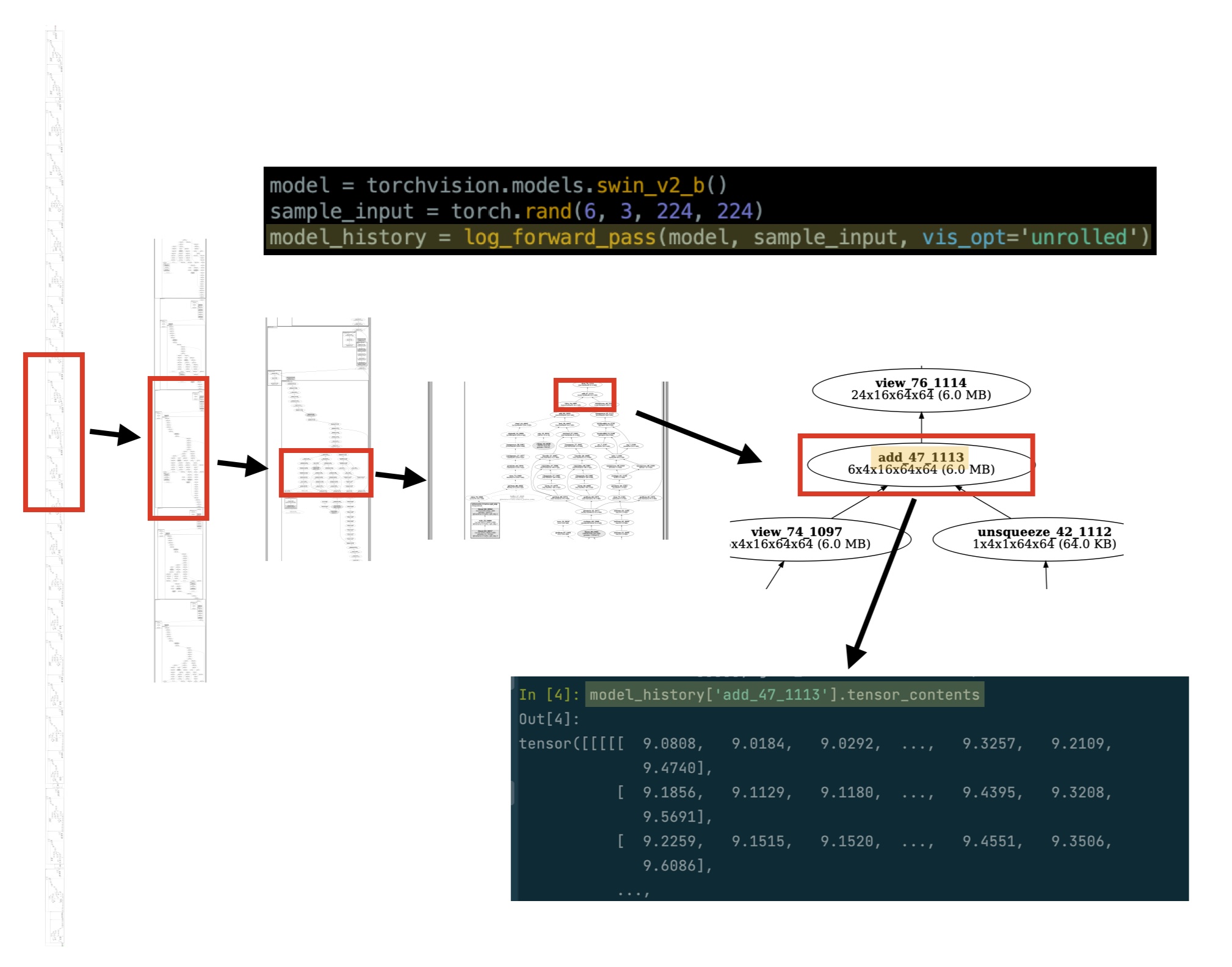
See, save, and steer any PyTorch model. TorchLens captures every activation and gradient -- across the forward and backward pass -- auto-visualizes the full computational graph, exposes rich per-op metadata, and lets you intervene on the network as it runs. Any architecture, even dynamic and recurrent ones.
Explore the Model Menagerie -- a live, browsable atlas of thousands of cataloged neural-network architecture entries (8,500+ catalog entries across ~3,600 architecture families, measured 2026-08-16) captured with TorchLens, from McCulloch & Pitts (1943) to today's frontier models. (Early preview.)
Run across thousands of cataloged entries in the Model Menagerie (image, video, audio, multimodal, language; feedforward, recurrent, transformer, GNN, MoE, diffusion) -- verified on thousands of models across all major architecture families: each verified capture is replayed op-by-op against its own forward pass, with metadata-invariant tripwires over the graph, so faithful capture is proven, not assumed. TorchLens also records 180+ metadata fields per operation, and 550+ fields in total across every record type — operations, modules, parameters, buffers, gradients, and the model itself.
import torch, torchvision.models as models, torchlens as tl

model = models.resnet18(weights="IMAGENET1K_V1").eval()  # .eval(): pretrained models arrive
# in train mode, and a train-mode forward silently updates BatchNorm running statistics
x = torch.rand(1, 3, 224, 224, generator=torch.Generator().manual_seed(0))

log = tl.trace(model, x)      # one call -- full graph + all activations
print(log.summary())          # module table, op count, FLOPs
print(log["conv2d_1_1"].out.shape)  # grab any activation by name ...
print(log["layer1.0"].out.shape)    # ... or by module path
print(log[7].func_name)             # ... or by ordinal
log.draw()                    # PDF of the computational graph
Every verb climbs the same three-rung input ladder (full guide):
# API sketch; `model` is your model and `lm` any HuggingFace language model.
log = tl.trace(model, x)                             # best: your real input
log = tl.trace(model, input_size=(1, 3, 224, 224))   # your shape, random values; disclosed
log = tl.trace(model)                                # inferred shape + random values; disclosed, or a teach
log = tl.trace(lm, "The quick brown fox")            # HF models: a string is a real input
Quick Links
- Paper | 10-minute tutorial notebook | Facets tutorial | 5-minute gallery | 50-minute gallery
- Performance guide | Receptive & projective fields | AI-agent quick reference | Limitations and remedies | Migration tables
Validated across thousands of catalog entries
TorchLens is not just smoke-tested on example models. The Model Menagerie validation campaign runs the same adversarial check across the cataloged architecture entries (8,500+ rows across ~3,600 families in the menagerie catalog, measured 2026-08-16; the live site carries additional locally-validated entries): capture the model with TorchLens, forward-replay the captured DAG, compare replayed outputs against the original forward pass, and run metadata-invariant tripwires over the resulting graph. If replay or an invariant fails, the capture is treated as genuinely wrong and caught automatically, not waved through because the model "ran."
model forward -> TorchLens capture -> DAG replay -> output parity + metadata invariants
Today the campaign has algorithmically verified thousands of models across all major
architecture families, and the count is climbing; the exact per-row verification status
lives in the menagerie project's append-only ledger rather than in this README, so the public
claim stays hedged until the campaign closes. Inside this repository, a coverage-chosen sample of
the hand-built classics (tests/classics_corpus/) runs the same capture, replay, and invariant
checks as part of the test suite. That is the wedge:
TorchLens aims for captures that are provably faithful, not just plausible.
Plain forward hooks and static extraction utilities can be fast and useful, but
they can also silently miss dynamic paths, reused modules, functional ops,
fused attention, recurrent unrolls, or metadata needed to tell two sites apart.
The residual is tracked openly: the remaining tail is mostly genuinely huge models, models with hard-to-build dependencies, or architectures that need more bespoke inputs before an automated run is fair. They are counted as unverified, not hidden as successes.
Installation
Install Graphviz first (required for graph visualizations), then TorchLens:
sudo apt install graphviz   # Debian/Ubuntu; see graphviz.org for other platforms
pip install torchlens
Supported versions (each row below is executed by a CI leg on every release, not asserted from metadata; the full platform statement is in docs/reference/limitations.md):
| Component | Supported | How it is verified |
|---|---|---|
| Python | 3.10, 3.11, 3.12, 3.13 | one smoke-tier CI row per interpreter, plus clean-venv wheel installs at release |
| PyTorch | 2.1+ on Python 3.10/3.11; 2.2+ on 3.12; 2.6+ on 3.13 (the first torch with wheels for each interpreter) | floor rows pin the exact floor pair per interpreter; newest-admitted rows pin the current release; a daily canary runs latest |
transformers (torchlens[hf]) |
Policy: track the latest released transformers. 4.45 (the floor) and the current 4.x release install, import, pass the version-policy lockstep and every real-model R0 row that is not keyed to the 5.x band (the op-count goldens and four fixtures recorded on 5.x, including the T5 sdpa construction pin that only 5.18+ satisfies, are deselected on the 4.x legs until per-band expectations land); both the release-gating R0 deep sweep (tests.yml) and the nightly hf-band-legs candidate leg pin exactly the latest released 5.x (5.18.0), re-recorded on every release bump. The candidate leg additionally runs the offline, real-checkpoint R1 + 20-scenario RG workflow gallery against an exact passed-ID floor; its three remaining known limitations (typed, pinned refusals, not crashes) are enumerated in tests/workflow_gallery/rg_enumerated_red_hf5.tsv |
floor / current / candidate constraint legs under tests/support/proofnet/constraints/ (nightly hf-band-legs); release-gating pin in .github/workflows/tests.yml |
| Platforms | Linux/CPU is the tested platform; macOS and Windows run a nightly import + capture + save/load canary only | see the CI-attested platforms section of the limitations doc |
pip install torchlens installs the CPU-agnostic core (torch is resolved by pip for
your platform); optional integrations are extras, e.g. pip install "torchlens[hf]".
Every declared extra is resolved on every supported interpreter by the nightly
metadata gate, and torchlens[all] means "everything that installs together" (the
excluded members are named in pyproject.toml).
Quickstart
import torch
import torchvision.models as models
import torchlens as tl

model = models.alexnet(weights=None)
x = torch.randn(1, 3, 224, 224)

log = tl.trace(model, x)
print(log.summary())
Model: AlexNet
+-----------------------------+---------------+--------+-------+
| Layer                       | Output Shape  | Params | Train |
+-----------------------------+---------------+--------+-------+
| input                       | [1,3,224,224] | 0      | -     |
| features (Sequential)       | [1,256,6,6]   | 2.5 M  | yes   |
| avgpool (AdaptiveAvgPool2d) | [1,256,6,6]   | 0      | -     |
| classifier (Sequential)     | [1,1000]      | 58.6 M | yes   |
| output                      | [1,1000]      | -      | -     |
+-----------------------------+---------------+--------+-------+
Params: 61,100,840 unique; trainable: 61,100,840
Ops: 22 total
Edges: 23 total
Forward FLOPs: 1.4 GFLOPs  MACs: 718.9 MFLOPs
Index any operation by name, module path, or ordinal:
log['relu_1_2'].out.shape      # torch.Size([1, 64, 55, 55])
log['features.6'].out.shape    # same op via module path
log[7].func_name               # 'conv2d'
log['conv2d_3'].out.shape      # short name (ordinal suffix optional)
log[-1].layer_label            # 'output_1'
Visualize the graph as a PDF:
log.draw()                        # unrolled by default
log.draw(vis_mode='rolled')       # rolled (compact for recurrent)
log.draw(vis_mode='unrolled')     # every pass as a distinct node

What You Can Do
1. Flexible feature extraction
Save everything, or select exactly what you need:
# Save only relu activations
log = tl.trace(model, x, save=tl.func('relu'))

# Save all ops inside the 'classifier' submodule
log = tl.trace(model, x, save=tl.in_module('classifier'))

# Save conv2d ops that are immediately followed by a relu, keeping a 4-op lookback window
conv_before_relu = tl.func('conv2d') & tl.followed_by(tl.func('relu'))
log = tl.trace(model, x, save=conv_before_relu,
               lookback=4, lookback_payload_policy='detached_raw')

# Stop capture early (can be faster than a plain forward pass)
log = tl.trace(model, x, save=tl.in_module('features.6'), halt=tl.in_module('features.6'))

# Lightweight sparse recording for tight loops -- materialize structure later
recording = tl.record(model, x, save=tl.func('relu'))
trace = recording.to_trace()

# One-line activation pull
act = tl.pluck(model, x, 'relu_1_2')   # returns tensor directly

# Batch extraction across a dataset (any iterable of unbatched samples works)
dataset = [torch.randn(3, 224, 224) for _ in range(8)]
tl.extract_dataset(model, dataset, layers=['relu_1_2', 'conv2d_3_7'],
                   batch_size=32, output_dir='torchlens-activations/')
Performance note: With halt= and tl.record, capture can run faster
than the raw forward pass -- measured at 0.84x raw on ResNet-18 and 0.83x on
GPT-2 (HookedTransformer) at 25% depth. Full exhaustive capture runs at
roughly 14x the raw forward and amortizes on large models. See
docs/performance.md for the full benchmark table.
Save and load traces portably:
tl.save(log, 'my_trace')
loaded = tl.load('my_trace')
2. Forward AND backward pass
Capture per-op gradients with the same API:
x = torch.randn(1, 3, 224, 224, requires_grad=True)
log = tl.trace(model, x, capture=tl.options.CaptureOptions(save_grads=True))
log.log_backward(log[log.output_layers[0]].out.sum())

grad = log['relu_1_2'].grad      # gradient tensor flowing through that op
print(grad.shape)                 # torch.Size([1, 64, 55, 55])
Narrow gradient saving to specific ops with the same selector predicates:
log = tl.trace(model, x, capture=tl.options.CaptureOptions(save_grads=tl.func('relu')))
log.log_backward(log[log.output_layers[0]].out.sum())
Backward capture is PyTorch-only. Non-torch backends expose derived leaf-level gradients through a second AD pass. See docs/backward.md.
Influence geometry in both directions
The first tool that gets ResNets right: TorchLens computes receptive fields back toward an input and projective fields forward toward an output over the captured DAG, then can cross-check the geometric answer with an empirical gradient support mask. It includes ResNet skip connections because it analyzes executed graph paths rather than multiplying a module list.
target = log["features.6"]
rf = target.receptive_field
unit = rf.center_unit(batch_index=0)
box = rf.at((3, 3))
check = rf.check(unit)
# Projective geometry needs a windowed path; AlexNet's dense classifier head is not,
# so select a downstream conv endpoint explicitly with target=.
outgoing = target.projective_field.at((3, 3), target=log['features.8'])

Every geometric claim is verification-backed, not asserted: rf.check(unit) cross-checks
one unit against an empirical gradient support mask, and
tl.validate(model, x, scope="receptive_field") runs the armed gradient tripwire over a
whole model with a PASS / FAIL / INDETERMINATE verdict. No other extraction tool ships a
receptive-field subsystem with this verification loop.
See the receptive and projective fields guide for the status contract, visual overlays, validation, and layer-to-layer queries.
3. Vast metadata per operation
Every operation records shape, dtype, device, timing, FLOPs, parameter info, module containment, graph distances, conditional context, RNG state, and more. The full print of any op includes all of this:
print(log['conv2d_3_7'])
Layer conv2d_3_7, operation 7/22:
    Output tensor: shape=(1, 384, 13, 13), dtype=torch.float32, size=253.5 KB
        tensor([[-0.0198,  0.0946,  0.1109, ...
    Related Layers:
        - parent layers: maxpool2d_2_6
        - child layers: relu_3_8
    Params: Computed from params with shape (384, 192, 3, 3), (384,); 663936 params total (2.5 MB)
    Function: conv2d (grad_fn_handle: ConvolutionBackward0)
    Computed inside module: features.6:1
    Config: out_channels=384, in_channels=192, kernel_size=(3, 3), padding=(1, 1)
    Time elapsed: 1.4 ms
    Lookup keys: -17, 7, conv2d_3, conv2d_3:1, conv2d_3_7, conv2d_3_7:1, features.6, features.6:1
Every op also records the Python call stack that produced it, with file and line number:
loc = log['conv2d_3_7'].code_context[0]
print(loc.file, loc.line_number, loc.func_name)
Metadata is available as pandas DataFrames:
df = log.to_pandas()            # one row per op
params_df = log.params.to_pandas()
modules_df = log.modules.to_pandas()
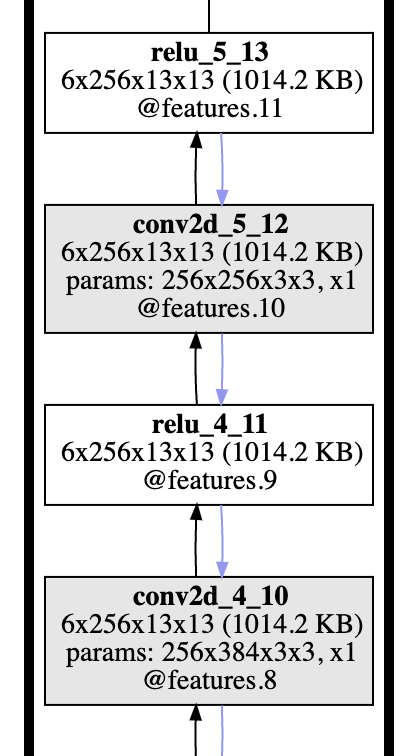
4. Automatic visualization
log.draw()                           # default: unrolled with sibling ordering
log.draw(vis_mode='rolled')          # compact rolled layout
log.draw(vis_mode='unrolled')        # every pass as a distinct node
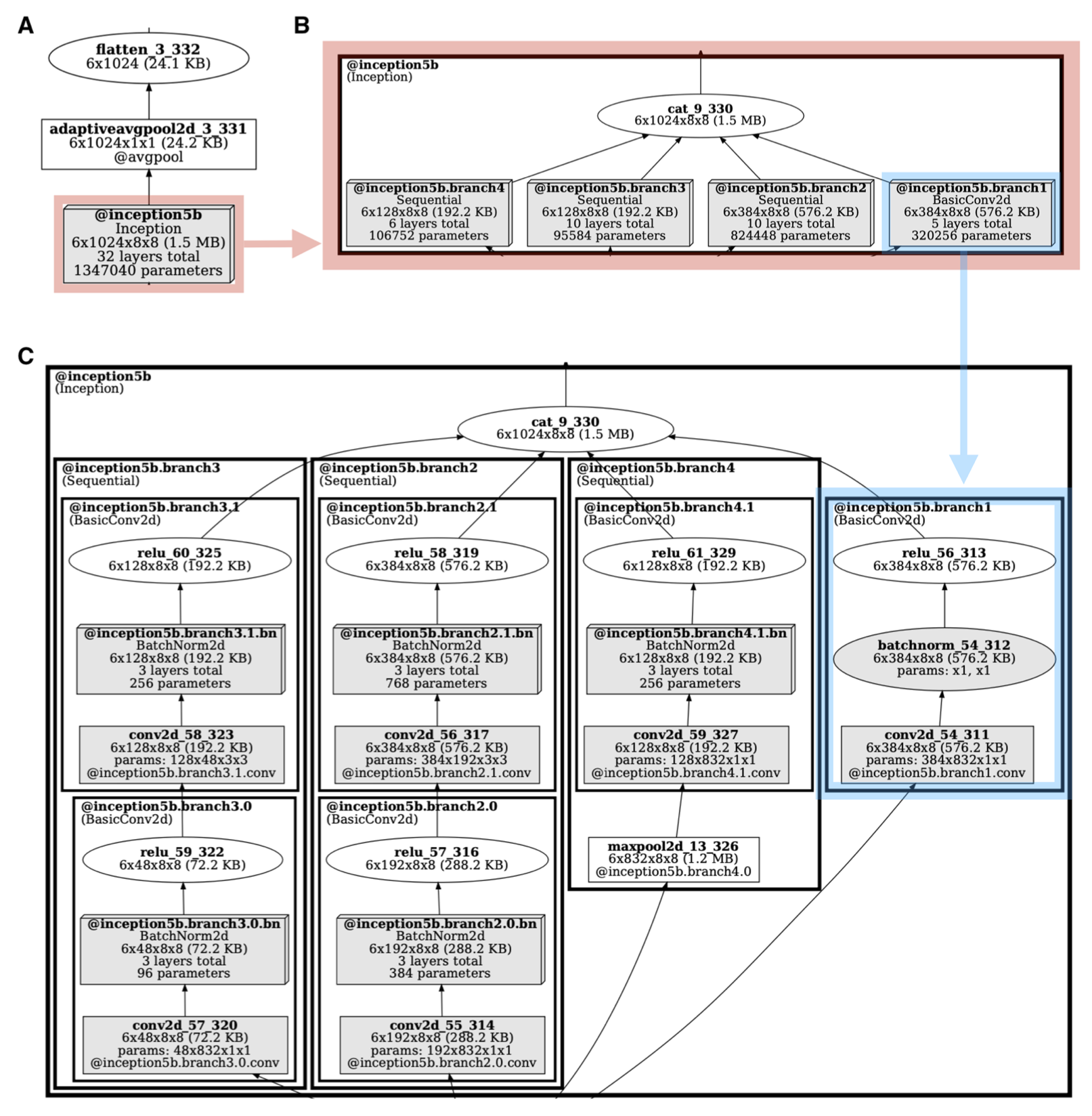
Control nesting depth to zoom in on submodules:
For recurrent models, the rolled view collapses repeated structure cleanly:
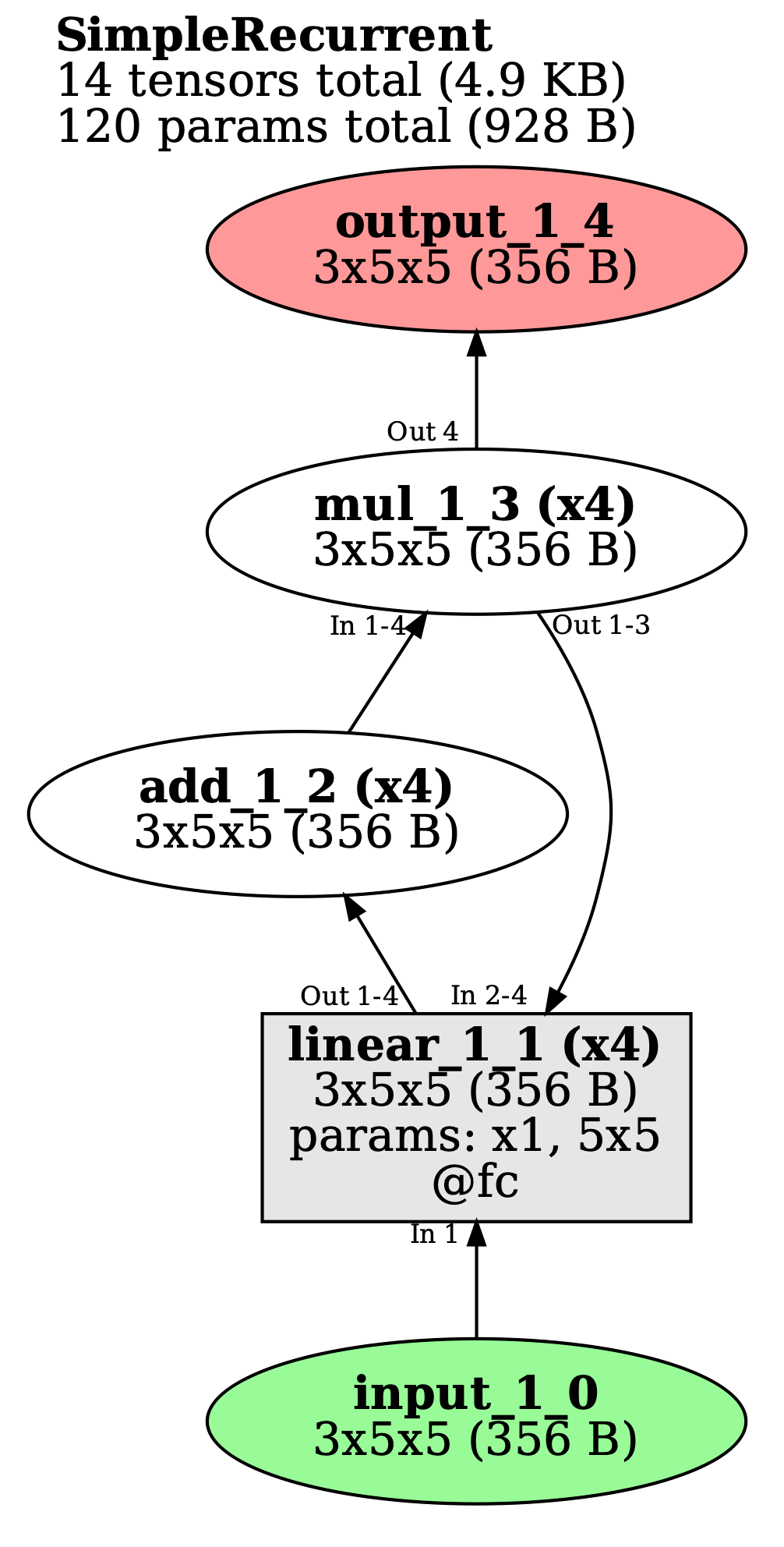
class SimpleRecurrent(torch.nn.Module):
    def __init__(self):
        super().__init__()
        self.fc = torch.nn.Linear(in_features=5, out_features=5)
    def forward(self, x):
        for r in range(4):
            x = self.fc(x)
            x = x + 1
            x = x * 2
        return x

recurrent_model = SimpleRecurrent()
seq = torch.randn(6, 5)
recurrent_log = tl.trace(recurrent_model, seq)
print(recurrent_log['linear_1:2'].out)     # second pass of the linear layer
recurrent_log.draw(vis_mode='rolled')
And the HTML export is already interactive -- one self-contained file with pan, zoom, and node-hover metadata, no server and no extra dependency:
from pathlib import Path
viewer = tl.export.html(recurrent_log, Path('trace.html'))   # open in any browser
See docs/reference/export.md for the SVG, Netron, Model Explorer, and profiler export family.
5. Interventions
Ablate, steer, scale, or replace activations during the forward pass:
# Zero-ablate all relu activations inline during capture
ablated = tl.trace(model, x, save=tl.func('relu'),
                   intervene=tl.when(tl.func('relu'), tl.zero_ablate()))
print(ablated['relu_1_2'].out.abs().max())  # tensor(0.)

# Scale relus to 50%
scaled = tl.trace(model, x, save=tl.func('relu'),
                  intervene=tl.when(tl.func('relu'), tl.scale(0.5)))
Available helpers: tl.zero_ablate, tl.mean_ablate,
torchlens.intervention.scramble_elements, tl.steer, tl.scale, tl.clamp,
tl.noise, tl.project_onto, tl.project_off, tl.swap_with, tl.splice_module.
For post-hoc DAG replay and isolated experiments, capture with
intervention_ready=True and use log.fork() + log.push() /
log.run(model, x). Live hooks during rerun require capture-time selectors
(e.g. tl.func(...), tl.module(...)); finalized labels resolve via
log.find_sites(...). See docs/intervention_api.md
for the full reference.
Compare multiple runs side by side with tl.bundle:
# Default save policy retains inputs, so the bundle can PROVE the two runs
# saw identical inputs before comparing (comparisons never assume it).
clean_log = tl.trace(model, x)
patched_log = tl.trace(model, x,
                       intervene=tl.when(tl.func('relu'), tl.zero_ablate()))
bundle = tl.bundle({'clean': clean_log, 'patched': patched_log}, baseline='clean')
bundle.compare_at('relu_1_2')   # one site; a multi-site selector must resolve uniquely
Facets provide named sub-views for attention heads, LSTM outputs, and fused projections (for models with those structures):
The following is an API sketch; vit_model and lstm must be models whose module
structures provide the shown paths, and are not defined by this generic example.
# API sketch; `vit_model` and `lstm` are application-supplied models with these paths.
# ViT / transformer model with attention blocks
log = tl.trace(vit_model, x)
q = log.modules['blocks.0.attn'].facets['q']    # query vectors for head 0
h_n = log.modules['lstm'].facets['h_n']         # LSTM final hidden state
See docs/facets.md for the full facets reference, including activation patching helpers, SDPA reconstruction, and TransformerLens aliases.
See docs/intervention_api.md for the full selector and helper reference.
6. Works on anything, including dynamic and recurrent models
TorchLens uses eager-mode Python-level function wrapping rather than graph tracing. This means it captures whatever actually runs, including:
- Dynamic control flow (if/else branching, loops, early exits)
- Recurrent architectures (RNNs, LSTMs, state-space models)
- Transformer variants including fused attention
- Graph neural networks
- Mixed architectures
This is the key differentiator from static-graph extractors like
torchvision.feature_extraction, which require static computational graphs
and cannot handle dynamic architectures.
Distributed boundaries. With tl.distributed.arm() enabled before rank-local
capture, explicit in-forward torch.distributed Python collectives become first-class
boundary nodes. Diagnose rank sets with tl.merge_report(...) and merge compatible
rank traces with tl.merge_ranks(...). Sharded tensor topologies such as DTensor/FSDP/TP
and pipeline point-to-point graphs still refuse with typed findings; see the
merged-trace contract.
Multi-backend. The same tl.trace API works across frameworks via
backend=:
| Capability | PyTorch | JAX (preview) | tinygrad (preview) | MLX (preview) | Paddle (preview) | TensorFlow (preview) |
|---|---|---|---|---|---|---|
| Forward capture + graph/metadata | yes | yes | yes | yes | yes | yes |
| Module hierarchy | torch_module |
Equinox/Flax NNX pytree_module; raw function_root |
object_module; raw function_root |
object_module; raw function_root |
object_module; raw function_root |
Keras/tf.Module object_module; raw function_root |
| Control-flow unroll | eager Python | lax.scan/cond/while_loop |
lazy UOp graph | limited | dygraph/eager Python only | eager Python control flow |
Static-label save= |
yes | yes | yes | yes | yes | yes |
Portable array .tlspec payloads |
full | forward/derived arrays | forward/derived arrays | forward/derived arrays | forward/derived arrays | forward arrays |
| Gradients | full backward graph | leaf-level + zero-tap T1 intermediate derived | leaf-level + T1 intermediate derived | leaf-level + custom-VJP-tap T1 intermediate derived | leaf-level + T1 intermediate derived | leaf + exact T1 intermediate derived (eager entries, tl.backends.tf.GradOptions) |
| Recurrence grouping (multi-pass layers) | yes | yes | yes (eager) | yes (eager) | yes (eager) | yes (eager; static FuncGraph path stays ungrouped) |
| Validation oracle (live) | whole-forward replay | per-equation replay + perturbation | per-UOp replay + perturbation | per-op replay + perturbation | replay + perturbation + coverage guard | per-op replay (allowlisted) + self-consistency |
| Interventions | yes | -- | -- | yes (+halt=) |
yes (+halt=, value-dependent predicates) |
yes (eager entries, static-label, fail-closed) |
| Halt / fastlog / streaming | yes | -- | -- | halt only | halt only | -- |
Preview save= selectors filter what is exposed, not what is captured (no memory
reduction); preview tl.validate(...) returns a status whose bool() raises for
partial coverage; and every preview auto-routes genuine framework models on
backend=None. See docs/backends.md for the per-backend contract.
# API sketch; supply compatible models and input in an application context.
log = tl.trace(torch_model, x)                      # PyTorch (default)
log = tl.trace(jax_fn,      inputs, backend='jax')  # JAX preview
log = tl.trace(tg_fn,       inputs, backend='tinygrad')
log = tl.trace(paddle_model, x,     backend='paddle')
log = tl.trace(tf_model,    x,      backend='tf')
PyTorch remains the full-feature backend. Preview backends are pinned and
documented in docs/.
7. Profile it, and stream statistics over whole datasets
Every trace already carries per-op timings, FLOPs, and memory; profile()
presents them per op, module, or call, sorted and truncated how you like, and
honesty() names the clock and instrumentation state behind every number
instead of just saying "measured":
prof_log = tl.trace(model, torch.randn(1, 3, 64, 64))
print(prof_log.profile(level='module', sort_by='flops', top_k=8))
print(prof_log.profile().honesty())

# Nsight-ready: wrap each captured op in an identity-carrying NVTX range
nvtx_log = tl.trace(model, torch.randn(1, 3, 64, 64),
                    capture=tl.options.CaptureOptions(emit_nvtx=True))
Dataset-level statistics stream in constant memory -- including exact full-data linear CKA, not a minibatch approximation:
stats = tl.aggregate(
    model,
    [torch.rand(1, 3, 64, 64) for _ in range(2)],   # any iterable of inputs
    metrics={'relu_1_2': tl.stats.Aggregator(tl.stats.Mean(), tl.stats.Norm()),
             'output': tl.stats.Quantile()},
)
print(stats['relu_1_2']['Mean'], sorted(stats['output']))
For training loops, build the sparse recorder once and log whichever steps you like; discovery helpers list what there is to ask for:
from torchlens.fastlog import Recorder
from torchlens.utils import list_modules, list_ops

with Recorder(model, save=tl.func('relu')) as rec:
    for step in range(2):                    # your optimizer loop
        rec.log(torch.rand(1, 3, 64, 64))    # sparse capture of this step

print(list_modules(model)[:3])               # every module address + class
print(list_ops(model, torch.randn(1, 3, 64, 64))[:3])   # op counts per forward
FLOP totals follow a declared convention (fma=2 by default; flop_convention="fma1"
recounts under fma=1 where a MAC split is derivable, and refuses typed where it is
not), and custom ops get first-class cost rules:
# API sketch; register in your application before tracing (process-global registry).
from torchlens.capture.flops import register_op_rule
register_op_rule('my_custom_op', lambda output_shape, param_shapes, args, kwargs: 0)
See docs/reference/stats.md for the full streaming-stats surface, docs/native-torch.md for what native torch tooling is authoritative for (and the exact recipes we point at), and docs/migration/from_hooks.md for an honest two-way comparison with forward hooks.
Gallery
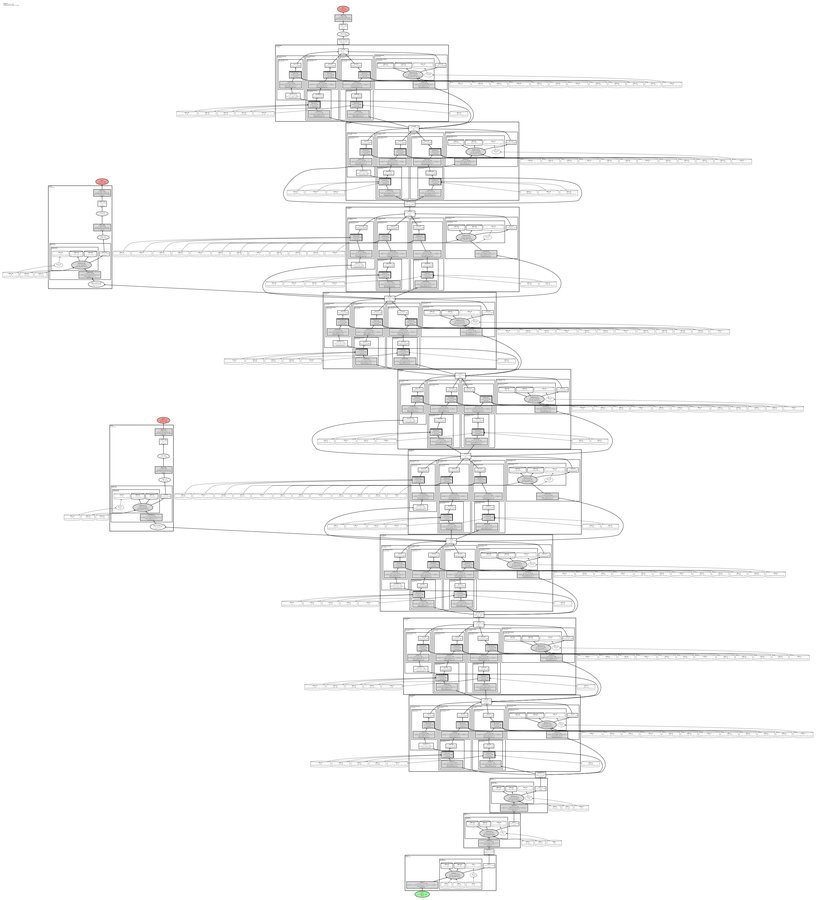
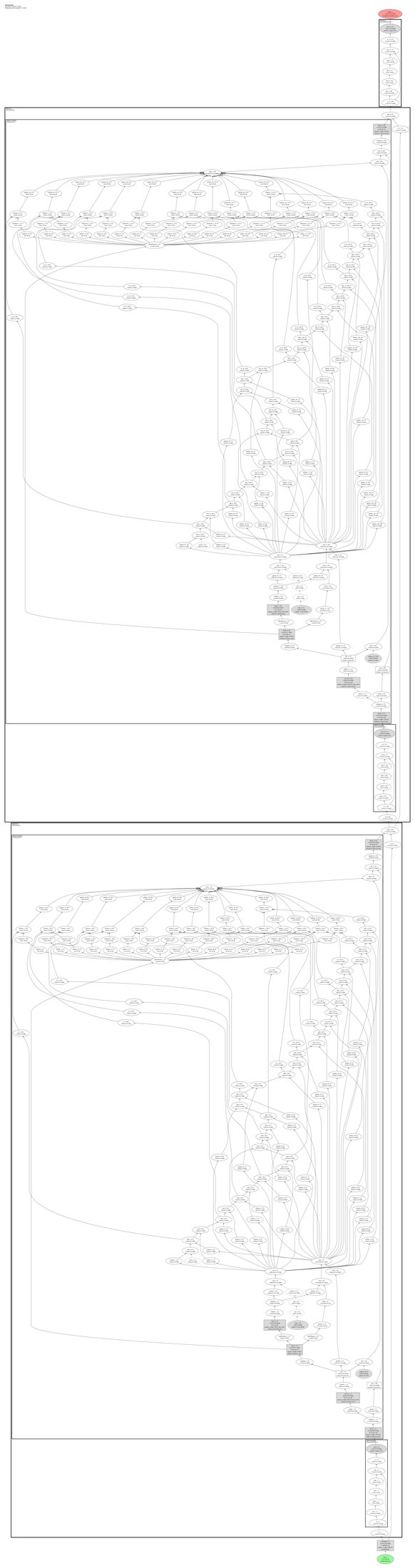
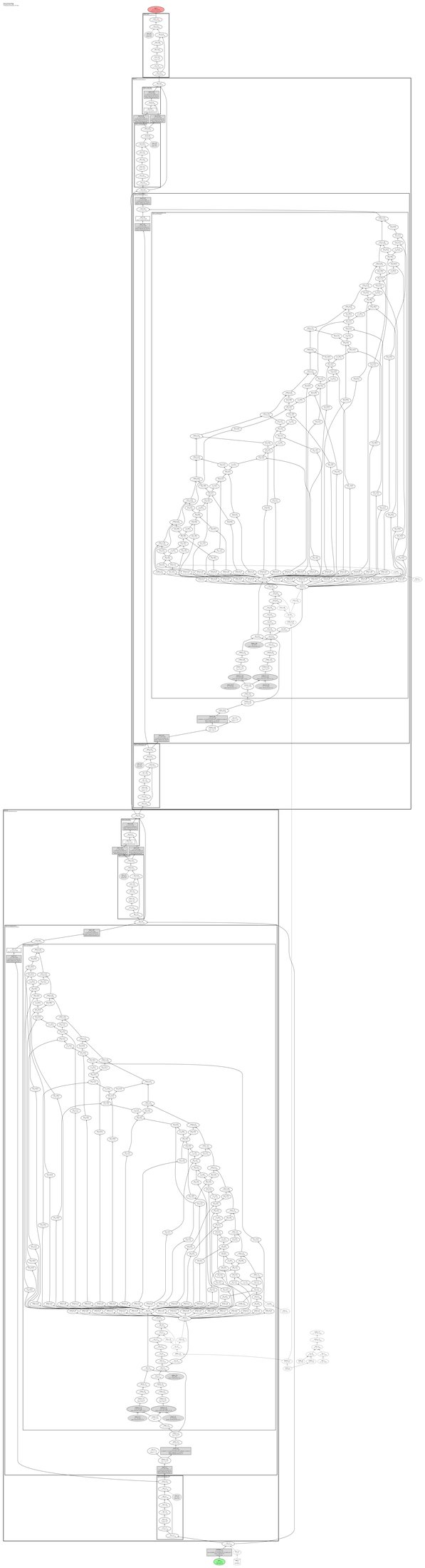
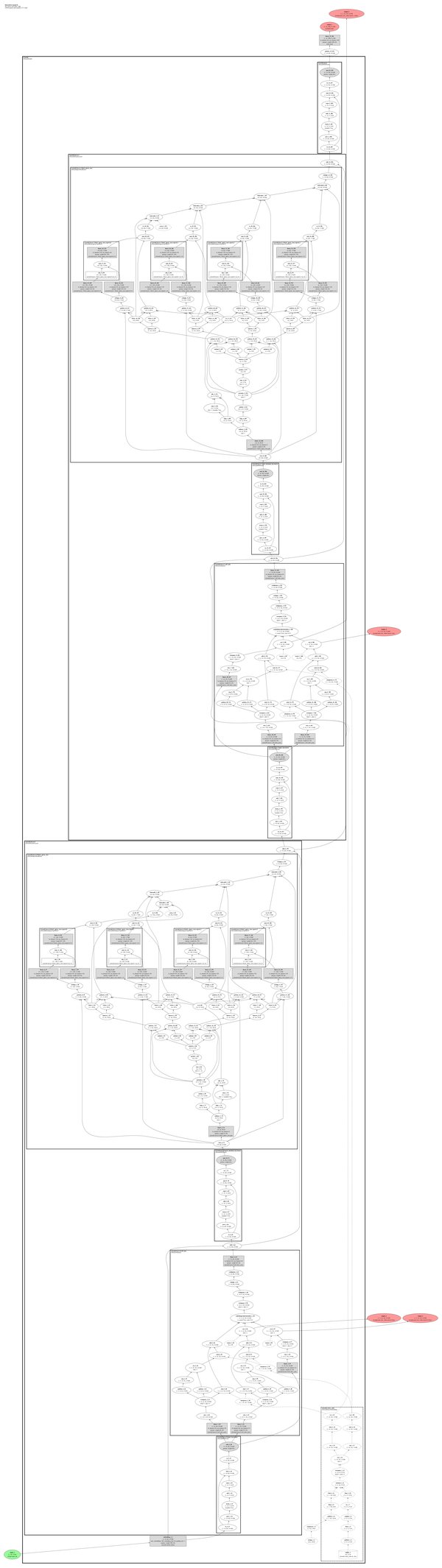
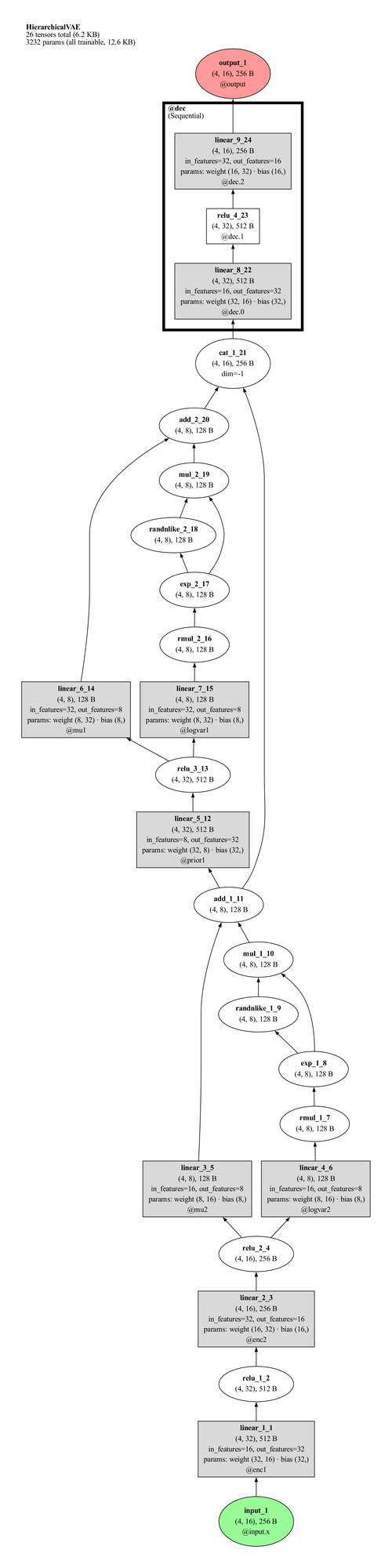
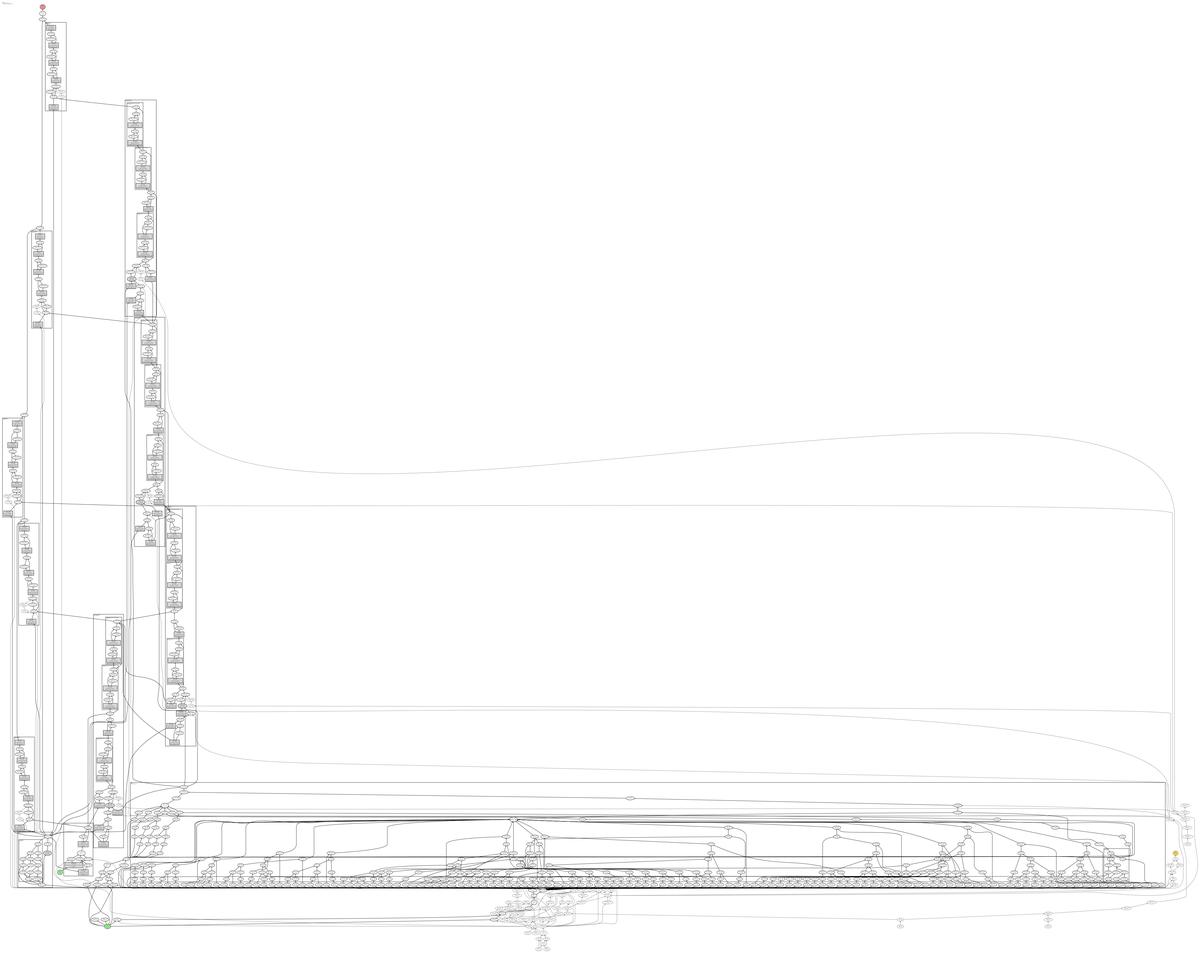
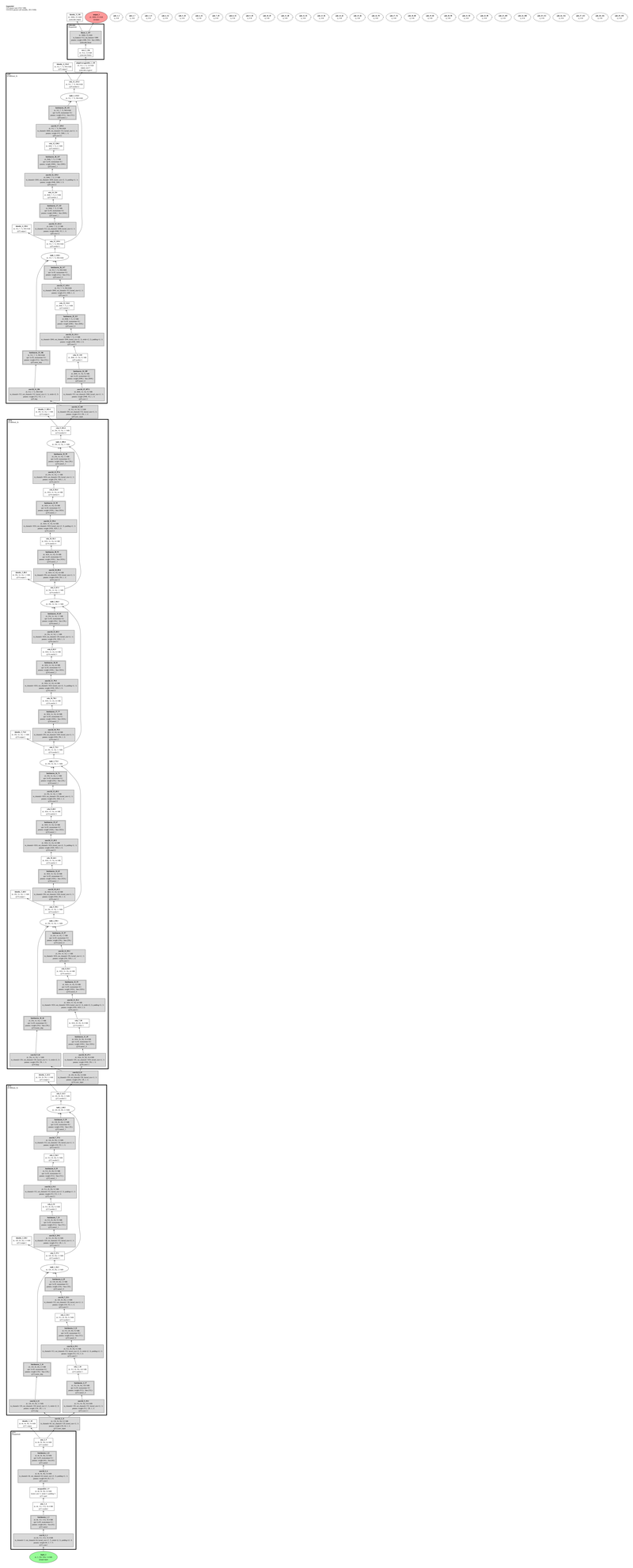
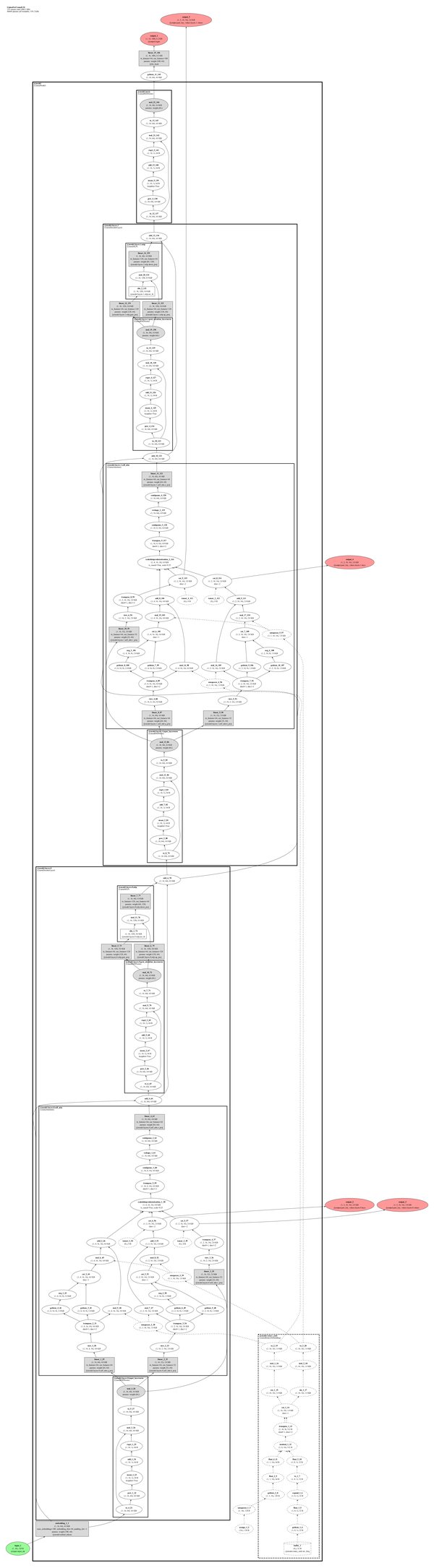
TorchLens visualizes any architecture -- no matter how exotic. Explore the Model Menagerie: a browsable atlas of thousands of cataloged neural-network architecture entries -- from McCulloch & Pitts (1943) to today's frontier models -- each with structured metadata and a TorchLens-rendered diagram. Thousands of them currently carry the replay-and-invariant verification described above.
Early preview. The gallery is live and growing; full-text search, a downloadable dataset, and richer per-model pages are on the way.
A sample across families is shown below.
Classic CNN + Vision Transformer
| GoogLeNet (inception + buffer edges) | Stable Diffusion (U-Net denoiser) | CLIP (vision + language towers) |
|---|---|---|
 |
 |
 |
State-Space + Recurrence
| Mamba (selective SSM) | Recurrent Gemma (linear recurrence) | Whisper (audio encoder-decoder) |
|---|---|---|
 |
 |
 |
Mixture-of-Experts + Generative
| Mixtral (sparse MoE) | Hierarchical VAE | Perceiver |
|---|---|---|
 |
 |
 |
Graph Networks + Exotic
| DimeNet (molecular GNN) | CORnet-S (visual cortex, unrolled) | LLaMA (decoder-only LLM) |
|---|---|---|
 |
 |
 |
Reinforcement Learning + Quantum ML + Scale
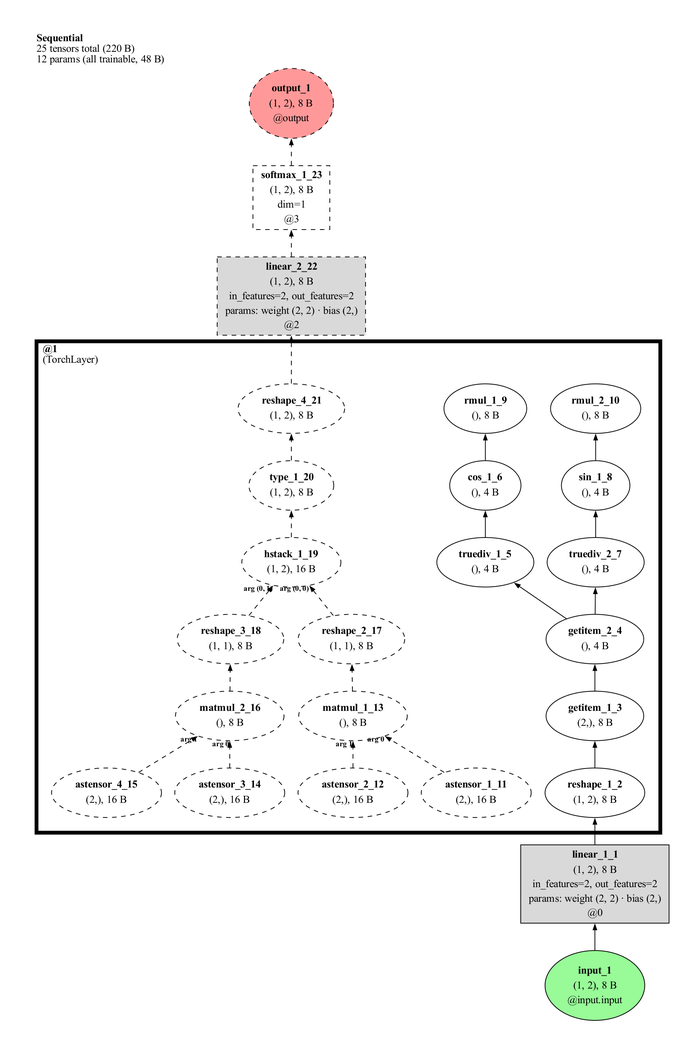
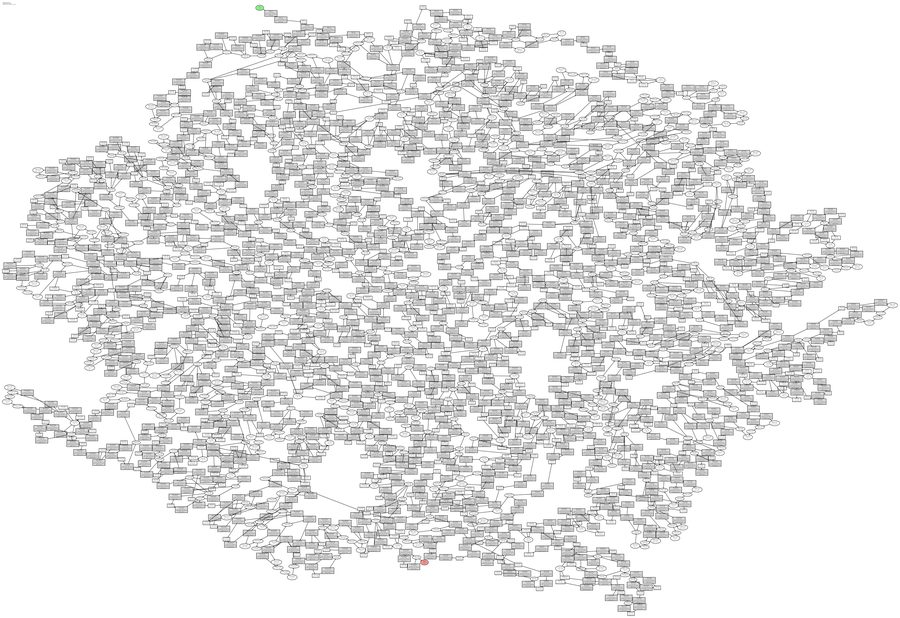
| Decision Transformer (offline RL) | Quantum ML circuit | 3,000-node graph (SFDP layout) |
|---|---|---|
 |
 |
 |
Pin your architecture in CI
Use the provisional address-free structural hash to catch an unintended graph change without pinning model weights or module names:
# `model` and `x` are your model and a representative example input.
import torchlens as tl

pinned = tl.assert_unchanged(model, x, expected=None)  # prints and returns a hash
tl.assert_unchanged(model, x, pinned)  # raises if the architecture changes
See tl.hash for trace-level hashing and its structural scope.
Compatibility
Before filing a bug for a model-specific failure, run the runtime compatibility report:
compat = tl.compat.report(model, x)
print(compat.to_markdown())
tl.compat.report inspects the model wrapper, modules, parameter sharing,
input tensors, CUDA visibility, and common framework markers, then reports
each row as pass, known_broken, scope, or not_tested.
torch.compile coexists with capture. On torch >= 2.6, every capture holds the
public torch.compiler.set_stance("force_eager") scoped to the forward, so
compiled regions run their original eager Python: the interior is fully logged
with full verified semantics, zero graph breaks or new compiles happen during
capture, compiled caches stay intact, and wrapper install/uninstall costs at
most one bounded recompile on the next compiled call. On torch < 2.6 the
historical fallback holds: a Dynamo-traced region reached mid-capture is
bypassed with a one-per-forward warning and the returned trace honestly
contains only what ran outside it (capture_verified=False, reason
"dynamo_region_not_logged"). TorchLens remains not compatible with
TorchScript or torch.export -- those forwards do not run as ordinary Python,
so the wrappers cannot intercept ops. It also has specific behaviors around
FSDP, sparse tensors, meta tensors, quantization, and torch.func.vmap.
See LIMITATIONS.md for the full matrix: what fails, what works, and the recommended workaround for each context.
TorchLens recovers most detached from torch import ... references with a disclosed rescue
re-run and a small mechanical belt. The historical broad sys.modules crawl and
patch_policy= rollout are deleted, along with the former no-op arguments. For the strongest
and simplest guarantee, call torchlens.backends.torch.wrappers.wrap_torch() before creating
detached references. The optional escape_detector="shadow" diagnoses raw callable escapes. See
detached-reference handling and the
limitations catalog.
A capture leaves no TorchLens callable on the model, so pickling the WHOLE
module (pickle.dumps(model) or torch.save(model)) works after tracing. The
one exception is a plain attribute holding a torch function (self.act = F.relu)
across a later wrap-state change: call tl.release_model(model) right before
whole-model serialization to normalize it; state_dict() saves, traces, and
saved activations are unaffected either way.
Tutorials and Docs
| Resource | Description |
|---|---|
| torchlens_in_10_minutes.ipynb | Core workflow: trace, index, visualize |
| facets_tutorial.ipynb | Attention heads, LSTM facets, patching |
| backward_tutorial.ipynb | Gradient capture and backward visualization |
| training_tutorial.ipynb | Training with captured activations |
| huggingface_tutorial.ipynb | HuggingFace transformer models |
| fastlog_tutorial.ipynb | High-throughput sparse recording |
| docs/intervention_api.md | Full selector and helper reference |
| docs/backward.md | Backward capture details and limitations |
| docs/facets.md | Facets, patching, and SDPA reconstruction |
| docs/performance.md | Speed knobs and benchmark numbers |
| docs/reference/debug.md | Trace diagnostics: lineage, non-finites, costs, and gradients |
| docs/reference/export.md | Static, profiling, tabular, and tracker exports (incl. the interactive HTML viewer) |
| docs/reference/stats.md | Streaming dataset statistics: tl.stats accumulators and tl.aggregate |
| docs/native-torch.md | What native torch tooling is authoritative for, with recipes |
| docs/migration/from_hooks.md | Honest two-way comparison with forward hooks |
| docs/reference/hash.md | Provisional structural hashes and CI architecture pins |
| docs/reference/attribution.md | Native input and layer attribution methods |
| docs/reference/collapse.md | Smart-collapse visual reference and label contract |
| docs/reference/glossary.md | Public terminology and stable mechanism names |
| docs/reference/limitations.md | Edge scenarios, typed symptoms, and remedies |
Security
Portable bundles contain a pickle file in metadata.pkl. It is read through a
restricted, default-deny unpickler, and foreign callables are never imported at
load time -- but executing what an artifact describes (running a runnable
artifact, or opting into trust_custom_callables=) is code execution, and
tracing a model runs its forward(). Only load bundles and trace models from
sources you trust. See SECURITY.md for the full trust model,
the supported-versions table, and dependency-advisory status (including the
transformers 4.x advisories and their remedy).
Other Packages You Should Check Out
TorchLens focuses on activation extraction, graph visualization, and intervention and intentionally omits model loading, stimulus management, and analysis pipelines. These packages cover that ground well:
- Cerbrec: interactive visualization and debugging for deep neural networks (uses TorchLens under the hood for PyTorch graph extraction)
- ThingsVision: model loading, stimulus management, and representational analysis for vision models
- Net2Brain: end-to-end pipeline for comparing DNN representations to neural data
- surgeon-pytorch: lightweight activation extraction with training-loss hooks
- deepdive: model loading and benchmarking across many model families
- torchvision feature_extraction: fast activation extraction for models with static computational graphs
- rsatoolbox: representational similarity analysis for DNN activations and brain data
Acknowledgments
The development of TorchLens benefitted greatly from discussions with Nikolaus Kriegeskorte, George Alvarez, Alfredo Canziani, Tal Golan, and the Visual Inference Lab at Columbia University. Thank you to Kale Kundert for helpful discussion and code contributions enabling PyTorch Lightning compatibility. Network visualizations are generated with Graphviz. Logo created by Nikolaus Kriegeskorte.
TorchLens borrows conventions and ideas, with credit, from many tools its users already know. The full credit roster -- every project and paper whose ideas shaped a shipped feature -- is in docs/acknowledgments.md.
Citing TorchLens
To cite TorchLens, please cite this paper:
Taylor, J., Kriegeskorte, N. Extracting and visualizing hidden activations and computational graphs of PyTorch models with TorchLens. Sci Rep 13, 14375 (2023). https://doi.org/10.1038/s41598-023-40807-0
If you find TorchLens useful, a star on this repo is appreciated.
Contact
TorchLens is in active development. Questions, bug reports, and suggestions are welcome via email, Twitter, the issues page, or the discussion board.