OpenClaw Studio
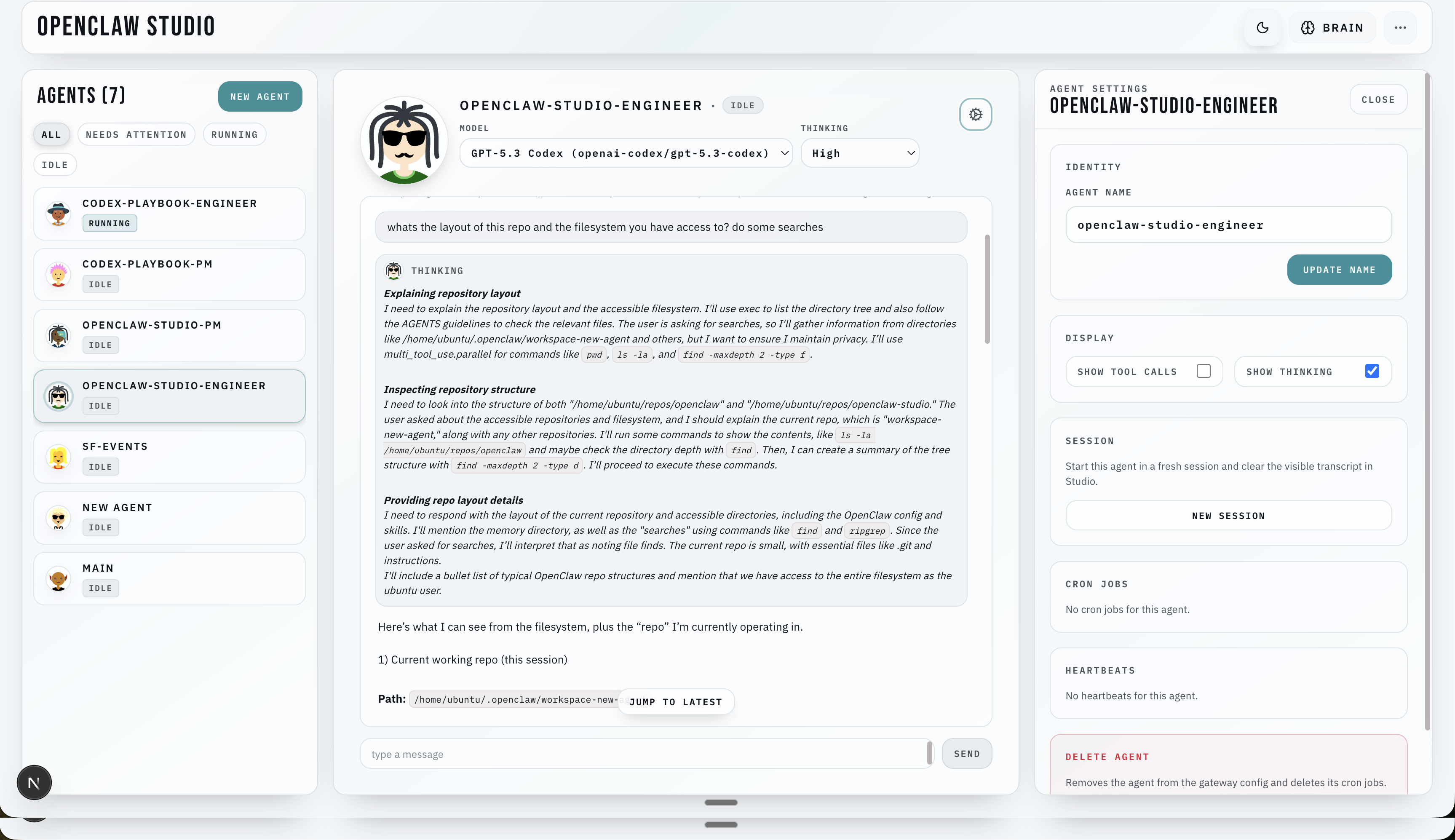
OpenClaw Studio is a clean web dashboard for OpenClaw. Use it to connect to your Gateway, see your agents, chat, manage approvals, and configure jobs from one place.
⭐ Drop a star to help us grow! ⭐
It helps more developers discover the project.
Get Started (Pick Your Setup)
If your Gateway is already running, pick the scenario that matches where your Gateway and Studio will run:
- A. Gateway local, Studio local (same computer)
- B. Gateway in the cloud, Studio local (your laptop)
- C. Studio in the cloud, Gateway in the cloud
All setups use the same install/run path (recommended): npx -y openclaw-studio@latest
Two links matter:
- Browser -> Studio
- Studio -> Gateway
localhost always means "the Studio host." If Studio and OpenClaw share a machine, the upstream should usually stay at ws://localhost:18789 even when that machine is a cloud VM.
Requirements
- Node.js 20.9+ (LTS recommended)
- An OpenClaw Gateway URL + token, or a local OpenClaw install Studio can detect
- Tailscale (optional, recommended for remote access)
A) Gateway local, Studio local (same computer)
npx -y openclaw-studio@latest
cd openclaw-studio
npm run dev
- Open http://localhost:3000
- In Studio, set:
- Upstream URL:
ws://localhost:18789 - Upstream Token: your gateway token (for example:
openclaw config get gateway.auth.token)
- Upstream URL:
B) Gateway in the cloud, Studio local (your laptop)
Run Studio on your laptop as above, then set an upstream URL your laptop can reach.
Recommended (Tailscale Serve on the gateway host):
- On the gateway host:
tailscale serve --yes --bg --https 443 http://127.0.0.1:18789
- In Studio (on your laptop):
- Upstream URL:
wss://.ts.net - Upstream Token: your gateway token
- Upstream URL:
- Keep in mind:
- Studio still needs a gateway token here, even if the OpenClaw Control UI can use Tailscale identity headers
- Raw
ws://:18789is an advanced/manual path and may need extra OpenClaw origin configuration
Alternative (SSH tunnel):
- From your laptop:
ssh -L 18789:127.0.0.1:18789 user@
- In Studio:
- Upstream URL:
ws://localhost:18789
- Upstream URL:
C) Studio in the cloud, Gateway in the cloud
This is the “always-on” setup. When Studio and OpenClaw run on the same cloud VM, keep the OpenClaw upstream local and solve browser access to Studio separately.
- On the VPS that will run Studio:
- Run Studio (same commands as above).
- If OpenClaw is on that same VPS, keep Studio's upstream set to:
- Upstream URL:
ws://localhost:18789 - Upstream Token: your gateway token
- Upstream URL:
- Expose Studio over tailnet HTTPS:
tailscale serve --yes --bg --https 443 http://127.0.0.1:3000
- Open Studio from your laptop/phone:
https://.ts.net
- Only use a remote upstream like
wss://.ts.netif Studio and OpenClaw are on different machines.
Notes:
- Avoid serving Studio behind
/studiounless you configurebasePathand rebuild. - If Studio is reachable beyond loopback,
STUDIO_ACCESS_TOKENis required. - If you bind Studio beyond loopback, open
/?access_token=...once from each new browser to set the Studio cookie.
How It Connects (Mental Model)
OpenClaw Studio now runs one runtime architecture with two primary paths:
- Browser -> Studio: HTTP + SSE (
/api/runtime/*,/api/intents/*,/api/runtime/stream) - Studio -> Gateway (upstream): one server-owned WebSocket opened by the Studio Node process
This is why ws://localhost:18789 means “gateway on the Studio host”, not “gateway on your phone”.
If Studio is running on a remote machine over SSH and the terminal says Open in browser: http://localhost:3000, that localhost is the remote machine. Use Tailscale Serve or an SSH tunnel to open Studio from your own laptop.
Install from source (advanced)
git clone https://github.com/grp06/openclaw-studio.git
cd openclaw-studio
npm install
npm run dev
Optional setup helper in a source checkout:
npm run studio:setup
That writes the saved gateway URL/token for this Studio host without opening the UI first.
Configuration
Paths and key settings:
- OpenClaw config:
~/.openclaw/openclaw.json(or viaOPENCLAW_STATE_DIR) - Studio settings:
~/.openclaw/openclaw-studio/settings.json - Control-plane runtime DB:
~/.openclaw/openclaw-studio/runtime.db - Default gateway URL:
ws://localhost:18789(override via Studio Settings orNEXT_PUBLIC_GATEWAY_URL) - Domain API mode: always enabled. Studio runs on the server-owned control-plane architecture.
STUDIO_ACCESS_TOKEN: required when binding Studio to a public host (HOST=0.0.0.0,HOST=::, or non-loopback hostnames/IPs); optional for loopback-only binds (127.0.0.1,::1,localhost)
Startup guard behavior:
npm run devandnpm run dev:turborunverify:native-runtime:repairbefore server startup.npm run startrunsverify:native-runtime:checkbefore startup (check-only; no dependency mutation).
Why SQLite exists now:
- Studio’s server-owned control plane stores durable runtime projection + replay outbox in
runtime.db. - This keeps runtime history and SSE replay deterministic across page refreshes and process restarts.
UI guide
See docs/ui-guide.md for UI workflows (agent creation, cron jobs, exec approvals).
PI + chat streaming
See docs/pi-chat-streaming.md for how Studio streams runtime events over domain SSE (/api/runtime/stream), applies replay/history, and renders tool calls, thinking traces, and final transcript lines.
Permissions + sandboxing
See docs/permissions-sandboxing.md for how agent creation choices (tool policy, sandbox config, exec approvals) flow from Studio into the OpenClaw Gateway and how upstream OpenClaw enforces them at runtime (workspaces, sandbox mounts, tool availability, and exec approval prompts).
Color system
See docs/color-system.md for the semantic color contract, status mappings, and guardrails that keep action/status/danger usage consistent across the UI.
Troubleshooting
If the UI loads but “Connect” fails, it’s usually Studio->Gateway:
- Confirm the upstream URL/token in the UI (stored on the Studio host at
/openclaw-studio/settings.json). - If Studio is on a remote host, remember that
ws://localhost:18789means "OpenClaw on the Studio host," not "OpenClaw on your laptop." - If Studio is on a remote host and you cannot open
http://localhost:3000from your laptop, expose Studio withtailscale serve --yes --bg --https 443 http://127.0.0.1:3000or usessh -L 3000:127.0.0.1:3000 user@host. EPROTO/ “wrong version number”: you usedwss://...to a non-TLS endpoint (usews://..., or put the gateway behind HTTPS)..ts.net+ws://: usewss://instead.- Assets 404 under
/studio: serve Studio at/or configurebasePathand rebuild. - 401 “Studio access token required”:
STUDIO_ACCESS_TOKENis enabled; open/?access_token=...once to set the cookie. - Helpful error codes:
studio.gateway_url_missing,studio.gateway_token_missing,studio.upstream_error,studio.upstream_closed.
If startup fails with better_sqlite3.node / NODE_MODULE_VERSION mismatch:
- Run
npm run verify:native-runtime:repair - Confirm
nodeandnpmpoint at the same runtime before launching Studio:node -v && node -p "process.versions.modules"which node && which npm- If they differ (for example Homebrew
npm+nvmnode), runnvm usein that terminal first.
- If it still fails, run:
npm rebuild better-sqlite3npm install
Architecture
See ARCHITECTURE.md for details on modules and data flow.