✨ The open-source multi-agent platform. Every agent gets its own computer, desktop, network, and long-term memory. You can bring your own key, or host your coding agent like Claude Code, Codex and so on.
⚠️DirectML is in maintenance mode ⚠️ DirectML is a high-performance, hardware-accelerated DirectX 12 library for machine learning. DirectML provides GPU acceleration for common machine learning tasks across a broad range of supported hardware and drivers, including all DirectX 12-capable GPUs from vendors such as AMD, Intel, NVIDIA, and Qualcomm.
General purpose GPU compute framework built on Vulkan to support 1000s of cross vendor graphics cards (AMD, Qualcomm, NVIDIA & friends). Blazing fast, mobile-enabled, asynchronous and optimized for advanced GPU data processing usecases. Backed by the Linux Foundation.
Official Implementation of EAGLE-1 (ICML'24), EAGLE-2 (EMNLP'24), and EAGLE-3 (NeurIPS'25).
Key parameters and specifications
Key parameters and specifications
Parameter
Value
Language
Emacs Lisp
Category
Infrastructure
Subcategory
Kernels
Stars
2,601
Forks
349
Contributors
32
Created date
2025-10-02
Updated date
2026-10-16
Stars in 1 day
0
Stars in 7 days
14
Rank
8,487
Previous rank
5,187
Rank change
-3,300
7-day stars rank
3,331
Previous 7-day stars rank
3,201
7-day stars rank change
-130
Total stars rank
5,112
Previous total stars rank
5,104
Total stars rank change
-8
Country
USA
README summary
Coral NPU Coral NPU is a hardware accelerator for ML inferencing. Coral NPU is an Open Source IP designed by Google Research and is freely available for integration into ultra-low-power System-on-Chips (SoCs) targeting wearable devices such as hearables, augmented reality (AR) glasses and smart watches. Coral NPU is a neural processing unit (NPU), also known as an AI accelerator or deep-learning processor. Coral NPU is based on the 32-bit RISC-V Instruction Set Architecture
(ISA). Coral NPU includes three distinct processor components that work together: matrix, vector (SIMD), and scalar. Coral NPU Architecture Datasheet Coral NPU Features Coral NPU offers the following top-level feature set: RV32IMF_Zve32x RISC-V instruction set (specifically ) 32-bit address space for applications and operating system kernels Four-stage processor, in-order dispatch, out-of-order retire Four-way scalar, two-way vector dispatch 128-bit SIMD, 256-bit (future) pipeline 8 KB ITCM memory (tightly-coupled memory
for instructions) 32 KB DTCM memory (tightly-coupled memory for data) Both memories are single-cycle-latency SRAM, more efficient than cache memory AXI4 bus interfaces, functioning as both manager and subordinate, to interact with external memory and allow external CPUs to configure Coral NPU System Requirements Bazel 8. dockerfile for a detailed list of requirements. Our CI systems run most builds and tests using this image. Verification & Testing For details on our testing methodologies and how to run or
write tests, see the corresponding test READMEs: Cocotb Tests (RTL & Netlist simulation) UVM Testbench (Co-simulation) Quick Start
Frequently asked questions
How many stars and forks are recorded?
google-coral/coralnpu has 2,601 stars and 349 forks.
What is the repository rank?
google-coral/coralnpu is ranked 8,487.
What language and category are recorded?
google-coral/coralnpu has 2,601 stars, uses Emacs Lisp and belongs to Infrastructure.
Which repository is closest in rank?
google-coral/coralnpu is compared with microsoft/DirectML, ranked 8,493 with 2,593 stars.
README
Coral NPU
Coral NPU is a hardware accelerator for ML inferencing. Coral NPU is an Open
Source IP designed by Google Research and is freely available for integration
into ultra-low-power System-on-Chips (SoCs) targeting wearable devices such as
hearables, augmented reality (AR) glasses and smart watches.
Coral NPU is a neural processing unit (NPU), also known as an AI accelerator or
deep-learning processor. Coral NPU is based on the 32-bit RISC-V Instruction Set
Architecture (ISA).
Coral NPU includes three distinct processor components that work together:
matrix, vector (SIMD), and scalar.
# Ensure that test suite passes
bazel run //tests/cocotb:core_mini_axi_sim_cocotb

# Build a binary
bazel build //examples:coralnpu_v2_hello_world_add_floats

# Build the Simulator (non-RVV for shorter build time):
bazel build //tests/verilator_sim:core_mini_axi_sim

# Run the binary on the simulator:
bazel-bin/tests/verilator_sim/core_mini_axi_sim --binary bazel-out/k8-fastbuild-ST-dd8dc713f32d/bin/examples/coralnpu_v2_hello_world_add_floats.elf
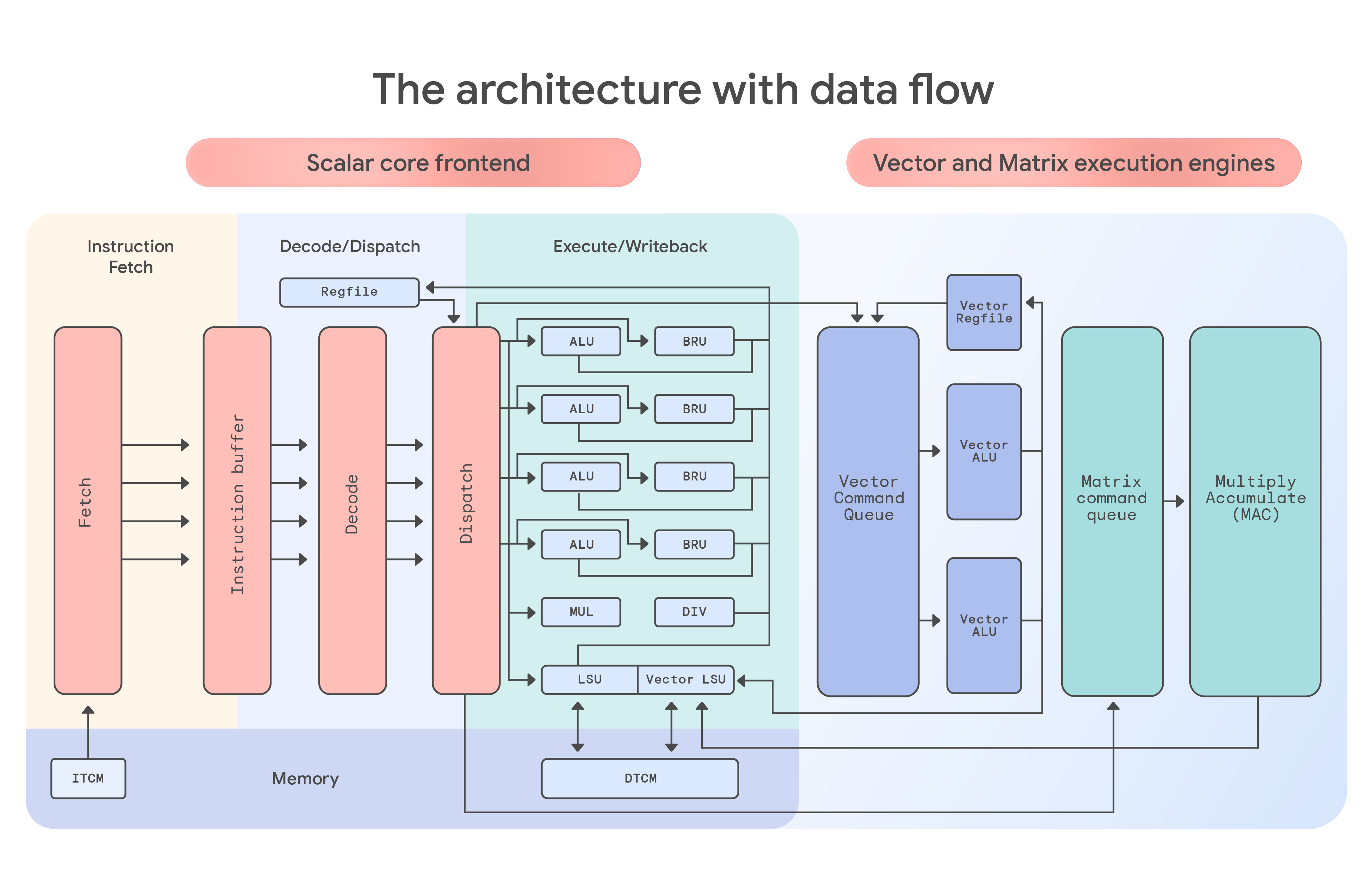 Coral NPU Architecture Datasheet