ALIbaba's Collection of Encoder-decoders from MinD (Machine IntelligeNce of Damo) Lab.
Key parameters and specifications
Key parameters and specifications
Parameter
Value
Language
Python
Category
Models
Subcategory
Foundation models, Vision models
Stars
2,065
Forks
177
Contributors
3
Created date
2022-12-29
Updated date
2026-10-12
Stars in 1 day
0
Stars in 7 days
-2
Rank
9,030
Previous rank
9,069
Rank change
39
7-day stars rank
18,246
Previous 7-day stars rank
18,199
7-day stars rank change
-47
Total stars rank
6,176
Previous total stars rank
6,168
Total stars rank change
-8
Country
USA
README summary
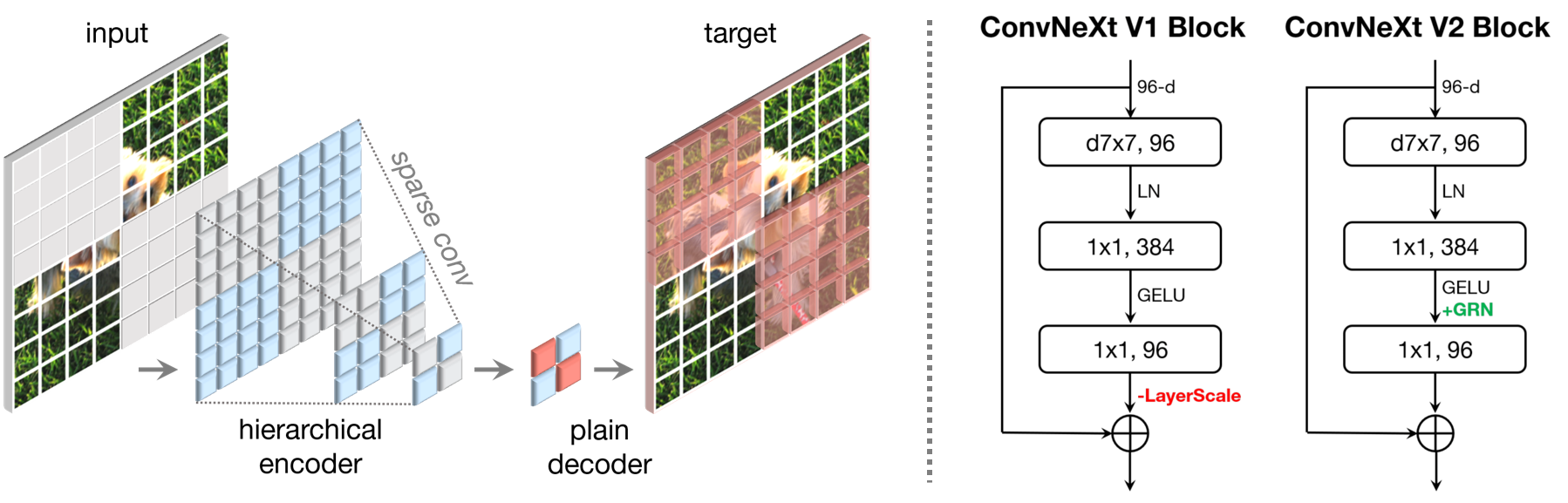
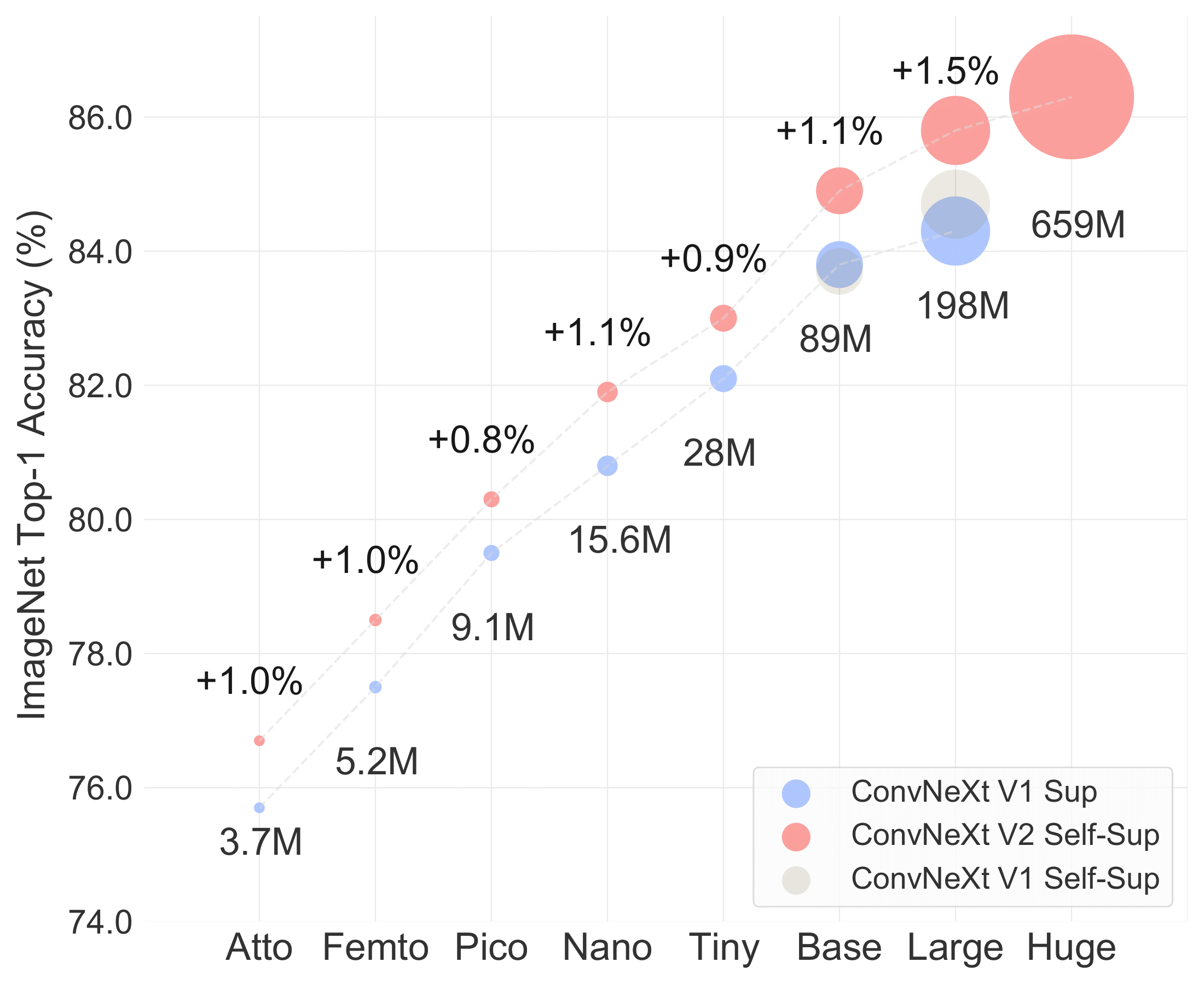
ConvNeXt V2 Official PyTorch Implementation This repo contains the PyTorch version of *8* model definitions (*Atto, Femto, Pico, Nano, Tiny, Base, Large, Huge*), pre-training/fine-tuning code and pre-trained weights (converted from JAX weights trained on TPU) for our ConvNeXt V2 paper. **ConvNeXt V2: Co-designing and Scaling ConvNets with Masked Autoencoders** Sanghyun Woo, Shoubhik Debnath, Ronghang Hu, Xinlei Chen, Zhuang Liu, In So Kweon and Saining Xie\ KAIST, Meta AI and New York University We propose a
fully convolutional masked autoencoder framework (FCMAE) and a new Global Response Normalization (GRN) layer that can be added to the ConvNeXt architecture to enhance inter-channel feature competition. This co-design of self-supervised learning techniques and architectural improvement results in a new model family called ConvNeXt V2, which significantly improves the performance of pure ConvNets on various recognition benchmarks. We also provide pre-trained ConvNeXt V2 models of various sizes. 7M | model | | ConvNeXt V2-F | 224x224 | 5. 2M | model
the pre-trained models can be found from the result tables. Setting model-specific is not strictly required in evaluation, as the module in timm behaves the same during evaluation; but it is required in training. md or our paper (appendix) for the values used for different models. md for pre-training and fine-tuning instructions. Acknowledgement This repository borrows from timm, ConvNeXt and MAE. We thank Ross Wightman for the initial design of the small-compute ConvNeXt model variants
and the associated training recipe. We also appreciate the helpful discussions and feedback provided by Kaiming He. License This project is released under the MIT license except ImageNet pre-trained and fine-tuned models which are licensed under a CC-BY-NC. Please see the LICENSE file for more information. Citation If you find this repository helpful, please consider citing:
Frequently asked questions
How many stars and forks are recorded?
facebookresearch/ConvNeXt-V2 has 2,065 stars and 177 forks.
What is the repository rank?
facebookresearch/ConvNeXt-V2 is ranked 9,030.
What language and category are recorded?
facebookresearch/ConvNeXt-V2 has 2,065 stars, uses Python and belongs to Models.
Which repository is closest in rank?
facebookresearch/ConvNeXt-V2 is compared with cfzd/Ultra-Fast-Lane-Detection, ranked 9,037 with 2,063 stars.
README
ConvNeXt V2
Official PyTorch Implementation
This repo contains the PyTorch version of 8 model definitions (Atto, Femto, Pico, Nano, Tiny, Base, Large, Huge), pre-training/fine-tuning code and pre-trained weights (converted from JAX weights trained on TPU) for our ConvNeXt V2 paper.
We propose a fully convolutional masked autoencoder framework (FCMAE) and a new Global Response Normalization (GRN) layer that can be added to the ConvNeXt architecture to enhance inter-channel feature competition. This co-design of self-supervised learning techniques and architectural improvement results in a new model family called ConvNeXt V2, which significantly improves the performance of pure ConvNets on various recognition benchmarks. We also provide pre-trained ConvNeXt V2 models of various sizes.
For evaluating other model variants, change --model, --resume, --input_size accordingly. URLs for the pre-trained models can be found from the result tables.
Setting model-specific --drop_path is not strictly required in evaluation, as the DropPath module in timm behaves the same during evaluation; but it is required in training. See TRAINING.md or our paper (appendix) for the values used for different models.
Training
See TRAINING.md for pre-training and fine-tuning instructions.
We thank Ross Wightman for the initial design of the small-compute ConvNeXt model variants and the associated training recipe. We also appreciate the helpful discussions and feedback provided by Kaiming He.
License
This project is released under the MIT license except ImageNet pre-trained and fine-tuned models which are licensed under a CC-BY-NC. Please see the LICENSE file for more information.
Citation
If you find this repository helpful, please consider citing:
@article{Woo2023ConvNeXtV2,
  title={ConvNeXt V2: Co-designing and Scaling ConvNets with Masked Autoencoders},
  author={Sanghyun Woo, Shoubhik Debnath, Ronghang Hu, Xinlei Chen, Zhuang Liu, In So Kweon and Saining Xie},
  year={2023},
  journal={arXiv preprint arXiv:2301.00808},
}