A Deep Learning Python Toolkit for Healthcare Applications.
Key parameters and specifications
Key parameters and specifications
Parameter
Value
Language
C++
Category
Model Development
Subcategory
Classical ML
Keywords
Computer vision, Robotics
Stars
1,675
Forks
395
Contributors
26
Created date
2016-04-13
Updated date
2026-10-15
Stars in 1 day
0
Stars in 7 days
2
Rank
9,713
Previous rank
5,544
Rank change
-4,169
7-day stars rank
7,959
Previous 7-day stars rank
8,001
7-day stars rank change
42
Total stars rank
7,380
Previous total stars rank
7,372
Total stars rank change
-8
Country
Switzerland
README summary
Voxblox Voxblox is a volumetric mapping library based mainly on Truncated Signed Distance Fields (TSDFs). It varies from other SDF libraries in the following ways: CPU-only, can be run single-threaded or multi-threaded for some integrators Support for multiple different layer types (containing different types of voxels) Serialization using protobufs Different ways of handling weighting during merging Different ways of inserting pose information about scans Tight ROS integration (in voxblox_ros package) Easily extensible with whatever integrators you
want Features an implementation of building Euclidean Signed Distance Fields (ESDFs, EDTs) directly from TSDFs. **If you're looking for skeletonization/sparse topology or planning applications, please refer to the mav_voxblox_planning repo. ** **If you want to create ground truth maps from meshes or gazebo environments, please check out the voxblox_ground_truth pakage! ** Documentation All voxblox documentation can be found on our readthedocs page Table of Contents Paper and Video Credits Example Outputs Performance Installation Running Voxblox Using Voxblox
for Planning Transformations in Voxblox Contributing to Voxblox Library API Paper and Video A video showing sample output from voxblox can be seen here. A video of voxblox being used for online planning on-board a multicopter can be seen here. If using voxblox for scientific publications, please cite the following paper, available here: Helen Oleynikova, Zachary Taylor, Marius Fehr, Juan Nieto, and Roland Siegwart, “**Voxblox: Incremental 3D Euclidean Signed Distance Fields for On-Board MAV Planning**”, in *IEEE/RSJ
International Conference on Intelligent Robots and Systems (IROS)*, 2017. Credits This library was written primarily by Helen Oleynikova and Marius Fehr, with significant contributions from Zachary Taylor, Alexander Millane, and others. The marching cubes meshing and ROS mesh generation were taken or heavily derived from open_chisel. We've retained the copyright headers for the relevant files.
Frequently asked questions
How many stars and forks are recorded?
ethz-asl/voxblox has 1,675 stars and 395 forks.
What is the repository rank?
ethz-asl/voxblox is ranked 9,713.
What language and category are recorded?
ethz-asl/voxblox has 1,675 stars, uses C++ and belongs to Model Development.
Which repository is closest in rank?
ethz-asl/voxblox is compared with nyu-mll/jiant, ranked 9,714 with 1,675 stars.
README
Voxblox
Voxblox is a volumetric mapping library based mainly on Truncated Signed Distance Fields (TSDFs). It varies from other SDF libraries in the following ways:
CPU-only, can be run single-threaded or multi-threaded for some integrators
Support for multiple different layer types (containing different types of voxels)
Serialization using protobufs
Different ways of handling weighting during merging
Different ways of inserting pose information about scans
Tight ROS integration (in voxblox_ros package)
Easily extensible with whatever integrators you want
Features an implementation of building Euclidean Signed Distance Fields (ESDFs, EDTs) directly from TSDFs.
If you're looking for skeletonization/sparse topology or planning applications, please refer to the mav_voxblox_planning repo.If you want to create ground truth maps from meshes or gazebo environments, please check out the voxblox_ground_truth pakage!
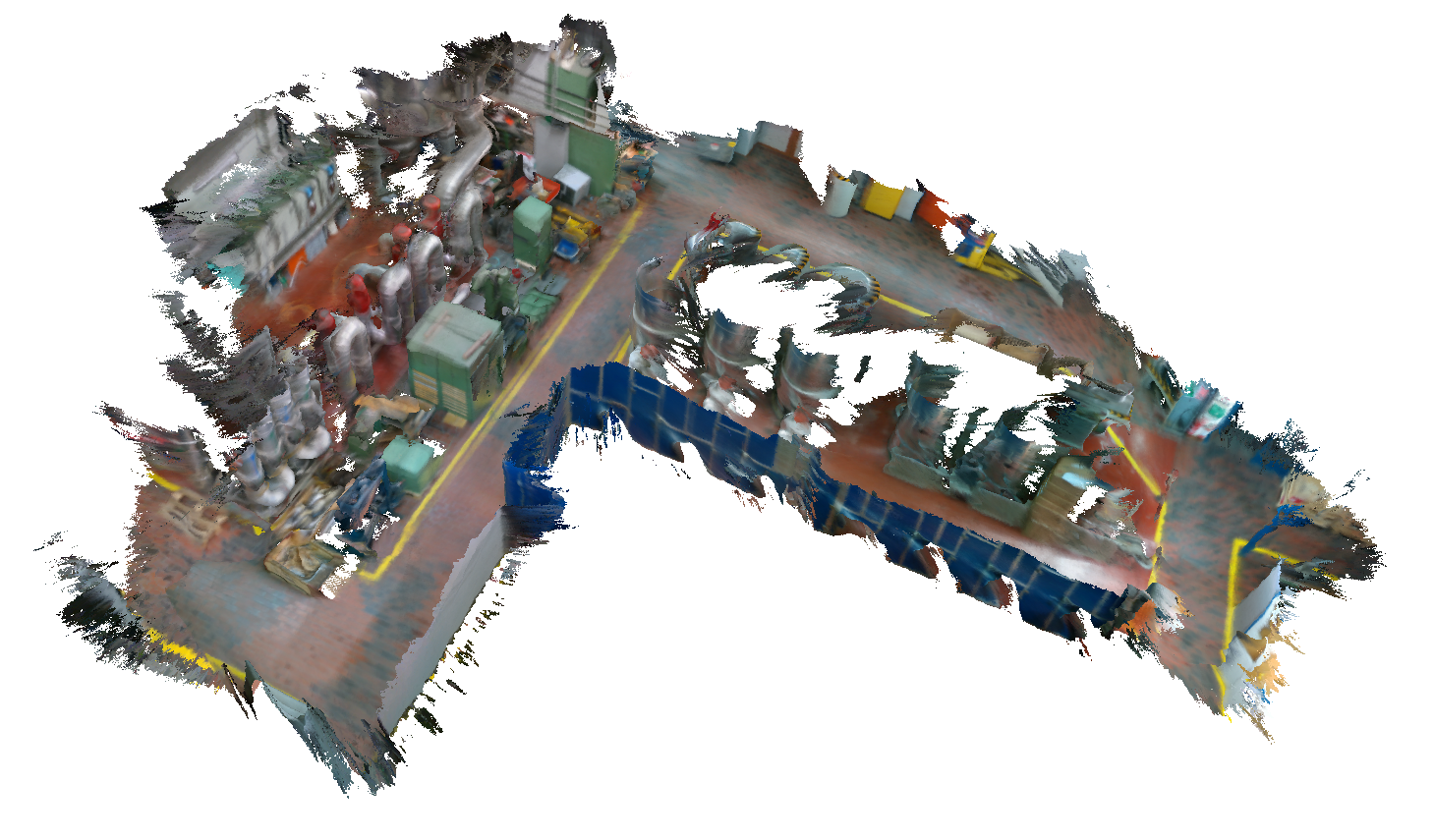
A video showing sample output from voxblox can be seen here.
A video of voxblox being used for online planning on-board a multicopter can be seen here.
If using voxblox for scientific publications, please cite the following paper, available here:
Helen Oleynikova, Zachary Taylor, Marius Fehr, Juan Nieto, and Roland Siegwart, “Voxblox: Incremental 3D Euclidean Signed Distance Fields for On-Board MAV Planning”, in IEEE/RSJ International Conference on Intelligent Robots and Systems (IROS), 2017.
@inproceedings{oleynikova2017voxblox,
  author={Oleynikova, Helen and Taylor, Zachary and Fehr, Marius and Siegwart, Roland and  Nieto, Juan},
  booktitle={IEEE/RSJ International Conference on Intelligent Robots and Systems (IROS)},
  title={Voxblox: Incremental 3D Euclidean Signed Distance Fields for On-Board MAV Planning},
  year={2017}
}
Credits
This library was written primarily by Helen Oleynikova and Marius Fehr, with significant contributions from Zachary Taylor, Alexander Millane, and others. The marching cubes meshing and ROS mesh generation were taken or heavily derived from open_chisel. We've retained the copyright headers for the relevant files.