← Open Source
dome272

VQGAN-pytorch

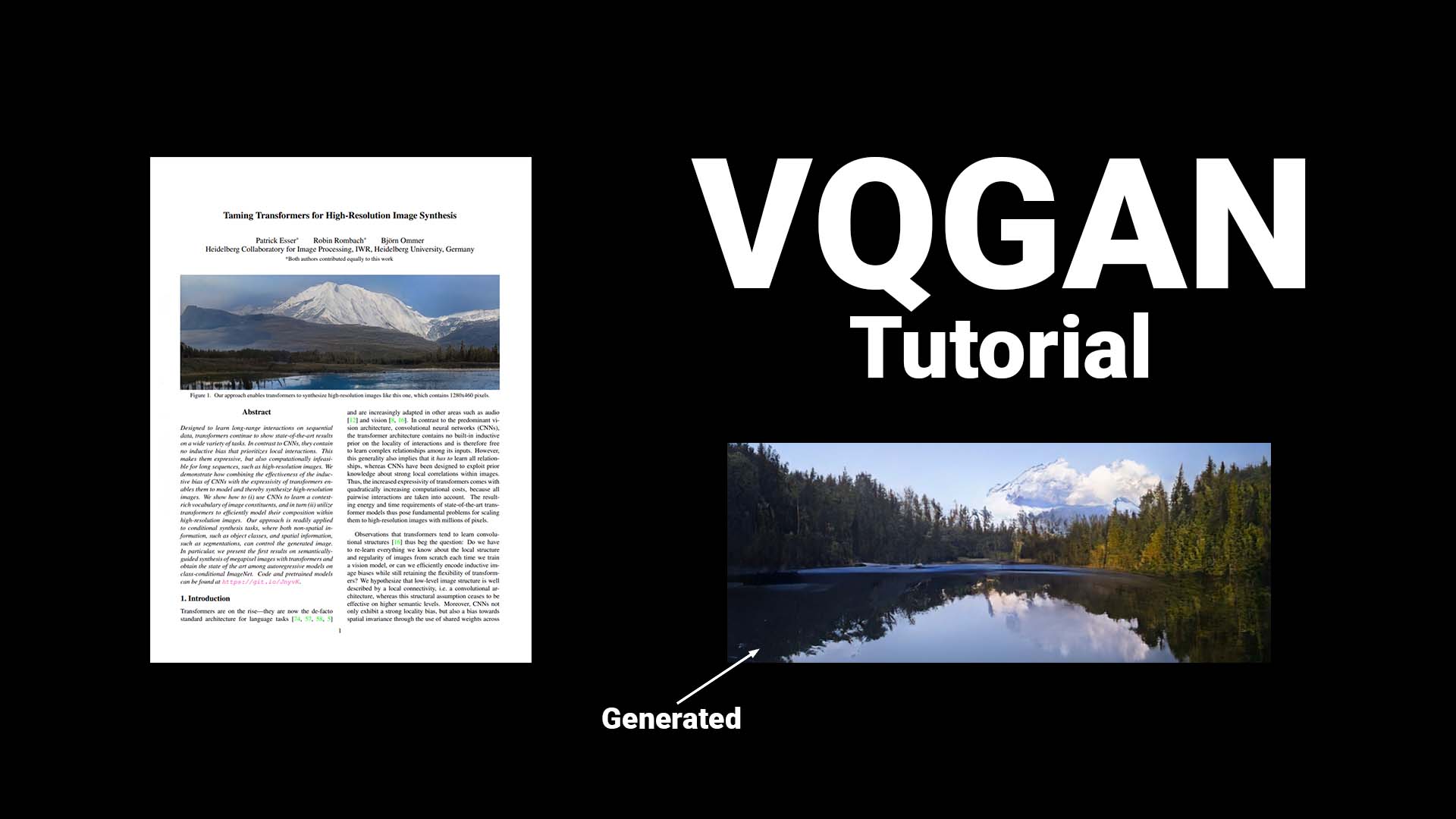
Pytorch implementation of VQGAN (Taming Transformers for High-Resolution Image Synthesis) (https://arxiv.org/pdf/2012.09841.pdf).

ModelsVision modelsPython
Open on GitHub
Momentum
+0stars in 24 hours0.0%
554
Stars
84
Forks
+1
This week
1
Contributors
Created 2022-02-15 · Updated 2026-10-13 · #17140 today
Top developers

dome272/VQGAN-pytorch is ranked 17,140 with 554 stars.

Same-category comparison

dome272/VQGAN-pytorch is ranked 17,140 among these 8 peers; microsoft/voxelpose-pytorch is ranked 17,144.

Same-category comparison
NameRankMetrics
rishikksh20/ViViT-pytorch17,026
Language:
Python
Stars:
560
Forks:
71
Description:
Implementation of ViViT: A Video Vision Transformer.
SKT-AI/KoGPT217,034
Stars:
559
Forks:
102
Description:
Korean GPT-2 pretrained cased (KoGPT2).
22-hours/cabrita17,049
Language:
Jupyter Notebook
Stars:
558
Forks:
69
Description:
Finetuning InstructLLaMA with portuguese data.
OpenLemur/Lemur17,113
Language:
Python
Stars:
555
Forks:
34
Description:
[ICLR 2024] Lemur: Open Foundation Models for Language Agents.
microsoft/voxelpose-pytorch17,144
Language:
Python
Stars:
554
Forks:
91
Description:
Official implementation of "VoxelPose: Towards Multi-Camera 3D Human Pose Estimation in Wild Environment".
InternLM/InternLM-Math17,166
Language:
Python
Stars:
552
Forks:
39
Description:
State-of-the-art bilingual open-sourced Math reasoning LLMs.
FlashLabs-AI-Corp/FlashLabs-Chroma17,181
Language:
Jupyter Notebook
Stars:
551
Forks:
57
Description:
Worlds first open-source real-time end-to-end spoken dialogue model with personalized voice cloning.
akashmjn/tinydiarize17,187
Language:
Python
Stars:
551
Forks:
21
Description:
Minimal extension of OpenAI's Whisper adding speaker diarization with special tokens.
Key parameters and specifications
ParameterValue
LanguagePython
CategoryModels
SubcategoryVision models
KeywordsComputer vision, Image production, Model architecture
Stars554
Forks84
Contributors1
Created date2022-02-15
Updated date2026-10-13
Stars in 1 day0
Stars in 7 days1
Rank17,140
Previous rank16,928
Rank change-212
7-day stars rank11,374
Previous 7-day stars rank11,433
7-day stars rank change59
Total stars rank17,878
Previous total stars rank17,852
Total stars rank change-26
CountryGermany
README summary

Note: Code Tutorial + Implementation Tutorial VQGAN Vector Quantized Generative Adversarial Networks (VQGAN) is a generative model for image modeling. It was introduced in Taming Transformers for High-Resolution Image Synthesis. The first stage learns in an autoencoder-like fashion by encoding images into a low-dimensional latent space, then applying vector quantization by making use of a codebook. Afterwards, the quantized latent vectors are projected back to the original image space by using a decoder. Encoder and Decoder are fully
convolutional. The second stage is learning a transformer for the latent space. Over the course of training it learns which codebook vectors go along together and which not. This can then be used in an autoregressive fashion to generate before unseen images from the data distribution. Results for First Stage (Reconstruction): 1. Epoch: Results for Second Stage (Generating new Images): Original Left | Reconstruction Middle Left | Completion Middle Right | New Image Right 1. Epoch: Note: Let the model train for even

longer to get better results. Train VQGAN on your own data: Training First Stage 1. (optional) Configure Hyperparameters in 2. (optional) Configure Hyperparameters in 2.

Frequently asked questions

How many stars and forks are recorded?

dome272/VQGAN-pytorch has 554 stars and 84 forks.

What is the repository rank?

dome272/VQGAN-pytorch is ranked 17,140.

What language and category are recorded?

dome272/VQGAN-pytorch has 554 stars, uses Python and belongs to Models.

Which repository is closest in rank?

dome272/VQGAN-pytorch is compared with microsoft/voxelpose-pytorch, ranked 17,144 with 554 stars.

README

Note:

Code Tutorial + Implementation Tutorial

VQGAN

Vector Quantized Generative Adversarial Networks (VQGAN) is a generative model for image modeling. It was introduced in Taming Transformers for High-Resolution Image Synthesis. The concept is build upon two stages. The first stage learns in an autoencoder-like fashion by encoding images into a low-dimensional latent space, then applying vector quantization by making use of a codebook. Afterwards, the quantized latent vectors are projected back to the original image space by using a decoder. Encoder and Decoder are fully convolutional. The second stage is learning a transformer for the latent space. Over the course of training it learns which codebook vectors go along together and which not. This can then be used in an autoregressive fashion to generate before unseen images from the data distribution.

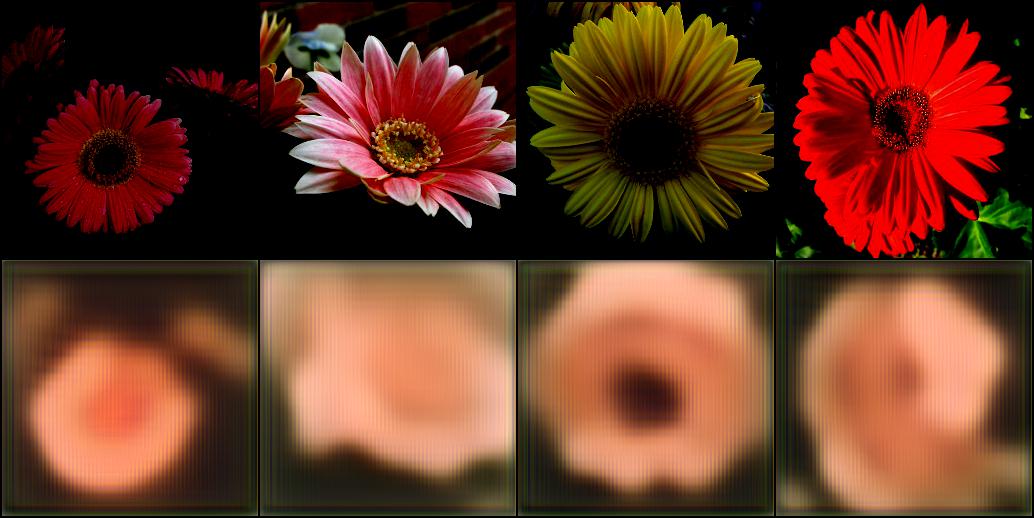
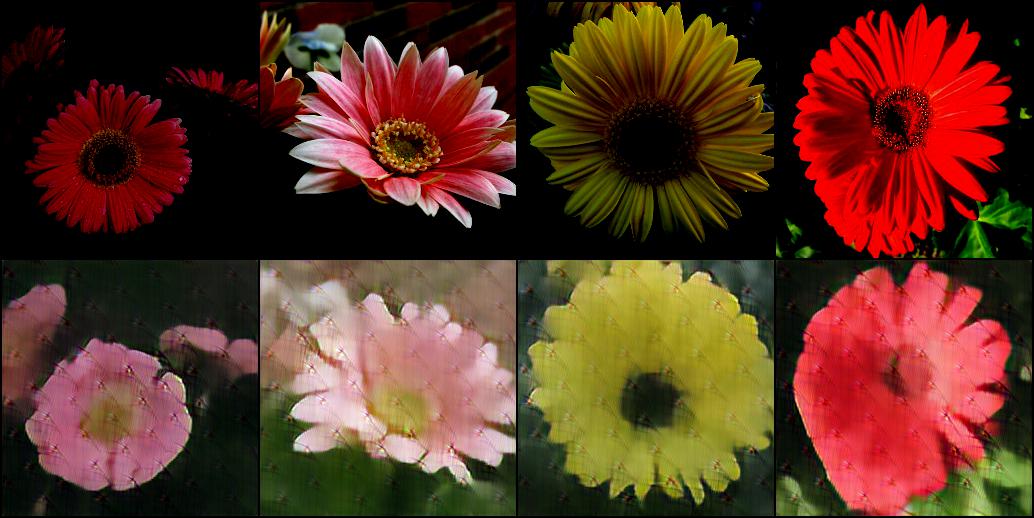
Results for First Stage (Reconstruction):

1. Epoch:
50. Epoch:
Results for Second Stage (Generating new Images):

Original Left | Reconstruction Middle Left | Completion Middle Right | New Image Right

1. Epoch:

100. Epoch:

Note: Let the model train for even longer to get better results.

Train VQGAN on your own data:

Training First Stage

  1. (optional) Configure Hyperparameters in training_vqgan.py
  2. Set path to dataset in training_vqgan.py
  3. python training_vqgan.py

Training Second Stage

  1. (optional) Configure Hyperparameters in training_transformer.py
  2. Set path to dataset in training_transformer.py
  3. python training_transformer.py

Citation

@misc{esser2021taming,
      title={Taming Transformers for High-Resolution Image Synthesis}, 
      author={Patrick Esser and Robin Rombach and Björn Ommer},
      year={2021},
      eprint={2012.09841},
      archivePrefix={arXiv},
      primaryClass={cs.CV}
}
Nearby in the ranking
Similar items