MCP server for Apple Developer Documentation - Search iOS/macOS/SwiftUI/UIKit docs, WWDC videos, Swift/Objective-C APIs & code examples in Claude, Cursor & AI assistants.
Observe how memory shapes an answer. Pensieve is an interactive system for visualizing, interpreting, and managing how Large Language Models (LLMs) “remember” a user. It bridges the gap between model-level mechanisms and user-level understanding, making AI memory observable, explainable, and partially controllable.
Key parameters and specifications
Key parameters and specifications
Parameter
Value
Language
Python
Category
AI Engineering
Subcategory
Make agent see hear talk
Stars
1,386
Forks
204
Contributors
2
Created date
2021-05-19
Updated date
2026-10-13
Stars in 1 day
0
Stars in 7 days
3
Rank
10,498
Previous rank
10,491
Rank change
-7
7-day stars rank
6,952
Previous 7-day stars rank
6,979
7-day stars rank change
27
Total stars rank
8,638
Previous total stars rank
8,626
Total stars rank change
-12
Country
China
README summary
Music Source Separation Music source separation is a task to separate audio recordings into individual sources. This repository is an PyTorch implmementation of music source separation. Users can separate their favorite songs into different sources by installing this repository. Users can also train their own source separation systems. This repository can also be used for training speech enhancement, instruments separation, and any separation systems. Demos Vocals and accompaniment separation: Installation Install Python 3. Sometimes the installation of bytesep will fail
when using higher versions of Python. Suggest to use conda (or other environment manage tools) to manage the packages. Separation After installation, to separate your favorite song is easy. Users can execute the following commands in any directory. Users can also put many audio files into a directory and separate them all. The currently supported source types include "vocals" and "accompaniment". Users could also plug this MSS system into their own programmes. The separation models are trained ONLY on the
Musdb18 dataset (100 songs). Trained checkpoints can be downloaded at: Train a music source separation system from scratch 0. Download dataset Users could train on the MUSDB18 dataset to reproduce our music source separation systems. Execute the following script to download and unzip the MUSDB18 dataset: The dataset looks like: 1. Pack audio files into hdf5 files Pack audio waveforms into hdf5 files to speed up training. Separate using user trained checkpoint Results 1. Separation Metrics The following table shows
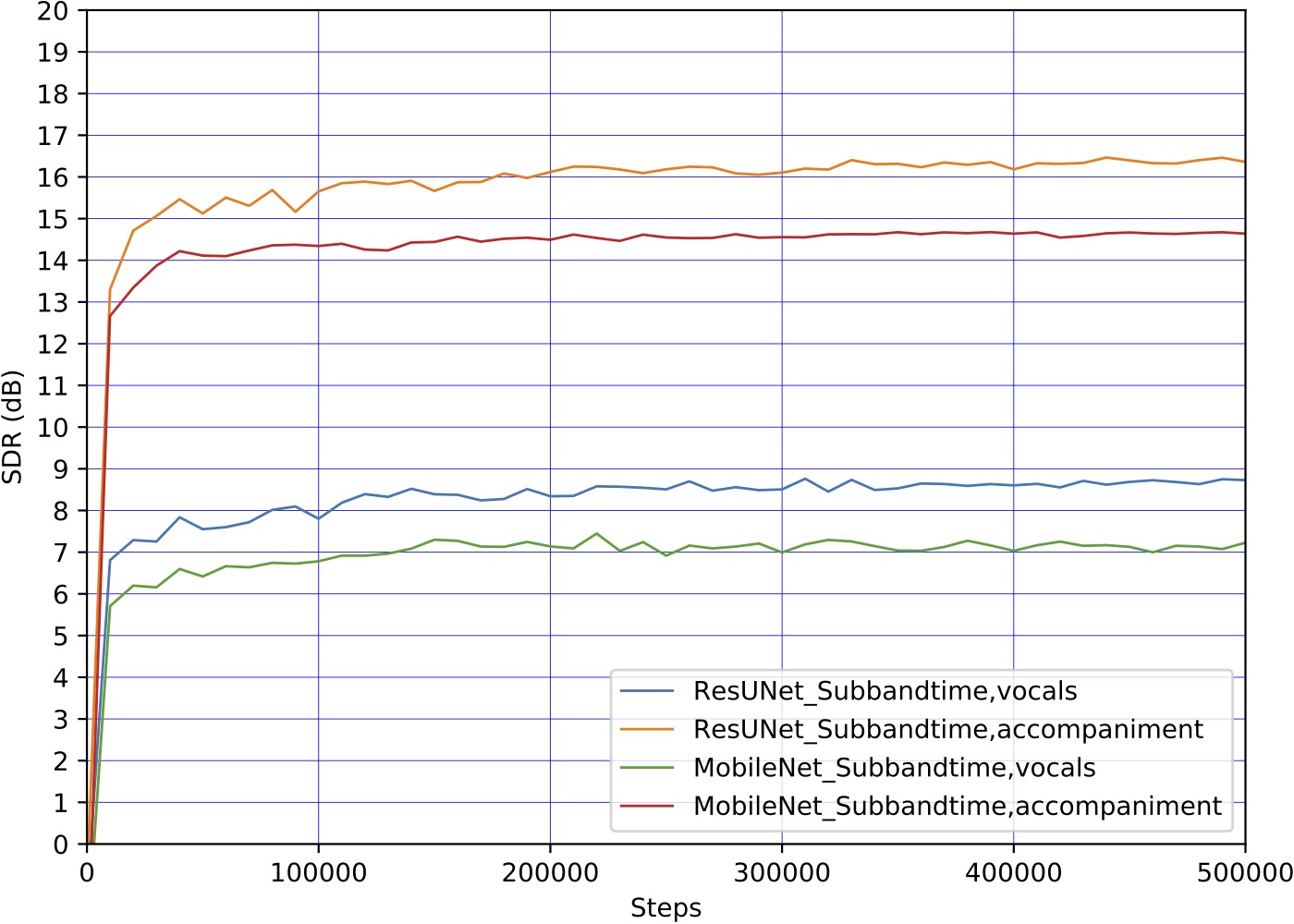
the signal to noise ratio (SDR) metrics of vocals and accompaniment. The MSS systems are only trained with 100 songs from the MUSDB18 dataset. The metrics are calculated on the 50 test songs. It is highly suggest to use the subband version because it is faster to train and inference. Parameters number & speed The following table shows the number of parameters and inference time of a 1-min audio clip. 00 s | | ResUNet143 Subband | 102 million | 0. Metrics over step
The evaluation metrics over different stesp is shown below. Finetune on new datasets Users can finetuen pretrained checkpoints on new datasets. The following script is a template showing how to finetune pretrained a MSS system to the VCTK dataset for speech enhancement. There is no problem if users do not have the VCTK dataset. ) Users can also resume the training from a checkpoint by modifying the following script. Cite [1] Qiuqiang Kong, Yin Cao, Haohe Liu, Keunwoo Choi, Yuxuan Wang
, Decoupling Magnitude and Phase Estimation with Deep ResUNet for Music Source Separation, International Society for Music Information Retrieval (ISMIR), 2021. Contact Qiquiang Kong Frequent Asked Questions (FAQ) FAQ. md External Links Other open sourced music source separation projects include but not limited to: Subband ResUNet: Demucs: Spleeter: Asteroid: Open-Unmix:
Frequently asked questions
How many stars and forks are recorded?
bytedance/music_source_separation has 1,386 stars and 204 forks.
What is the repository rank?
bytedance/music_source_separation is ranked 10,498.
What language and category are recorded?
bytedance/music_source_separation has 1,386 stars, uses Python and belongs to AI Engineering.
Which repository is closest in rank?
bytedance/music_source_separation is compared with Prismer-AI/PrismerCloud, ranked 10,497 with 1,386 stars.
README
Music Source Separation
Music source separation is a task to separate audio recordings into individual sources. This repository is an PyTorch implmementation of music source separation. Users can separate their favorite songs into different sources by installing this repository. Users can also train their own source separation systems. This repository can also be used for training speech enhancement, instruments separation, and any separation systems.
Sometimes the installation of bytesep will fail when using higher versions of Python. Suggest to use conda (or other environment manage tools) to manage the packages.
pip install bytesep==0.1.1
Separation
After installation, to separate your favorite song is easy. Users can execute the following commands in any directory.
python3 -m bytesep download_checkpoints
python3 -m bytesep separate \
    --source_type="vocals" \
    --audio_path="./resources/vocals_accompaniment_10s.mp3" \
    --output_path="separated_results/output.mp3"
Users can also put many audio files into a directory and separate them all.
python3 -m bytesep separate \
    --source_type="vocals" \
    --audio_path="audios_directory" \
    --output_path="outputs_directory"
The currently supported source types include "vocals" and "accompaniment". Users could also plug this MSS system into their own programmes. See example.py for examples.
Train a music source separation system from scratch
0. Download dataset
Users could train on the MUSDB18 dataset to reproduce our music source separation systems. Execute the following script to download and unzip the MUSDB18 dataset:
The following table shows the signal to noise ratio (SDR) metrics of vocals and accompaniment. The MSS systems are only trained with 100 songs from the MUSDB18 dataset. The metrics are calculated on the 50 test songs. It is highly suggest to use the subband version because it is faster to train and inference.
Model
vocals (dB)
accompaniment (dB)
ResUNet143 vocals
8.9
16.8
ResUNet143 Subband vocals
8.7
16.4
MobileNet Subband vocals
7.2
14.6
2. Parameters number & speed
The following table shows the number of parameters and inference time of a 1-min audio clip.
Model
Trainable params. num
process 1-min time (GPU Tesla V100)
process 1-min time (CPU Core i7)
ResUNet143 ISMIR
102 million
2.24 s
53.00 s
ResUNet143 Subband
102 million
0.56 s
13.68 s
MobileNet Subband
0.306 million
0.33 s
9.84
3. Metrics over step
The evaluation metrics over different stesp is shown below.
Finetune on new datasets
Users can finetuen pretrained checkpoints on new datasets. The following script is a template showing how to finetune pretrained a MSS system to the VCTK dataset for speech enhancement. (This is just an example. There is no problem if users do not have the VCTK dataset.) Users can also resume the training from a checkpoint by modifying the following script.
./scripts/4_train/vctk-musdb18/finetune.sh
Cite
[1] Qiuqiang Kong, Yin Cao, Haohe Liu, Keunwoo Choi, Yuxuan Wang, Decoupling Magnitude and Phase Estimation with Deep ResUNet for Music Source Separation, International Society for Music Information Retrieval (ISMIR), 2021.
@inproceedings{kong2021decoupling,
  title={Decoupling Magnitude and Phase Estimation with Deep ResUNet for Music Source Separation.},
  author={Kong, Qiuqiang and Cao, Yin and Liu, Haohe and Choi, Keunwoo and Wang, Yuxuan },
  booktitle={ISMIR},
  year={2021},
  organization={Citeseer}
}