U-ViT
Official PyTorch implementation of All are Worth Words: A ViT Backbone for Diffusion Models (CVPR 2023)
💡Projects with U-ViT:
- UniDiffuser, a multi-modal large-scale diffusion model based on a 1B U-ViT, is open-sourced
- DPT, code, demo a conditional diffusion model trained with 1 label/class with SOTA SSL generation and classification results on ImageNet
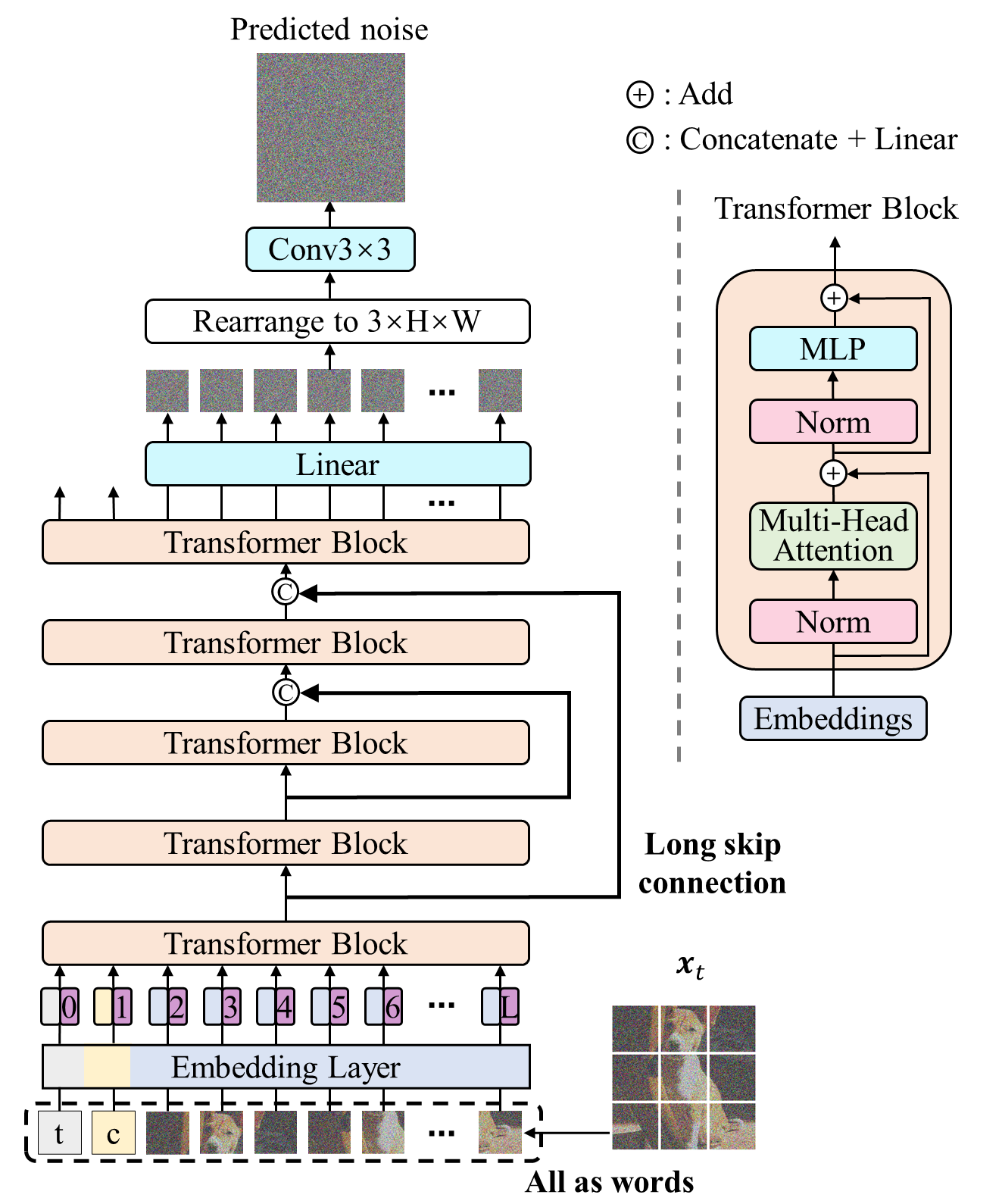
Vision transformers (ViT) have shown promise in various vision tasks while the U-Net based on a convolutional neural network (CNN) remains dominant in diffusion models. We design a simple and general ViT-based architecture (named U-ViT) for image generation with diffusion models. U-ViT is characterized by treating all inputs including the time, condition and noisy image patches as tokens and employing long skip connections between shallow and deep layers. We evaluate U-ViT in unconditional and class-conditional image generation, as well as text-to-image generation tasks, where U-ViT is comparable if not superior to a CNN-based U-Net of a similar size. In particular, latent diffusion models with U-ViT achieve record-breaking FID scores of 2.29 in class-conditional image generation on ImageNet 256x256, and 5.48 in text-to-image generation on MS-COCO, among methods without accessing large external datasets during the training of generative models.
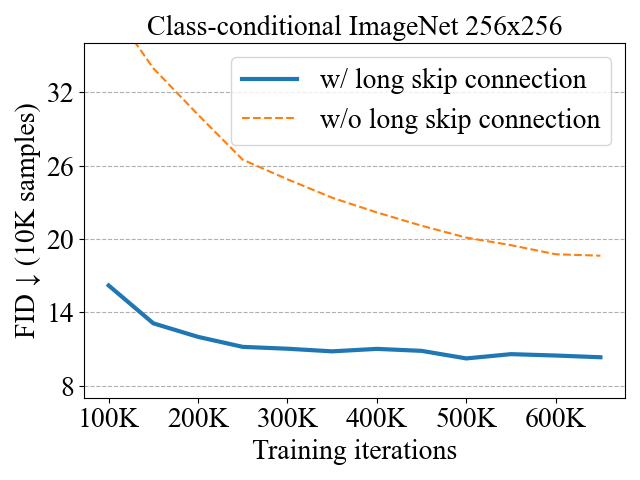
Our results suggest that, for diffusion-based image modeling, the long skip connection is crucial while the down-sampling and up-sampling operators in CNN-based U-Net are not always necessary. We believe that U-ViT can provide insights for future research on backbones in diffusion models and benefit generative modeling on large scale cross-modality datasets.
This codebase implements the transformer-based backbone 📌U-ViT📌 for diffusion models, as introduced in the paper. U-ViT treats all inputs as tokens and employs long skip connections. The long skip connections grealy promote the performance and the convergence speed.
💡This codebase contains:
- An implementation of U-ViT with optimized attention computation
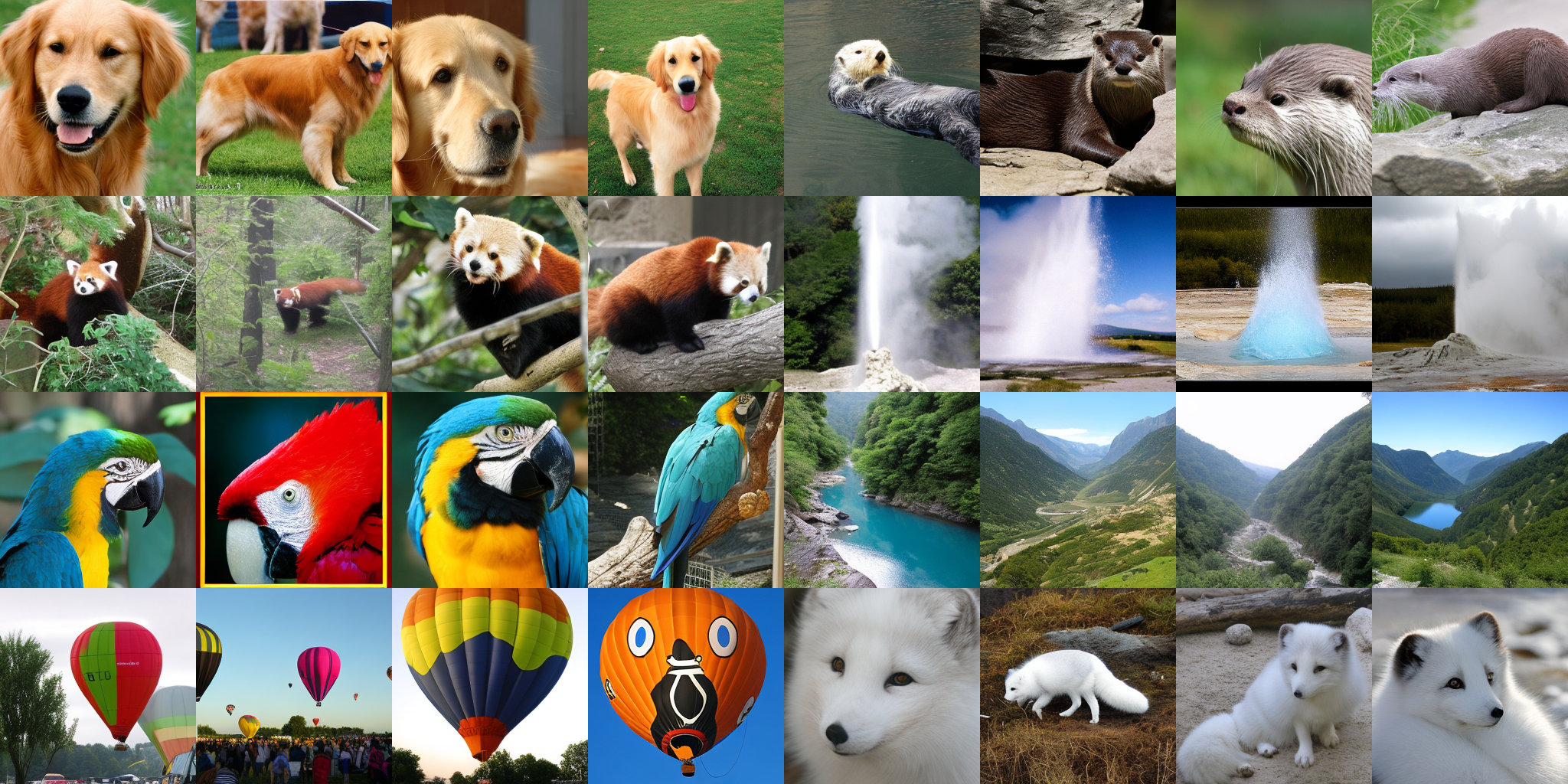
- Pretrained U-ViT models on common image generation benchmarks (CIFAR10, CelebA 64x64, ImageNet 64x64, ImageNet 256x256, ImageNet 512x512)
- Efficient training scripts for pixel-space diffusion models, latent space diffusion models and text-to-image diffusion models
- Efficient evaluation scripts for pixel-space diffusion models and latent space diffusion models and text-to-image diffusion models
- A Colab notebook demo for sampling from U-ViT on ImageNet (FID=2.29)

💡This codebase supports useful techniques for efficient training and sampling of diffusion models:
- Mixed precision training with the huggingface accelerate library (🥰automatically turned on)
- Efficient attention computation with the facebook xformers library (needs additional installation)
- Gradient checkpointing trick, which reduces ~65% memory (🥰automatically turned on)
- With these techniques, we are able to train our largest U-ViT-H on ImageNet at high resolutions such as 256x256 and 512x512 using a large batch size of 1024 with only 2 A100❗
Training speed and memory of U-ViT-H/2 on ImageNet 256x256 using a batch size of 128 with a A100:
| mixed precision training | xformers | gradient checkpointing | training speed | memory |
|---|---|---|---|---|
| ❌ | ❌ | ❌ | - | out of memory |
| ✔ | ❌ | ❌ | 0.97 steps/second | 78852 MB |
| ✔ | ✔ | ❌ | 1.14 steps/second | 54324 MB |
| ✔ | ✔ | ✔ | 0.87 steps/second | 18858 MB |
Dependency
pip install torch torchvision --extra-index-url https://download.pytorch.org/whl/cu116  # install torch-1.13.1
pip install accelerate==0.12.0 absl-py ml_collections einops wandb ftfy==6.1.1 transformers==4.23.1

# xformers is optional, but it would greatly speed up the attention computation.
pip install -U xformers
pip install -U --pre triton
- This repo is based on
timm==0.3.2, for which a fix is needed to work with PyTorch 1.8.1+. (Perhaps other versions also work, but I haven't tested it.) - We highly suggest install xformers, which would greatly speed up the attention computation for both training and inference.
Pretrained Models
| Model | FID | training iterations | batch size |
|---|---|---|---|
| CIFAR10 (U-ViT-S/2) | 3.11 | 500K | 128 |
| CelebA 64x64 (U-ViT-S/4) | 2.87 | 500K | 128 |
| ImageNet 64x64 (U-ViT-M/4) | 5.85 | 300K | 1024 |
| ImageNet 64x64 (U-ViT-L/4) | 4.26 | 300K | 1024 |
| ImageNet 256x256 (U-ViT-L/2) | 3.40 | 300K | 1024 |
| ImageNet 256x256 (U-ViT-H/2) | 2.29 | 500K | 1024 |
| ImageNet 512x512 (U-ViT-L/4) | 4.67 | 500K | 1024 |
| ImageNet 512x512 (U-ViT-H/4) | 4.05 | 500K | 1024 |
| MS-COCO (U-ViT-S/2) | 5.95 | 1M | 256 |
| MS-COCO (U-ViT-S/2, Deep) | 5.48 | 1M | 256 |
Preparation Before Training and Evaluation
Autoencoder
Download stable-diffusion directory from this link (which contains image autoencoders converted from Stable Diffusion).
Put the downloaded directory as assets/stable-diffusion in this codebase.
The autoencoders are used in latent diffusion models.
Data
- ImageNet 64x64: Put the standard ImageNet dataset (which contains the
trainandvaldirectory) toassets/datasets/ImageNet. - ImageNet 256x256 and ImageNet 512x512: Extract ImageNet features according to
scripts/extract_imagenet_feature.py. - MS-COCO: Download COCO 2014 training, validation data and annotations. Then extract their features according to
scripts/extract_mscoco_feature.pyscripts/extract_test_prompt_feature.pyscripts/extract_empty_feature.py.
Reference statistics for FID
Download fid_stats directory from this link (which contains reference statistics for FID).
Put the downloaded directory as assets/fid_stats in this codebase.
In addition to evaluation, these reference statistics are used to monitor FID during the training process.
Training
We use the huggingface accelerate library to help train with distributed data parallel and mixed precision. The following is the training command:
# the training setting
num_processes=2  # the number of gpus you have, e.g., 2
train_script=train.py  # the train script, one of
                       # train.py: training on pixel space
                       # train_ldm.py: training on latent space with continuous timesteps
                       # train_ldm_discrete.py: training on latent space with discrete timesteps
                       # train_t2i_discrete.py: text-to-image training on latent space
config=configs/cifar10_uvit_small.py  # the training configuration
                                      # you can change other hyperparameters by modifying the configuration file

# launch training
accelerate launch --multi_gpu --num_processes $num_processes --mixed_precision fp16 $train_script --config=$config
We provide all commands to reproduce U-ViT training in the paper:
# CIFAR10 (U-ViT-S/2)
accelerate launch --multi_gpu --num_processes 4 --mixed_precision fp16 train.py --config=configs/cifar10_uvit_small.py

# CelebA 64x64 (U-ViT-S/4)
accelerate launch --multi_gpu --num_processes 4 --mixed_precision fp16 train.py --config=configs/celeba64_uvit_small.py

# ImageNet 64x64 (U-ViT-M/4)
accelerate launch --multi_gpu --num_processes 8 --mixed_precision fp16 train.py --config=configs/imagenet64_uvit_mid.py

# ImageNet 64x64 (U-ViT-L/4)
accelerate launch --multi_gpu --num_processes 8 --mixed_precision fp16 train.py --config=configs/imagenet64_uvit_large.py

# ImageNet 256x256 (U-ViT-L/2)
accelerate launch --multi_gpu --num_processes 8 --mixed_precision fp16 train_ldm.py --config=configs/imagenet256_uvit_large.py

# ImageNet 256x256 (U-ViT-H/2)
accelerate launch --multi_gpu --num_processes 8 --mixed_precision fp16 train_ldm_discrete.py --config=configs/imagenet256_uvit_huge.py

# ImageNet 512x512 (U-ViT-L/4)
accelerate launch --multi_gpu --num_processes 8 --mixed_precision fp16 train_ldm.py --config=configs/imagenet512_uvit_large.py

# ImageNet 512x512 (U-ViT-H/4)
accelerate launch --multi_gpu --num_processes 8 --mixed_precision fp16 train_ldm_discrete.py --config=configs/imagenet512_uvit_huge.py

# MS-COCO (U-ViT-S/2)
accelerate launch --multi_gpu --num_processes 4 --mixed_precision fp16 train_t2i_discrete.py --config=configs/mscoco_uvit_small.py

# MS-COCO (U-ViT-S/2, Deep)
accelerate launch --multi_gpu --num_processes 4 --mixed_precision fp16 train_t2i_discrete.py --config=configs/mscoco_uvit_small.py --config.nnet.depth=16
Evaluation (Compute FID)
We use the huggingface accelerate library for efficient inference with mixed precision and multiple gpus. The following is the evaluation command:
# the evaluation setting
num_processes=2  # the number of gpus you have, e.g., 2
eval_script=eval.py  # the evaluation script, one of
                     # eval.py: for models trained with train.py (i.e., pixel space models)
                     # eval_ldm.py: for models trained with train_ldm.py (i.e., latent space models with continuous timesteps)
                     # eval_ldm_discrete.py: for models trained with train_ldm_discrete.py (i.e., latent space models with discrete timesteps)
                     # eval_t2i_discrete.py: for models trained with train_t2i_discrete.py (i.e., text-to-image models on latent space)
config=configs/cifar10_uvit_small.py  # the training configuration

# launch evaluation
accelerate launch --multi_gpu --num_processes $num_processes --mixed_precision fp16 eval_script --config=$config
The generated images are stored in a temperary directory, and will be deleted after evaluation. If you want to keep these images, set --config.sample.path=/save/dir.
We provide all commands to reproduce FID results in the paper:
# CIFAR10 (U-ViT-S/2)
accelerate launch --multi_gpu --num_processes 4 --mixed_precision fp16 eval.py --config=configs/cifar10_uvit_small.py --nnet_path=cifar10_uvit_small.pth

# CelebA 64x64 (U-ViT-S/4)
accelerate launch --multi_gpu --num_processes 4 --mixed_precision fp16 eval.py --config=configs/celeba64_uvit_small.py --nnet_path=celeba64_uvit_small.pth

# ImageNet 64x64 (U-ViT-M/4)
accelerate launch --multi_gpu --num_processes 8 --mixed_precision fp16 eval.py --config=configs/imagenet64_uvit_mid.py --nnet_path=imagenet64_uvit_mid.pth

# ImageNet 64x64 (U-ViT-L/4)
accelerate launch --multi_gpu --num_processes 8 --mixed_precision fp16 eval.py --config=configs/imagenet64_uvit_large.py --nnet_path=imagenet64_uvit_large.pth

# ImageNet 256x256 (U-ViT-L/2)
accelerate launch --multi_gpu --num_processes 8 --mixed_precision fp16 eval_ldm.py --config=configs/imagenet256_uvit_large.py --nnet_path=imagenet256_uvit_large.pth

# ImageNet 256x256 (U-ViT-H/2)
accelerate launch --multi_gpu --num_processes 8 --mixed_precision fp16 eval_ldm_discrete.py --config=configs/imagenet256_uvit_huge.py --nnet_path=imagenet256_uvit_huge.pth

# ImageNet 512x512 (U-ViT-L/4)
accelerate launch --multi_gpu --num_processes 8 --mixed_precision fp16 eval_ldm.py --config=configs/imagenet512_uvit_large.py --nnet_path=imagenet512_uvit_large.pth

# ImageNet 512x512 (U-ViT-H/4)
accelerate launch --multi_gpu --num_processes 8 --mixed_precision fp16 eval_ldm_discrete.py --config=configs/imagenet512_uvit_huge.py --nnet_path=imagenet512_uvit_huge.pth

# MS-COCO (U-ViT-S/2)
accelerate launch --multi_gpu --num_processes 4 --mixed_precision fp16 eval_t2i_discrete.py --config=configs/mscoco_uvit_small.py --nnet_path=mscoco_uvit_small.pth

# MS-COCO (U-ViT-S/2, Deep)
accelerate launch --multi_gpu --num_processes 4 --mixed_precision fp16 eval_t2i_discrete.py --config=configs/mscoco_uvit_small.py --config.nnet.depth=16 --nnet_path=mscoco_uvit_small_deep.pth
References
If you find the code useful for your research, please consider citing
@inproceedings{bao2022all,
  title={All are Worth Words: A ViT Backbone for Diffusion Models},
  author={Bao, Fan and Nie, Shen and Xue, Kaiwen and Cao, Yue and Li, Chongxuan and Su, Hang and Zhu, Jun},
  booktitle = {CVPR},
  year={2023}
}
This implementation is based on
- Extended Analytic-DPM (provide the FID reference statistics on CIFAR10 and CelebA 64x64)
- guided-diffusion (provide the FID reference statistics on ImageNet)
- pytorch-fid (provide the official implementation of FID to PyTorch)
- dpm-solver (provide the sampler)