Fast and accurate human pose estimation in PyTorch. Contains implementation of "Real-time 2D Multi-Person Pose Estimation on CPU: Lightweight OpenPose" paper.
Chinese NER(Named Entity Recognition) using BERT(Softmax, CRF, Span).
Key parameters and specifications
Key parameters and specifications
Parameter
Value
Language
Python
Category
Model Development
Subcategory
Domain-specific training, Training toolkits
Stars
2,243
Forks
397
Contributors
32
Created date
2017-02-02
Updated date
2026-10-09
Stars in 1 day
0
Stars in 7 days
1
Rank
8,820
Previous rank
8,885
Rank change
65
7-day stars rank
9,436
Previous 7-day stars rank
9,484
7-day stars rank change
48
Total stars rank
5,787
Previous total stars rank
5,779
Total stars rank change
-8
Country
USA
README summary
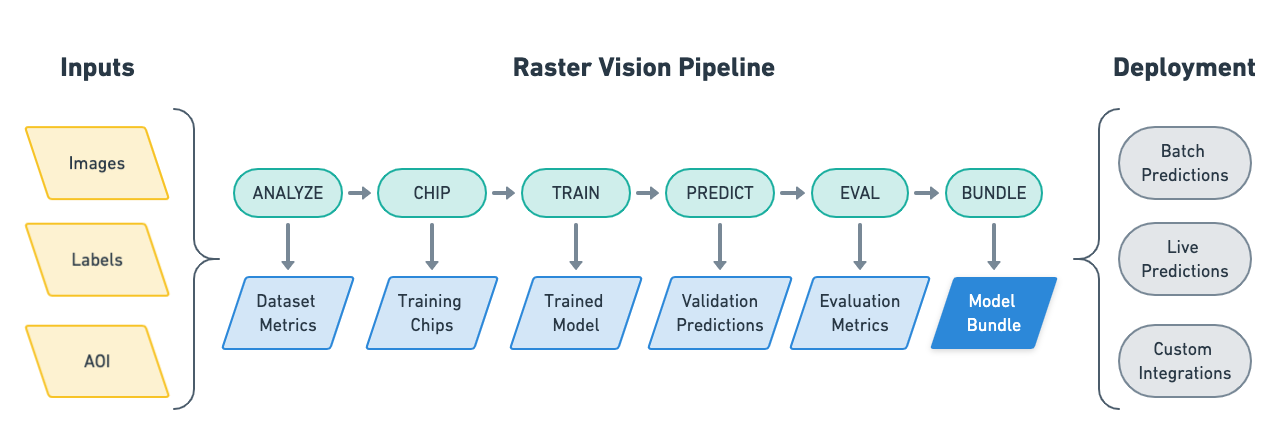
Raster Vision is an open source Python **library** and **framework** for building computer vision models on satellite, aerial, and other large imagery sets (including oblique drone imagery). It has built-in support for chip classification, object detection, and semantic segmentation with backends using PyTorch. **As a library**, Raster Vision provides a full suite of utilities for dealing with all aspects of a geospatial deep learning workflow: reading geo-referenced data, training models, making predictions, and writing out predictions in geo
-referenced formats. **As a low-code framework**, Raster Vision allows users (who don't need to be experts in deep learning! ) to quickly and repeatably configure experiments that execute a machine learning pipeline including: analyzing training data, creating training chips, training models, creating predictions, evaluating models, and bundling the model files and configuration for easy deployment. Raster Vision also has built-in support for running experiments in the cloud using AWS Batch as well as AWS Sagemaker. Installation *For more details
, see the Setup documentation*. Install via You can install Raster Vision directly via . Use Pre-built Docker Image Alternatively, you may use a Docker image. We publish a new tag per merge into , which is tagged with the first 7 characters of the commit hash. To use the latest version, pull the suffix, e. Git tags are also published, with the Github tag name as the Docker tag suffix. Build Docker Image You can also build a Docker image from
scratch yourself. After cloning this repo, run , and run then the container using . Usage Examples and Tutorials **Non-developers** may find it easiest to use Raster Vision as a low-code framework where Raster Vision handles all the complexities and the user only has to configure a few parameters. The *Quickstart guide* is a good entry-point into this. More advanced examples can be found on the *Examples* page. For **developers** and those looking to dive deeper or combine Raster
Vision with their own code, the best starting point is *Usage Overview*, followed by *Basic Concepts* and *Tutorials*. Contact and Support You can ask questions and talk to developers (let us know what you're working on! ) at: Discussion Forum Mailing List Developing To set up the development environment: For and clone the repo and navigate to it. Create and activate a new Python virtual environment via your environment manager of choice ( , , , etc. Run to install all Raster Vision plugins in
editable mode along with all the dependencies. Contributing *For more information, see Contributing. It is best to get in touch with the maintainers about larger features or design changes *before* starting the work, as it will make the process of accepting changes smoother. Everyone who contributes code to Raster Vision will be asked to sign a Contributor License Agreement. Licenses Raster Vision is licensed under the Apache 2 license. 3rd party licenses for all dependecies used by Raster Vision can
be found here.
Frequently asked questions
How many stars and forks are recorded?
azavea/raster-vision has 2,243 stars and 397 forks.
What is the repository rank?
azavea/raster-vision is ranked 8,820.
What language and category are recorded?
azavea/raster-vision has 2,243 stars, uses Python and belongs to Model Development.
Which repository is closest in rank?
azavea/raster-vision is compared with Accenture/AmpliGraph, ranked 8,821 with 2,242 stars.
README
Raster Vision is an open source Python library and framework for building computer vision models on satellite, aerial, and other large imagery sets (including oblique drone imagery).
It has built-in support for chip classification, object detection, and semantic segmentation with backends using PyTorch.

As a library, Raster Vision provides a full suite of utilities for dealing with all aspects of a geospatial deep learning workflow: reading geo-referenced data, training models, making predictions, and writing out predictions in geo-referenced formats.
As a low-code framework, Raster Vision allows users (who don't need to be experts in deep learning!) to quickly and repeatably configure experiments that execute a machine learning pipeline including: analyzing training data, creating training chips, training models, creating predictions, evaluating models, and bundling the model files and configuration for easy deployment.
Raster Vision also has built-in support for running experiments in the cloud using AWS Batch as well as AWS Sagemaker.
Alternatively, you may use a Docker image. Docker images are published to quay.io (see the tags tab).
We publish a new tag per merge into master, which is tagged with the first 7 characters of the commit hash. To use the latest version, pull the latest suffix, e.g. raster-vision:pytorch-latest. Git tags are also published, with the Github tag name as the Docker tag suffix.
Build Docker Image
You can also build a Docker image from scratch yourself. After cloning this repo, run docker/build, and run then the container using docker/run.
Usage Examples and Tutorials
Non-developers may find it easiest to use Raster Vision as a low-code framework where Raster Vision handles all the complexities and the user only has to configure a few parameters. The Quickstart guide is a good entry-point into this. More advanced examples can be found on the Examples page.
For developers and those looking to dive deeper or combine Raster Vision with their own code, the best starting point is Usage Overview, followed by Basic Concepts and Tutorials.
Contact and Support
You can ask questions and talk to developers (let us know what you're working on!) at:
We are happy to take contributions! It is best to get in touch with the maintainers
about larger features or design changes before starting the work,
as it will make the process of accepting changes smoother.
Everyone who contributes code to Raster Vision will be asked to sign a Contributor License Agreement. See Contributing for instructions.
Licenses
Raster Vision is licensed under the Apache 2 license. See license here.
3rd party licenses for all dependecies used by Raster Vision can be found here.