← Open Source
abarankab

DDPM

PyTorch DDPM implementation.

Model DevelopmentArchitecturePython
Open on GitHub
Momentum
+0stars in 24 hours0.0%
870
Stars
127
Forks
+0
This week
1
Contributors
Created 2021-07-20 · Updated 2026-10-13 · #13032 today
Top developers
abarankab

abarankab/DDPM is ranked 13,032 with 870 stars.

Same-category comparison

abarankab/DDPM is ranked 13,032 among these 8 peers; NVIDIA-BioNeMo/bionemo-recipes is ranked 13,030.

Same-category comparison
NameRankMetrics
CharlesShang/TFFRCNN13,020
Language:
Python
Stars:
871
Forks:
403
Description:
FastER RCNN built on tensorflow.
instadeepai/jumanji13,025
Language:
Python
Stars:
871
Forks:
99
Description:
🕹️ A diverse suite of scalable reinforcement learning environments in JAX.
switchablenorms/Switchable-Normalization13,027
Language:
HTML
Stars:
871
Forks:
128
Description:
Code for Switchable Normalization from "Differentiable Learning-to-Normalize via Switchable Normalization", https://arxiv.org/abs/1806.10779.
NVIDIA-BioNeMo/bionemo-recipes13,030
Language:
Python
Stars:
870
Forks:
185
Description:
BioNeMo Recipes: For building and adapting AI models in drug discovery at scale.
georgian-io/LLM-Finetuning-Toolkit13,035
Language:
Python
Stars:
870
Forks:
107
Description:
Toolkit for fine-tuning, ablating and unit-testing open-source LLMs.
Kyubyong/sudoku13,041
Language:
Python
Stars:
869
Forks:
132
Description:
Can Neural Networks Crack Sudoku.
bstriner/keras-adversarial13,043
Language:
Python
Stars:
869
Forks:
229
Description:
Keras Generative Adversarial Networks.
yeyupiaoling/PPASR13,046
Language:
Python
Stars:
869
Forks:
129
Key parameters and specifications
ParameterValue
LanguagePython
CategoryModel Development
SubcategoryArchitecture
KeywordsImage production
Stars870
Forks127
Contributors1
Created date2021-07-20
Updated date2026-10-13
Stars in 1 day0
Stars in 7 days0
Rank13,032
Previous rank12,923
Rank change-109
7-day stars rank13,729
Previous 7-day stars rank13,741
7-day stars rank change12
Total stars rank12,439
Previous total stars rank12,421
Total stars rank change-18
CountryUK
README summary

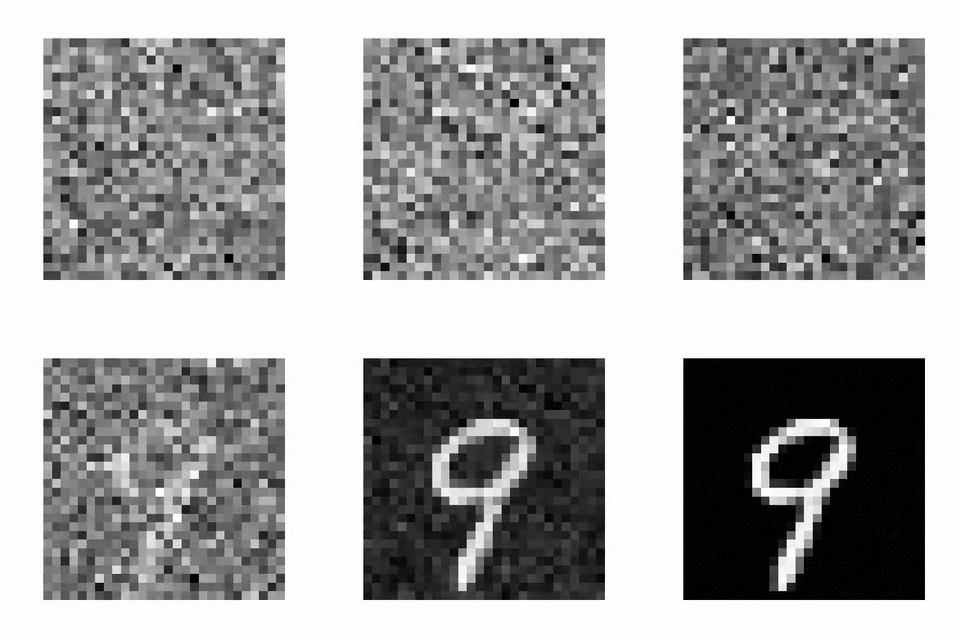
Denoising Diffusion Probabilistic Models An implementation of Denoising Diffusion Probabilistic Models for image generation written in PyTorch. This roughly follows the original code by Ho et al. Unlike their implementation, however, my model allows for class conditioning through bias in residual blocks. Experiments I have trained the model on MNIST and CIFAR-10 datasets. The model seemed to converge well on the MNIST dataset, producing realistic samples. However, I am yet to report the same CIFAR-10 quality that Ho

. Here are the samples generated with a linear schedule after 2000 epochs: Here is a sample of a diffusion sequence on MNIST: Resources I gave a talk about diffusion models, NCSNs, and their applications in audio generation. I also compiled a report with what are, in my opinion, the most crucial findings on the topic of denoising diffusion models. It is also available in this repository. Acknowledgements I used Phil Wang's implementation and the official Tensorflow repo as a reference

for my work. Citations `bibtex @inproceedings{anonymous2021improved, }

Frequently asked questions

How many stars and forks are recorded?

abarankab/DDPM has 870 stars and 127 forks.

What is the repository rank?

abarankab/DDPM is ranked 13,032.

What language and category are recorded?

abarankab/DDPM has 870 stars, uses Python and belongs to Model Development.

Which repository is closest in rank?

abarankab/DDPM is compared with NVIDIA-BioNeMo/bionemo-recipes, ranked 13,030 with 870 stars.

README

Denoising Diffusion Probabilistic Models

An implementation of Denoising Diffusion Probabilistic Models for image generation written in PyTorch. This roughly follows the original code by Ho et al. Unlike their implementation, however, my model allows for class conditioning through bias in residual blocks.

Experiments

I have trained the model on MNIST and CIFAR-10 datasets. The model seemed to converge well on the MNIST dataset, producing realistic samples. However, I am yet to report the same CIFAR-10 quality that Ho. et al. provide in their paper. Here are the samples generated with a linear schedule after 2000 epochs:

Here is a sample of a diffusion sequence on MNIST:

Resources

I gave a talk about diffusion models, NCSNs, and their applications in audio generation. The slides are available here.

I also compiled a report with what are, in my opinion, the most crucial findings on the topic of denoising diffusion models. It is also available in this repository.

Acknowledgements

I used Phil Wang's implementation and the official Tensorflow repo as a reference for my work.

Citations

@misc{ho2020denoising,
    title   = {Denoising Diffusion Probabilistic Models},
    author  = {Jonathan Ho and Ajay Jain and Pieter Abbeel},
    year    = {2020},
    eprint  = {2006.11239},
    archivePrefix = {arXiv},
    primaryClass = {cs.LG}
}
@inproceedings{anonymous2021improved,
    title   = {Improved Denoising Diffusion Probabilistic Models},
    author  = {Anonymous},
    booktitle = {Submitted to International Conference on Learning Representations},
    year    = {2021},
    url     = {https://openreview.net/forum?id=-NEXDKk8gZ},
    note    = {under review}
}
Nearby in the ranking
Similar items