Agentic RL Reproductions with Slime
 Reproductions of various Agentic RL training methods, built on top of the slime framework.
slime exposes flexible hooks for custom generate functions and reward functions, making it straightforward to integrate multi-step agent rollouts into RL training pipelines. This repository implements and reproduces representative Agentic RL algorithms on top of that foundation. All implementations live under the agentic/ directory.
Implemented Methods
AgentFlow — agentic/agentflow/
Reproduces the core idea of AgentFlow: extending single-step LLM inference into a multi-turn Planner → Executor → Verifier agent loop, applying RL signals (GRPO) to the Planner's generation trajectory. This allows the model to improve its tool-use and reasoning capabilities without requiring manually annotated intermediate steps.
Architecture
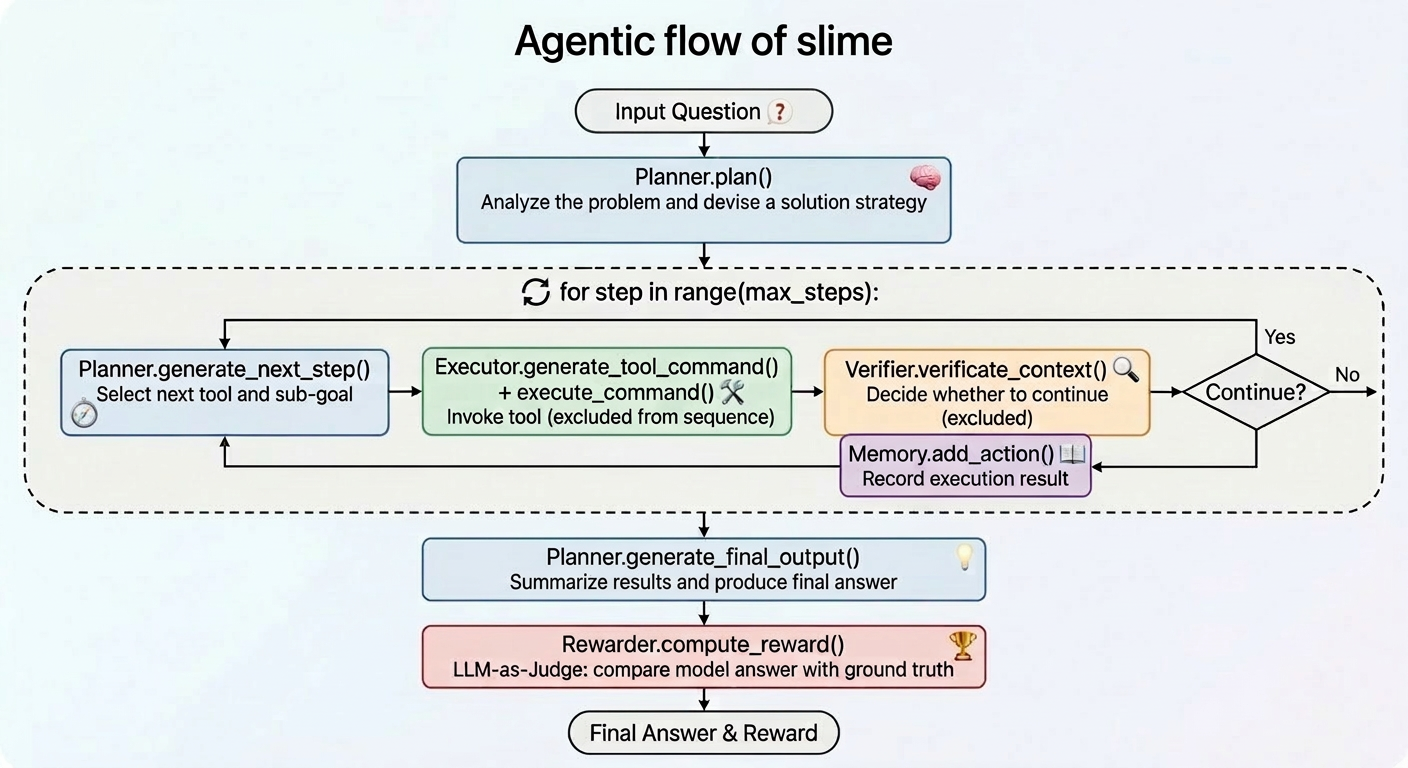
Input question
  │
  ▼
Planner.plan()              ← Analyze the problem and devise a solution strategy (loss_mask=1)
  │
  └─► for step in range(max_steps):
        │
        ├─ Planner.generate_next_step()             ← Select next tool and sub-goal (loss_mask=1)
        ├─ Executor.generate_tool_command()
        │  + execute_command()                       ← Invoke tool (excluded from sequence)
        ├─ Verifier.verificate_context()             ← Decide whether to continue (excluded)
        └─ Memory.add_action()                       ← Record execution result
  │
  ▼
Planner.generate_final_output()   ← Summarize results and produce final answer (loss_mask=0)
  │
  ▼
Rewarder.compute_reward()         ← LLM-as-Judge: compare model answer with ground truth
Tools (tools/)
| Tool | Description |
|---|---|
base_generator |
General-purpose text generation tool; answers sub-tasks directly via LLM |
python_coder |
Python code generation and execution tool for math computation and algorithmic problem solving |
Results
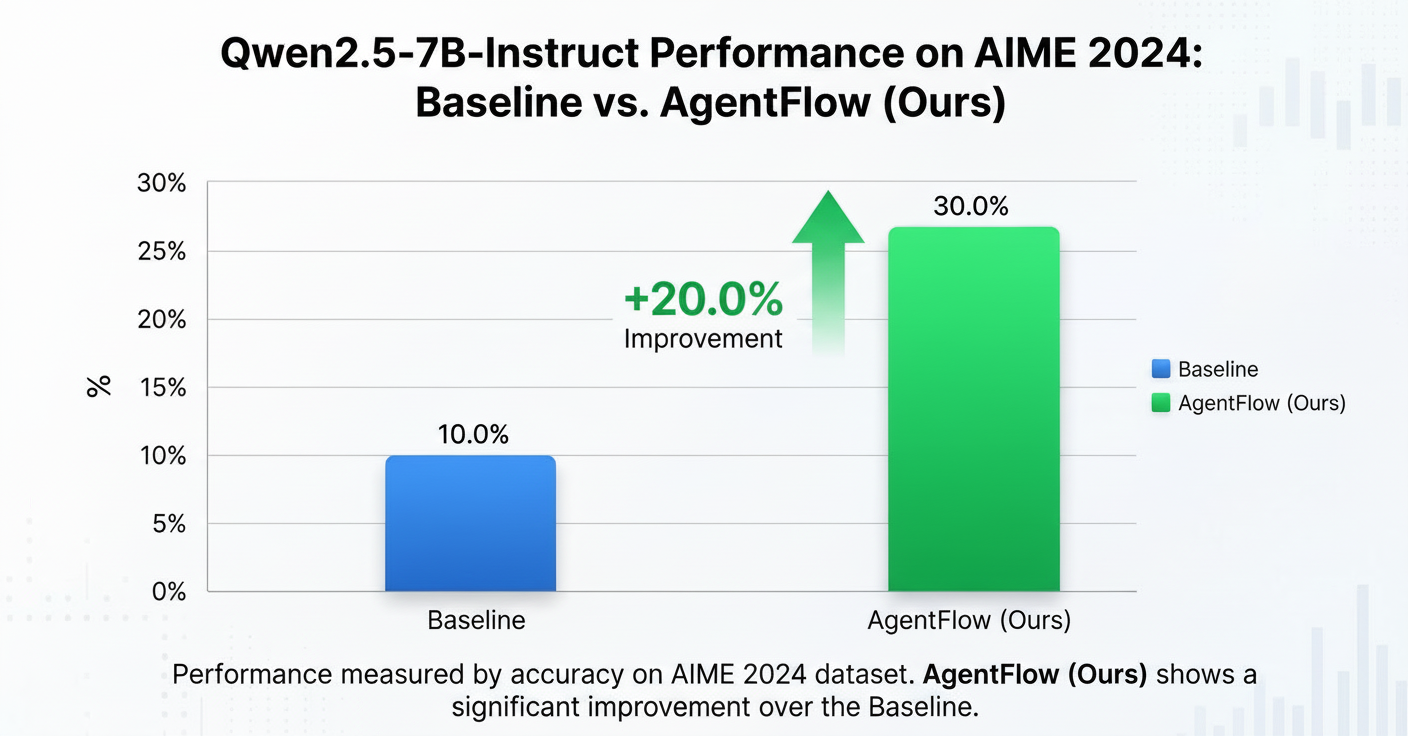
| Model | Dataset | Baseline | AgentFlow (Ours) | Improvement |
|---|---|---|---|---|
| Qwen2.5-7B-Instruct | AIME 2024 | 10.0% | 30.0% | +20.0% |
The trained model weights have been released on HuggingFace: LMIS-ORG/AgentFlow_Slime_Agentic_Qwen2.5_7B
Training Configuration
- Algorithm: GRPO with KL divergence constraint (
low_var_kl) - Model: Qwen2.5-7B (replaceable)
- Dataset: DAPO-Math-17K
- Inference Engine: SGLang (Planner and Executor run on separate ports)
- Evaluation: AIME 2024
Quick Start
All training parameters and launch instructions can be found in agentic/agentflow/.
MemAgent — agentic/memagent/
Reproduces the core idea of MemAgent: compressing arbitrarily long documents into a fixed-size recurrent memory via a chunk-by-chunk LLM update loop, then answering questions from memory alone. RL (GRPO) is applied to all memory-update turns using a Multi-Conversation training objective, so the model learns to retain what matters across chunks without ever seeing the full context at once.
Architecture
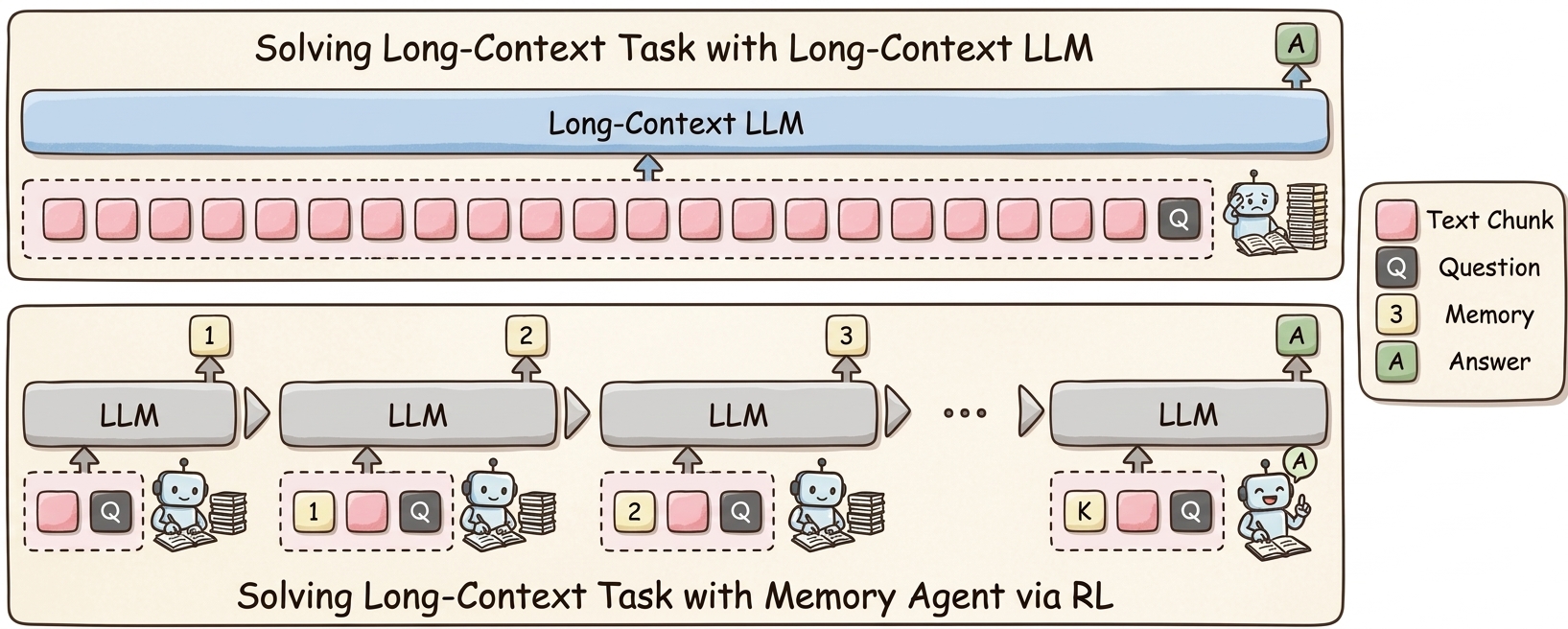
Input: question + long document
  │
  ▼
memory = "No previous memory"
  │
  └─► for chunk in split(document, chunk_tokens):
        │
        └─ LLM(problem, memory, chunk) → updated memory   (loss_mask=1)
  │
  ▼
LLM(problem, memory) → final answer in \boxed{}           (loss_mask=0)
  │
  ▼
Reward: exact-match / F1 against ground truth
         (distributed evenly across all memory-update turns)
Each memory-update turn is an independent training sequence. The reward is evenly amortised across all turns in the conversation (via custom_convert), matching the Multi-Conv RL objective in the MemAgent paper.
Results
Evaluated on RULER-HQA across context lengths from 7K to 448K tokens (5 runs, best score reported):
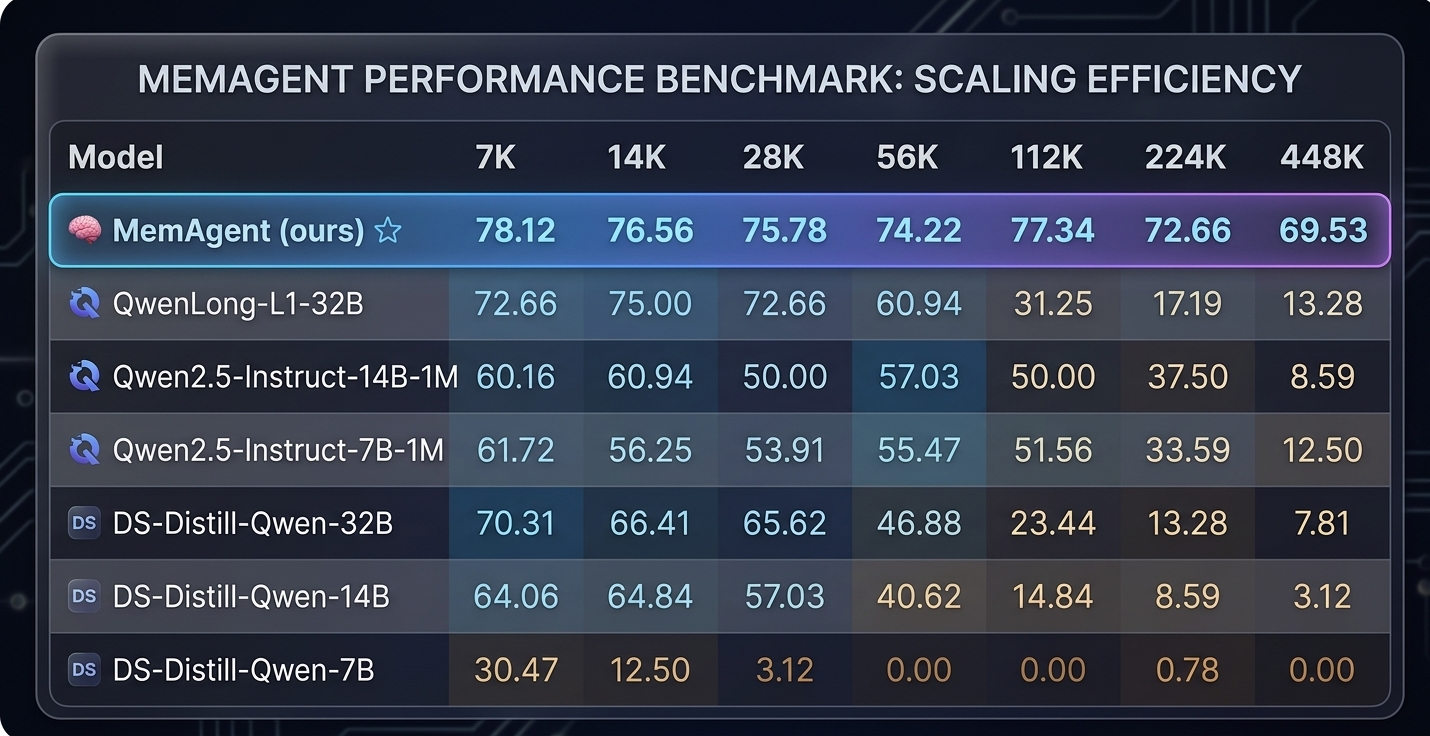
MemAgent (ours) is trained on a 7B base model and consistently outperforms all baselines, including much larger models, across all context lengths. The trained model weights have been released on HuggingFace: LMIS-ORG/MemAgent_Slime_Agentic_Qwen2.5_7B
Training Configuration
- Algorithm: GRPO with KL divergence constraint (
low_var_kl) - Model: Qwen2.5-7B (replaceable)
- Dataset: HotpotQA (BytedTsinghua-SIA/hotpotqa)
- Inference Engine: SGLang with YaRN (
--sglang-context-length 131072) - Evaluation: RULER-HQA (7K → 448K)
Quick Start
All training parameters and launch instructions can be found in agentic/memagent/.
ToolOrchestra — agentic/ToolOrchestra/
Reproduces the core idea of ToolOrchestra: an Orchestrator-Expert multi-agent framework for RL training. A central Orchestrator LLM learns to route tasks to the best specialized expert model and the corresponding tools through multi-turn tool calls. GRPO is applied to the Orchestrator's decision trajectory, enabling it to improve tool-use and routing capabilities without manually annotated intermediate steps.
Architecture
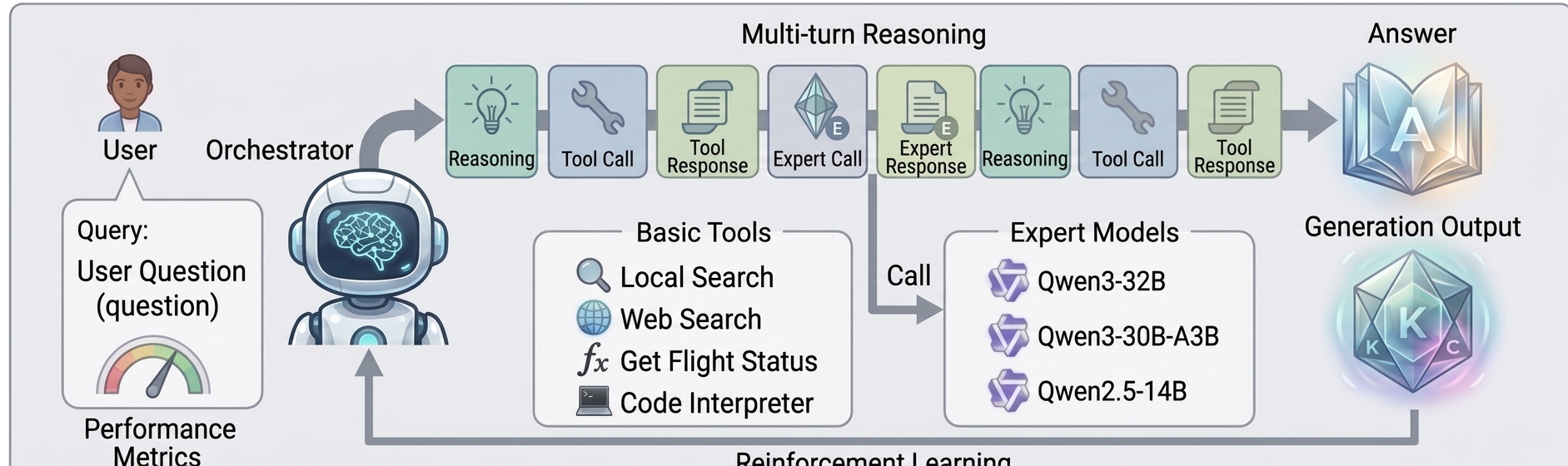
Input question
  │
  ▼
Orchestrator LLM                        ← Decide which tool to call (loss_mask=1)
  │
  └─► for turn in range(max_turns):
        │
        ├─ parse_tool_call()            ← Parse  from model output
        │
        ├─ tool call                    ← Call retrieval / external tool (loss_mask=0)
        │    └─ FAISS retrieval service (port 8000)
        │
        ├─ call_expert ──────────────► Expert LLM routing (loss_mask=0)
        │                               └─ specialist models on separate ports
        │
        └─ answer ──────────────────► Final answer → stop loop
  │
  ▼
GenerationOutput
  - token_ids + log_probs  (all turns concatenated)
  - loss_mask: Orchestrator output = 1 / tool result = 0
Results
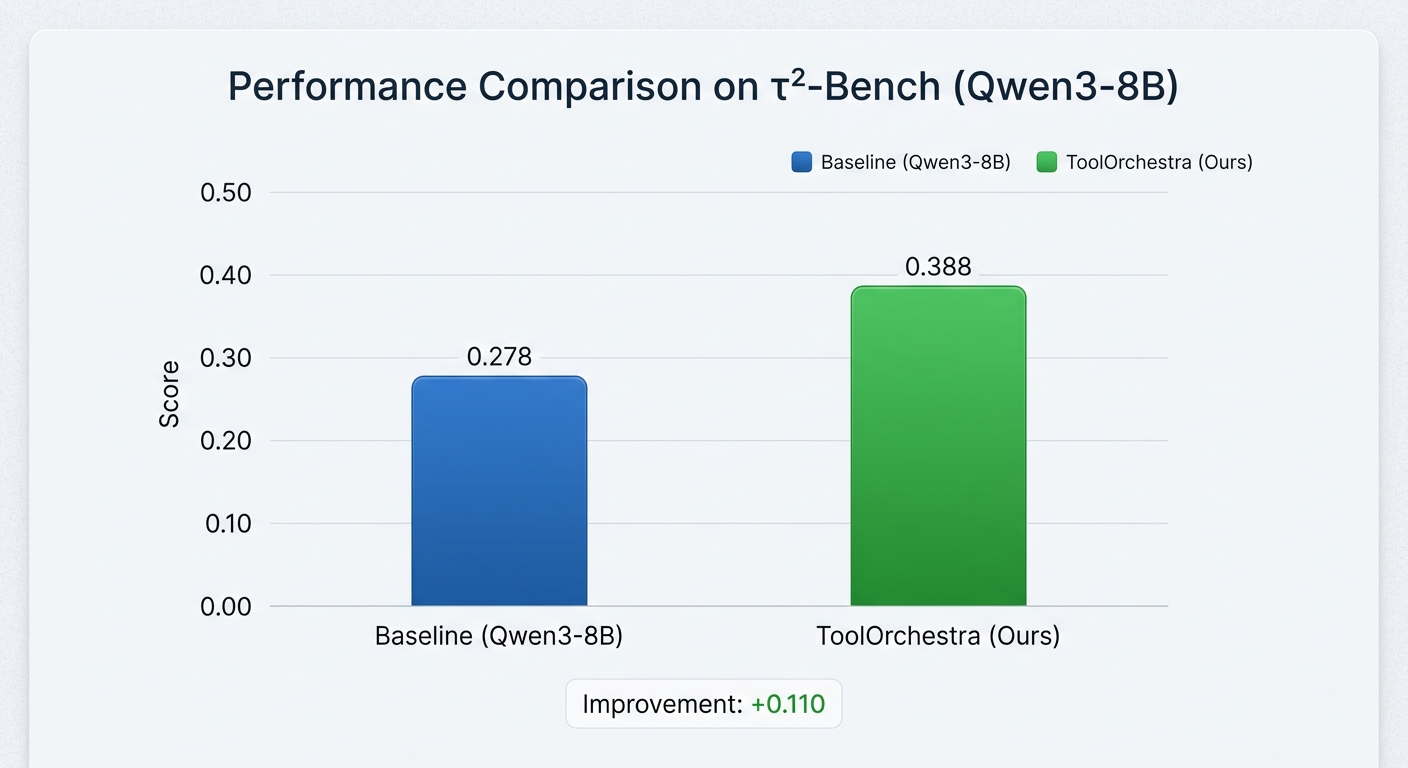
| Model | Dataset | Baseline (Qwen3-8B) | ToolOrchestra (Ours) | Improvement |
|---|---|---|---|---|
| Qwen3-8B | τ²-Bench | 0.278 | 0.388 | +0.110 |
The trained model weights have been released on HuggingFace: LMIS-ORG/ToolOrchestra_Slime_Agentic_Qwen3_8B
Training Configuration
- Algorithm: GRPO with KL divergence constraint (
low_var_kl) - Model: Qwen3-8B (replaceable)
- Dataset: τ²-Bench
- Inference Engine: SGLang (expert models run on separate ports)
- Evaluation: τ²-Bench
Quick Start
All training parameters and launch instructions can be found in agentic/ToolOrchestra/.
How It Integrates with Slime
Each method hooks into the training loop via three slime customization points:
--custom-generate-function-path             rollout.generate    # custom multi-step rollout
--custom-rm-path                            rollout.reward_func # custom reward computation
--custom-eval-rollout-log-function-path     rollout.eval_log    # custom eval logging
The generate function constructs the full agent trajectory and returns a token sequence with a loss_mask. Only tokens generated by the Planner participate in gradient computation; injected tool results and the final summary output have their masks set to 0.
Requirements
The recommended way to set up the environment is via the official Docker image:
# Pull the latest image
docker pull slimerl/slime:latest

# Start the container
docker run --rm --gpus all --ipc=host --shm-size=16g \
  --ulimit memlock=-1 --ulimit stack=67108864 \
  -it slimerl/slime:latest /bin/bash
For manual installation, see requirements.txt and docker/.
Key dependencies:
slime >= 0.2.2sglangraytransformerstorch >= 2.0
Roadmap
PRs and issues are welcome for discussions on integrating new methods.