a real-time digital-human model for long-form audio-video generation.
Key parameters and specifications
Key parameters and specifications
Parameter
Value
Language
Python
Category
Models
Subcategory
Vision models, Domain-specific models
Keywords
Embodied, Model architecture, Multimodal, Robotics
Stars
567
Forks
44
Contributors
3
Created date
2025-09-18
Updated date
2026-10-16
Stars in 1 day
3
Stars in 7 days
2
Rank
3,209
Previous rank
16,724
Rank change
13,515
7-day stars rank
8,806
Previous 7-day stars rank
15,821
7-day stars rank change
7,015
Total stars rank
17,549
Previous total stars rank
17,595
Total stars rank change
46
Country
China
README summary
5: Unifying Understanding, Latent Foresight, and Action for Compositional Generalization [! NOTE] The InternVLA-A1 code has moved to the branch. 5** unifies vision-language **understanding**, visual **foresight**, and **action** generation in one policy. *The Core:* Attaches a lightweight unified action expert to a native Qwen3. 5-2B VLM backbone through shared full-attention layers, while preserving modality-specific Gated DeltaNet processing. *The Foresight:* Uses learnable foresight tokens to query task-relevant future dynamics from the shared multimodal context, supervised by
a frozen WAN2. 2-5B video generation model during training. *The Output:* Discards the video branch at inference and predicts continuous action chunks through flow matching, keeping deployment latency practical. 5** delivers strong performance across broad simulation benchmarks and real-world manipulation settings. 5 training and evaluation code [x] Release pre-training and fine-tuning tutorials [x] Release simulation evaluation entries for RoboTwin, LIBERO, LIBERO-Plus, DOMINO, and SimplerEnv [ ] Combine InternVLA-A1, InternVLA-A1. 5 and more VLAs and WAMs
in the repo [ ] Release the example VQA data and training tutorials Table of Contents Installation Playground Pre-training Fine-tuning Fine-tuning on LeRobot V2. We recommend using **conda** to create an isolated environment. Please refer to the Installation Tutorial to prepare your environment, install dependencies, and patch the required HuggingFace Transformers modules for Qwen3. The pre-training entry uses , discovers LeRobot-format datasets under , applies , and trains the policy with Qwen3. 5-2B, FAST action tokens, and the WAN
video auxiliary branch. 1 dataset Please refer to the LeRobot V2. 1 Fine-tuning Tutorial to fine-tune InternVLA-A1. 5 with real-world datasets in the LeRobot V2. This guide walks through the complete pipeline: download dataset -> convert to LeRobot V3. 0 format -> compute delta-action statistics -> fine-tune InternVLA-A1. 0 Fine-tuning Tutorial and the RoboTwin 2. Real-robot inference For real-robot deployment, we recommend using the optimized action-only inference backend. 5 config and before
constructing the policy, add: This skips WAN video-branch loading and uses the low-latency optimized backend for action prediction. Keep the standard backend only when you need future-video visualization or WAN-related inference outputs. License and Citation All code within this repo is released under CC BY-NC-SA 4. Please consider citing our project if it helps your research. Contact If you have any questions, feel free to submit GitHub issues or email mahaoxiang@pjlab. Acknowledgments LeRobot
openpi InternVLA-A1 Qwen3.
Frequently asked questions
How many stars and forks are recorded?
InternRobotics/InternVLA-A-series has 567 stars and 44 forks.
What is the repository rank?
InternRobotics/InternVLA-A-series is ranked 3,209.
What language and category are recorded?
InternRobotics/InternVLA-A-series has 567 stars, uses Python and belongs to Models.
Which repository is closest in rank?
InternRobotics/InternVLA-A-series is compared with Omni-Interaction-Gander/Omni-Interaction-Agent, ranked 3,211 with 565 stars.
README
InternVLA-A1.5: Unifying Understanding, Latent Foresight, and Action for Compositional Generalization
[!NOTE]
The InternVLA-A1 code has moved to the InternVLA-A1 branch.
Highlights
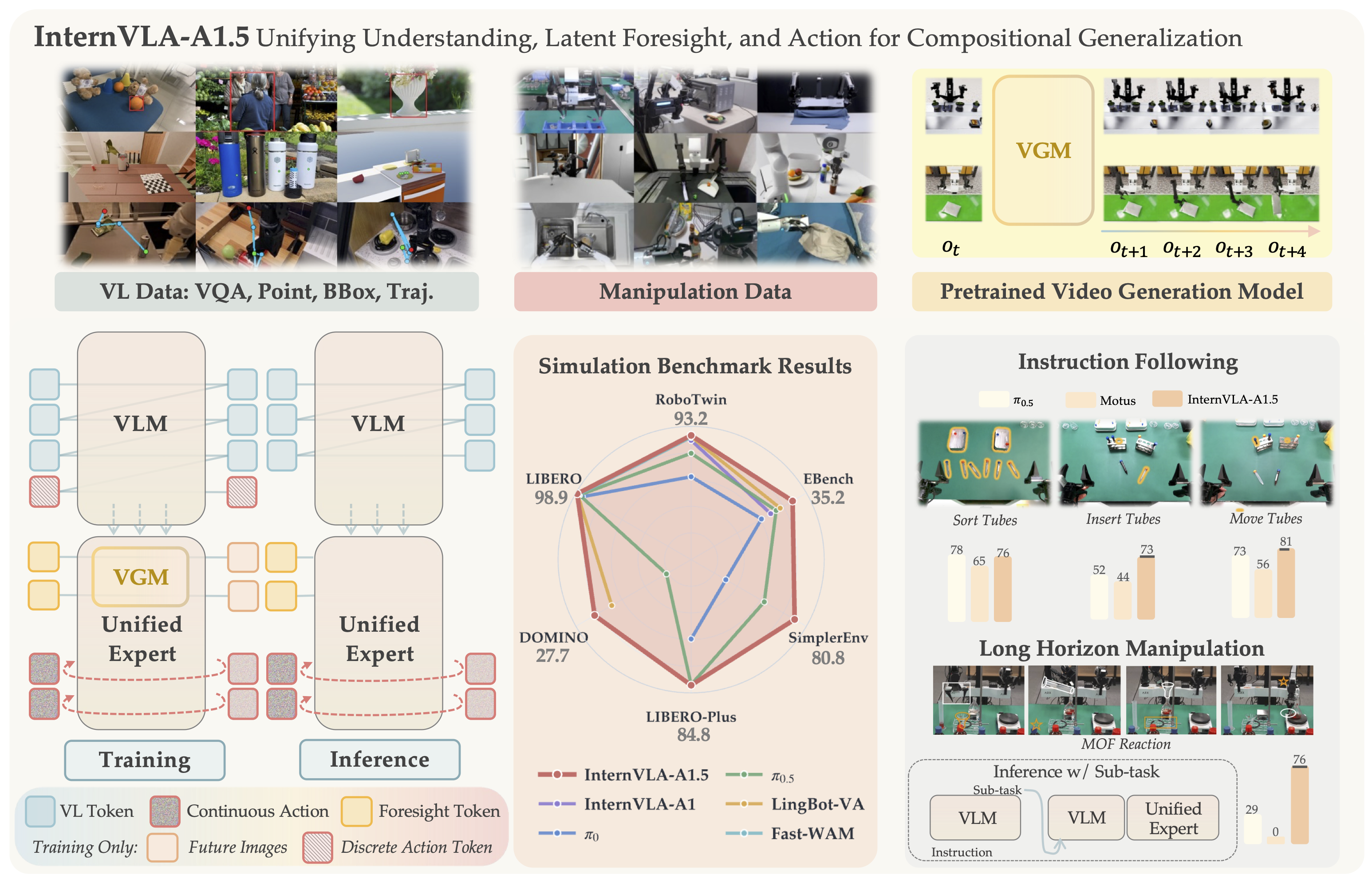
InternVLA-A1.5 unifies vision-language understanding, visual foresight, and action generation in one policy.
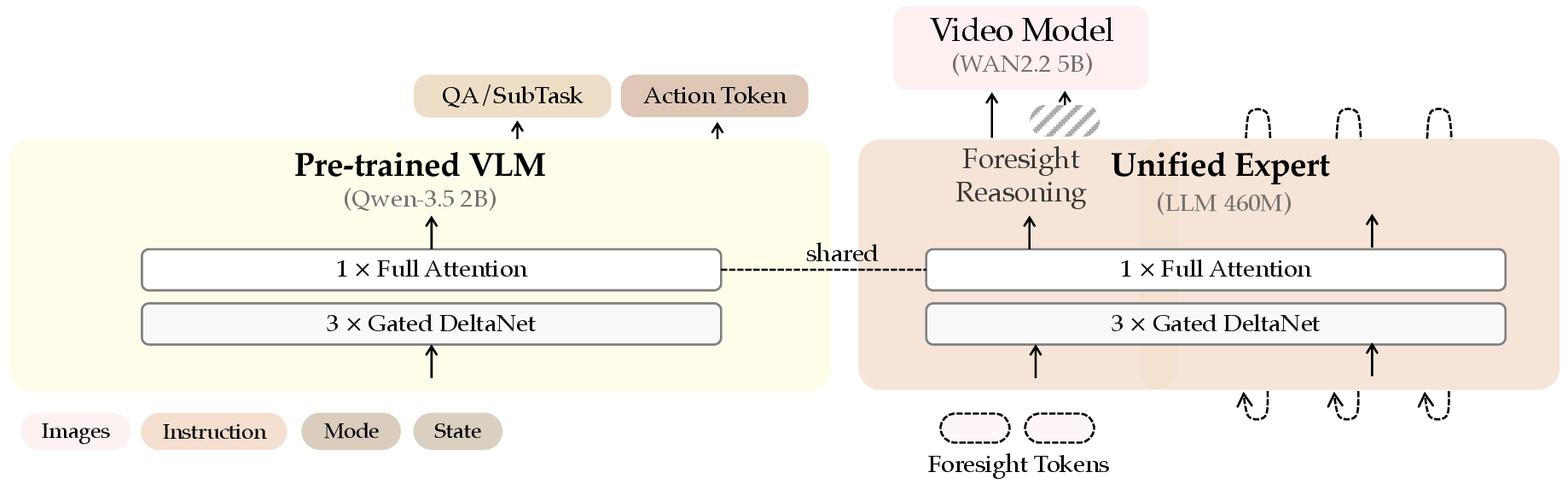
The Core: Attaches a lightweight unified action expert to a native Qwen3.5-2B VLM backbone through shared full-attention layers, while preserving modality-specific Gated DeltaNet processing.
The Foresight: Uses learnable foresight tokens to query task-relevant future dynamics from the shared multimodal context, supervised by a frozen WAN2.2-5B video generation model during training.
The Output: Discards the video branch at inference and predicts continuous action chunks through flow matching, keeping deployment latency practical.
InternVLA-A1.5 delivers strong performance across broad simulation benchmarks and real-world manipulation settings.
RoboTwin 2.0
LIBERO
LIBERO-Plus
SimplerEnv
DOMINO
EBench
93.2
98.9
84.8
80.8
27.7
35.2
Model
HuggingFace
ModelScope
InternVLA-A1.5-base
InternVLA-A1.5-RoboTwin
InternVLA-A1.5-Libero
InternVLA-A1.5-DOMINO
TODO List
[x] Release InternVLA-A1.5 training and evaluation code
[x] Release pre-training and fine-tuning tutorials
[x] Release simulation evaluation entries for RoboTwin, LIBERO, LIBERO-Plus, DOMINO, and SimplerEnv
[ ] Combine InternVLA-A1, InternVLA-A1.5 and more VLAs and WAMs in the repo
[ ] Release the example VQA data and training tutorials
This repository has been tested on Python 3.11, CUDA 12.8, and PyTorch 2.10.0.
We recommend using conda to create an isolated environment.
Please refer to the Installation Tutorial to prepare your environment, install dependencies, and patch the required HuggingFace Transformers modules for Qwen3.5 and the robot-learning policies.
Here, abs indicates using absolute actions, and false means that the training script will use the statistics file (stats.json) provided by lerobot/pusht itself.
The pre-training entry uses launch/internvla_a15_pretrain.sh, discovers LeRobot-format datasets under data/a1, applies configs/weight_rules_pretrain.yaml, and trains the internvla_a1_5 policy with Qwen3.5-2B, FAST action tokens, and the WAN video auxiliary branch.
Fine-tuning
Fine-tuning on LeRobot V2.1 dataset
Please refer to the LeRobot V2.1 Fine-tuning Tutorial to fine-tune InternVLA-A1.5 with real-world datasets in the LeRobot V2.1 format.
This guide walks through the complete pipeline: download dataset -> convert to LeRobot V3.0 format -> compute delta-action statistics -> fine-tune InternVLA-A1.5.
For real-robot deployment, we recommend using the optimized action-only inference backend. After loading the InternVLA-A1.5 config and before constructing the policy, add:
This skips WAN video-branch loading and uses the low-latency optimized backend for action prediction. Keep the standard backend only when you need future-video visualization or WAN-related inference outputs.
License and Citation
All code within this repo is released under CC BY-NC-SA 4.0. Please consider citing our project if it helps your research.
@article{internvla_a15,
  title={InternVLA-A1.5: Unifying Understanding, Latent Foresight, and Action for Compositional Generalization},
  author={Ma, Haoxiang and Cai, Junhao and Xu, Xiaoxu and Li, Hao and Yang, Yuyin and Tian, Yang and Cao, Jiafei and Zhu, Hongrui and Qiu, Zherui and others},
  journal={arXiv preprint arXiv:2607.04988}
  year={2026},
}

@article{internvla_a1,
  title={InternVLA-A1: Unifying Understanding, Generation and Action for Robotic Manipulation},
  author={Cai, Junhao and Cai, Zetao and Cao, Jiafei and Chen, Yilun and He, Zeyu and Jiang, Lei and Li, Hang and Li, Hengjie and Li, Yang and Liu, Yufei and others},
  journal={arXiv preprint arXiv:2601.02456},
  year={2026}
}
Contact
If you have any questions, feel free to submit GitHub issues or email mahaoxiang@pjlab.org.cn.