Code, data and weights for the paper **What drives success in physical planning with Joint-Embedding Predictive World Models.
Key parameters and specifications
Key parameters and specifications
Parameter
Value
Language
Python
Category
Models
Subcategory
Domain-specific models, Embedding Models
Keywords
3D, Datasets, Model architecture, Multimodal
Stars
503
Forks
45
Contributors
2
Created date
2022-03-14
Updated date
2026-10-02
Stars in 1 day
0
Stars in 7 days
0
Rank
18,250
Previous rank
18,002
Rank change
-248
7-day stars rank
16,554
Previous 7-day stars rank
16,571
7-day stars rank change
17
Total stars rank
19,272
Previous total stars rank
19,246
Total stars rank change
-26
Country
Israel
README summary
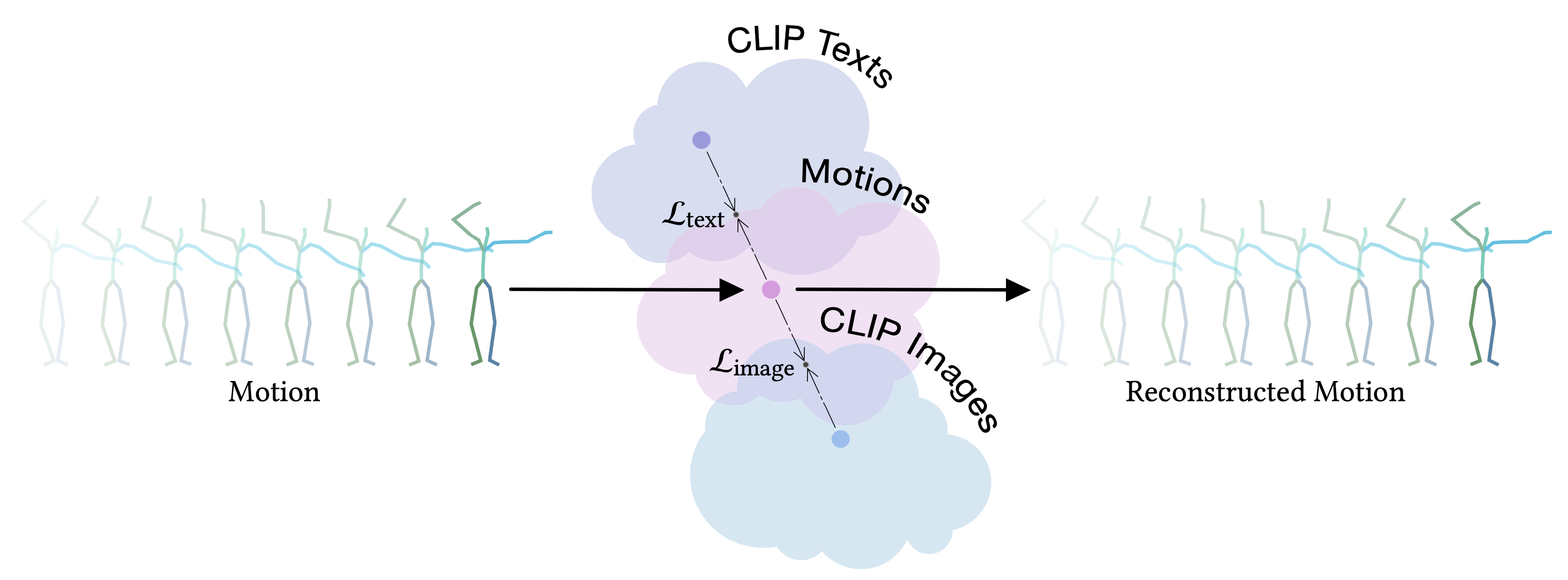
MotionCLIP Official Pytorch implementation of the paper **"MotionCLIP: Exposing Human Motion Generation to CLIP Space"**. Please visit our **webpage** for more details. Bibtex If you find this code useful in your research, please cite: Updates **31/AUG/22** - Training loop reproduces paper results. (a bug fix) **11/MAY/22** - First release. Create conda environment The code was tested on Python 3. Download the parsed data directly** Parsed AMASS dataset -> If you prefer to parse the data yourself, follow this: Download
and unzip the above datasets and place them correspondingly: AMASS -> (Download the SMPL+H version for each dataset separately, please note to download ALL the dataset in AMASS website) BABEL -> Rendered AMASS images -> Then, process the three datasets into a unified dataset with triplets: To parse acording to the AMASS split (for all applications except action recognition), run: **Only if** you intend to use **Action Recognition**, run also: 3. Download the SMPL body model This will download the SMPL neutral
model from this **github repo** and additionnal files. In addition, download the **Extended SMPL+H model** (used in AMASS project) from MANO, and place it in . Using the pretrained model First, download the model and place it at 1. Text-to-Motion To reproduce paper results, run: To run MotionCLIP with your own texts, create a text file, with each line depicts a different text input (see as a reference) and point to it with instead. Vector Editing To reproduce
paper results, run: To gain the input motions, we support two modes: - Retrieve motions from train/validation sets, according to their textual label. On it first run, generates a file containing a list of all textual labels. You can look it up and choose motions for your own editing. - The inputs are free texts, instead of motions. We use CLIP text encoder to get CLIP representations, perform vector editing, then use MotionCLIP decoder to output the edited motion. To run
MotionCLIP on your own editing, create a csv file, with each line depicts a different edit (see as a reference) and point to it with instead. Interpolation To reproduce paper results, run: To gain the input motions, we use the mode described earlier. To run MotionCLIP on your own interpolations, create a csv file, with each line depicts a different interpolation (see as a reference) and point to it with instead. Action Recognition For action recognition, we use a model
trained on text class names. Train your own ~~**NOTE (11/MAY/22):** The paper model is not perfectly reproduced using this code. The trained model checkpoint we provide does reproduce results. ~~ **(Resolved 31/AUG/22)** To reproduce run: To reproduce run: Acknowledgment The code of the transformer model and the dataloader are based on ACTOR repository. License This code is distributed under an MIT LICENSE. Note that our code depends on other libraries, including CLIP, SMPL, SMPL-X, PyTorch3D, and
uses datasets which each have their own respective licenses that must also be followed.
Frequently asked questions
How many stars and forks are recorded?
GuyTevet/MotionCLIP has 503 stars and 45 forks.
What is the repository rank?
GuyTevet/MotionCLIP is ranked 18,250.
What language and category are recorded?
GuyTevet/MotionCLIP has 503 stars, uses Python and belongs to Models.
Which repository is closest in rank?
GuyTevet/MotionCLIP is compared with PengBoXiangShang/SiamRPN_plus_plus_PyTorch, ranked 18,253 with 503 stars.
If you find this code useful in your research, please cite:
@article{tevet2022motionclip,
title={MotionCLIP: Exposing Human Motion Generation to CLIP Space},
author={Tevet, Guy and Gordon, Brian and Hertz, Amir and Bermano, Amit H and Cohen-Or, Daniel},
journal={arXiv preprint arXiv:2203.08063},
year={2022}
}
Updates
31/AUG/22 - Training loop reproduces paper results. (a bug fix)
To run MotionCLIP with your own texts, create a text file, with each line depicts a different text input (see paper_texts.txt as a reference) and point to it with --input_file instead.
data - Retrieve motions from train/validation sets, according to their textual label. On it first run, src.visualize.motion_editing generates a file containing a list of all textual labels. You can look it up and choose motions for your own editing.
text - The inputs are free texts, instead of motions. We use CLIP text encoder to get CLIP representations, perform vector editing, then use MotionCLIP decoder to output the edited motion.
To run MotionCLIP on your own editing, create a csv file, with each line depicts a different edit (see paper_edits.csv as a reference) and point to it with --input_file instead.
To gain the input motions, we use the data mode described earlier.
To run MotionCLIP on your own interpolations, create a csv file, with each line depicts a different interpolation (see paper_interps.csv as a reference) and point to it with --input_file instead.
4. Action Recognition
For action recognition, we use a model trained on text class names. Download and place it at ./exps/classes-model.
NOTE (11/MAY/22):
The paper model is not perfectly reproduced using this code. We are working to resolve this issue.
The trained model checkpoint we provide does reproduce results.(Resolved 31/AUG/22)
Note that our code depends on other libraries, including CLIP, SMPL, SMPL-X, PyTorch3D, and uses datasets which each have their own respective licenses that must also be followed.