
Introduction
QRec is a Python framework for recommender systems (Supported by Python 3.7.4 and Tensorflow 1.14+) in which a number of influential and newly state-of-the-art recommendation models are implemented. QRec has a lightweight architecture and provides user-friendly interfaces. It can facilitate model implementation and evaluation.
Founder and principal contributor: @Coder-Yu
Other contributors: @DouTong @Niki666 @HuXiLiFeng @BigPowerZ @flyxu
Supported by: @AIhongzhi (A/Prof. Hongzhi Yin, UQ), @mingaoo (A/Prof. Min Gao, CQU)
We also provide Pytorch implementations of some models in another library. Please click here
What's New
31/03/2022 - SimGCL proposed in our SIGIR'22 paper has been added.
12/10/2021 - BUIR proposed in SIGIR'21 paper has been added.
30/07/2021 - We have transplanted QRec from py2 to py3.
07/06/2021 - SEPT proposed in our KDD'21 paper has been added.
16/05/2021 - SGL proposed in SIGIR'21 paper has been added.
16/01/2021 - MHCN proposed in our WWW'21 paper has been added.
22/09/2020 - DiffNet proposed in SIGIR'19 has been added.
19/09/2020 - DHCF proposed in KDD'20 has been added.
29/07/2020 - ESRF proposed in my TKDE paper has been added.
23/07/2020 - LightGCN proposed in SIGIR'20 has been added.
17/09/2019 - NGCF proposed in SIGIR'19 has been added.
13/08/2019 - RSGAN proposed in ICDM'19 has been added.
09/08/2019 - Our paper is accepted as full research paper by ICDM'19.
20/02/2019 - IRGAN proposed in SIGIR'17 has been added.
12/02/2019 - CFGAN proposed in CIKM'18 has been added.
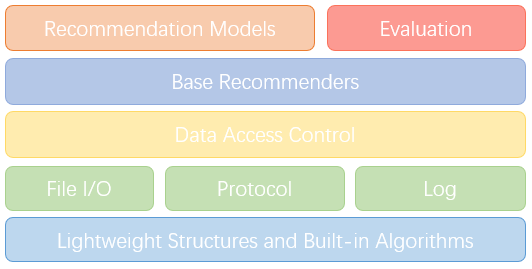
Architecture
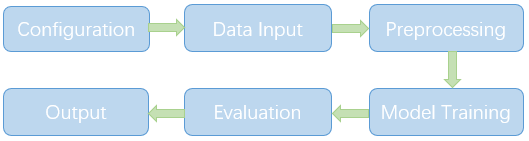
Workflow
Features
Cross-platform: QRec can be easily deployed and executed in any platforms, including MS Windows, Linux and Mac OS. Fast execution: QRec is based on Numpy, Tensorflow and some lightweight structures, which make it run fast. Easy configuration: QRec configs recommenders with a configuration file and provides multiple evaluation protocols. Easy expansion: QRec provides a set of well-designed recommendation interfaces by which new algorithms can be easily implemented.
Requirements
gensim==4.1.2 joblib==1.1.0 mkl==2022.0.0 mkl_service==2.4.0 networkx==2.6.2 numba==0.53.1 numpy==1.20.3 scipy==1.6.2 tensorflow==1.14.0
Usage
There are two ways to run the recommendation models in QRec:
1.Configure the xx.conf file in the directory named config. (xx is the name of the model you want to run) 2.Run main.py.
Or
Follow the codes in snippet.py.
For more details, we refer you to the handbook of QRec.
Configuration
Essential Options
Entry
Example
Description
ratings
D:/MovieLens/100K.txt
Set the file path of the dataset. Format: each row separated by empty, tab or comma symbol.
social
D:/MovieLens/trusts.txt
Set the file path of the social dataset. Format: each row separated by empty, tab or comma symbol.
ratings.setup
-columns 0 1 2
-columns: (user, item, rating) columns of rating data are used.
social.setup
-columns 0 1 2
-columns: (trustor, trustee, weight) columns of social data are used.
UserKNN
name of the recommendation model.
evaluation.setup
-testSet ./dataset/test.txt
Main option: -testSet, -ap, -cv (choose one of them)
  -testSet path/to/test/file (need to specify the test set manually)

  -ap ratio (ap means that the ratings are automatically partitioned into training set and test set, the number is the ratio of the test set. e.g. -ap 0.2)

  -cv k (-cv means cross validation, k is the number of the fold. e.g. -cv 5)

  -predict path/to/user list/file (predict for a given list of users without evaluation; need to mannually specify the user list file (each line presents a user))

  Secondary option:-b, -p, -cold, -tf, -val (multiple choices)

  -val ratio  (model test would be conducted on the validation set which is generated by randomly sampling the training dataset with the given ratio.)

  -b thres (binarizing the rating values. Ratings equal or greater than thres will be changed into 1, and ratings lower than thres will be left out. e.g. -b 3.0)

  -p (if this option is added, the cross validation wll be executed parallelly, otherwise executed one by one)

  -tf  (model training will be conducted on TensorFlow (only applicable and needed for shallow models))

  -cold thres (evaluation on cold-start users; users in the training set with rated items more than thres will be removed from the test set)
item.ranking
off -topN -1
Main option: whether to do item ranking
-topN N1,N2,N3...: the length of the recommendation list. *QRec can generate multiple evaluation results for different N at the same time
output.setup
on -dir ./Results/
Main option: whether to output recommendation results
-dir path: the directory path of output results.
Memory-based Options
similarity
pcc/cos
Set the similarity method to use. Options: PCC, COS;
num.neighbors
30
Set the number of neighbors used for KNN-based algorithms such as UserKNN, ItemKNN.
Model-based Options
num.factors
5/10/20/number
Set the number of latent factors
num.max.epoch
100/200/number
Set the maximum number of epoch for iterative recommendation algorithms.
learnRate
-init 0.01 -max 1
-init initial learning rate for iterative recommendation algorithms;
-max: maximum learning rate (default 1);
reg.lambda
-u 0.05 -i 0.05 -b 0.1 -s 0.1
-u: user regularizaiton; -i: item regularization; -b: bias regularizaiton; -s: social regularization
Implement Your Model
1.Make your new algorithm generalize the proper base class. 2.Reimplement some of the following functions as needed.
- readConfiguration()
- printAlgorConfig()
- initModel()
- trainModel()
- saveModel()
- loadModel()
- predictForRanking()
- predict()
For more details, we refer you to the handbook of QRec.
Implemented Algorithms
Rating prediction
Paper
SlopeOne
Lemire and Maclachlan, Slope One Predictors for Online Rating-Based Collaborative Filtering, SDM'05.
PMF
Salakhutdinov and Mnih, Probabilistic Matrix Factorization, NIPS'08.
SoRec
Ma et al., SoRec: Social Recommendation Using Probabilistic Matrix Factorization, SIGIR'08.
SVD++
Koren, Factorization meets the neighborhood: a multifaceted collaborative filtering model, SIGKDD'08.
RSTE
Ma et al., Learning to Recommend with Social Trust Ensemble, SIGIR'09.
SVD
Y. Koren, Collaborative Filtering with Temporal Dynamics, SIGKDD'09.
SocialMF
Jamali and Ester, A Matrix Factorization Technique with Trust Propagation for Recommendation in Social Networks, RecSys'10.
EE
Khoshneshin et al., Collaborative Filtering via Euclidean Embedding, RecSys'10.
SoReg
Ma et al., Recommender systems with social regularization, WSDM'11.
LOCABAL
Tang, Jiliang, et al. Exploiting local and global social context for recommendation, AAAI'13.
SREE
Li et al., Social Recommendation Using Euclidean embedding, IJCNN'17.
CUNE-MF
Zhang et al., Collaborative User Network Embedding for Social Recommender Systems, SDM'17.
Item Ranking
Paper
BPR
Rendle et al., BPR: Bayesian Personalized Ranking from Implicit Feedback, UAI'09.
WRMF
Yifan Hu et al.Collaborative Filtering for Implicit Feedback Datasets, KDD'09.
SBPR
Zhao et al., Leveraing Social Connections to Improve Personalized Ranking for Collaborative Filtering, CIKM'14
ExpoMF
Liang et al., Modeling User Exposure in Recommendation, WWW''16.
CoFactor
Liang et al., Factorization Meets the Item Embedding: Regularizing Matrix Factorization with Item Co-occurrence, RecSys'16.
TBPR
Wang et al. Social Recommendation with Strong and Weak Ties, CIKM'16'.
CDAE
Wu et al., Collaborative Denoising Auto-Encoders for Top-N Recommender Systems, WSDM'16'.
DMF
Xue et al., Deep Matrix Factorization Models for Recommender Systems, IJCAI'17'.
NeuMF
He et al. Neural Collaborative Filtering, WWW'17.
CUNE-BPR
Zhang et al., Collaborative User Network Embedding for Social Recommender Systems, SDM'17'.
IRGAN
Wang et al., IRGAN: A Minimax Game for Unifying Generative and Discriminative Information Retrieval Models, SIGIR'17'.
SERec
Wang et al., Collaborative Filtering with Social Exposure: A Modular Approach to Social Recommendation, AAAI'18'.
APR
He et al., Adversarial Personalized Ranking for Recommendation, SIGIR'18'.
IF-BPR
Yu et al. Adaptive Implicit Friends Identification over Heterogeneous Network for Social Recommendation, CIKM'18'.
CFGAN
Chae et al. CFGAN: A Generic Collaborative Filtering Framework based on Generative Adversarial Networks, CIKM'18.
NGCF
Wang et al. Neural Graph Collaborative Filtering, SIGIR'19'.
DiffNet
Wu et al. A Neural Influence Diffusion Model for Social Recommendation, SIGIR'19'.
RSGAN
Yu et al. Generating Reliable Friends via Adversarial Learning to Improve Social Recommendation, ICDM'19'.
LightGCN
He et al. LightGCN: Simplifying and Powering Graph Convolution Network for Recommendation, SIGIR'20.
DHCF
Ji et al. Dual Channel Hypergraph Collaborative Filtering, KDD'20.
ESRF
Yu et al. Enhancing Social Recommendation with Adversarial Graph Convlutional Networks, TKDE'20.
MHCN
Yu et al. Self-Supervised Multi-Channel Hypergraph Convolutional Network for Social Recommendation, WWW'21.
SGL
Wu et al. Self-supervised Graph Learning for Recommendation, SIGIR'21.
SEPT
Yu et al. Socially-Aware Self-supervised Tri-Training for Recommendation, KDD'21.
BUIR
Lee et al. Bootstrapping User and Item Representations for One-Class Collaborative Filtering, SIGIR'21.
SimGCL
Yu et al. Are Graph Augmentations Necessary? Simple Graph Contrastive Learning for Recommendation, SIGIR'22.
Related Datasets
Data Set
Basic Meta
User Context
Users
Items
Ratings (Scale)
Density
Users
Links (Type)
Ciao [1]
7,375
105,114
284,086
[1, 5]
0.0365%
7,375
111,781
Trust
Epinions [2]
40,163
139,738
664,824
[1, 5]
0.0118%
49,289
487,183
Trust
Douban [3]
2,848
39,586
894,887
[1, 5]
0.794%
2,848
35,770
Trust
LastFM [4]
1,892
17,632
92,834
implicit
0.27%
1,892
25,434
Trust
Yelp [5]
19,539
21,266
450,884
implicit
0.11%
19,539
864,157
Trust
Amazon-Book [6]
52,463
91,599
2,984,108
implicit
0.11%
Reference
[1]. Tang, J., Gao, H., Liu, H.: mtrust:discerning multi-faceted trust in a connected world. In: International Conference on Web Search and Web Data Mining, WSDM 2012, Seattle, Wa, Usa, February. pp. 93–102 (2012)
[2]. Massa, P., Avesani, P.: Trust-aware recommender systems. In: Proceedings of the 2007 ACM conference on Recommender systems. pp. 17–24. ACM (2007)
[3]. G. Zhao, X. Qian, and X. Xie, “User-service rating prediction by exploring social users’ rating behaviors,” IEEE Transactions on Multimedia, vol. 18, no. 3, pp. 496–506, 2016.
[4]. Iván Cantador, Peter Brusilovsky, and Tsvi Kuflik. 2011. 2nd Workshop on Information Heterogeneity and Fusion in Recom- mender Systems (HetRec 2011). In Proceedings of the 5th ACM conference on Recommender systems (RecSys 2011). ACM, New York, NY, USA
[5]. Yu et al. Self-Supervised Multi-Channel Hypergraph Convolutional Network for Social Recommendation, WWW'21.
[6]. He et al. LightGCN: Simplifying and Powering Graph Convolution Network for Recommendation, SIGIR'20.
Acknowledgment
This project is supported by the Responsible Big Data Intelligence Lab (RBDI) at the school of ITEE, University of Queensland, and Chongqing University.
If our project is helpful to you, please cite one of these papers.
@inproceedings{yu2021socially,
title={Socially-aware self-supervised tri-training for recommendation},
author={Yu, Junliang and Yin, Hongzhi and Gao, Min and Xia, Xin and Zhang, Xiangliang and Viet Hung, Nguyen Quoc},
booktitle={Proceedings of the 27th ACM SIGKDD Conference on Knowledge Discovery & Data Mining},
pages={2084--2092},
year={2021}
}
@inproceedings{yu2021self,
title={Self-Supervised Multi-Channel Hypergraph Convolutional Network for Social Recommendation},
author={Yu, Junliang and Yin, Hongzhi and Li, Jundong and Wang, Qinyong and Hung, Nguyen Quoc Viet and Zhang, Xiangliang},
booktitle={Proceedings of the Web Conference 2021},
pages={413--424},
year={2021}
}