


MemAgent: Reshaping Long-Context LLM with Multi-Conv RL based Memory Agent
[!IMPORTANT]
🔥 News!!!
- [2025/07] We provide a quickstart script that makes using MemAgent super easy, see the Quickstart section below.
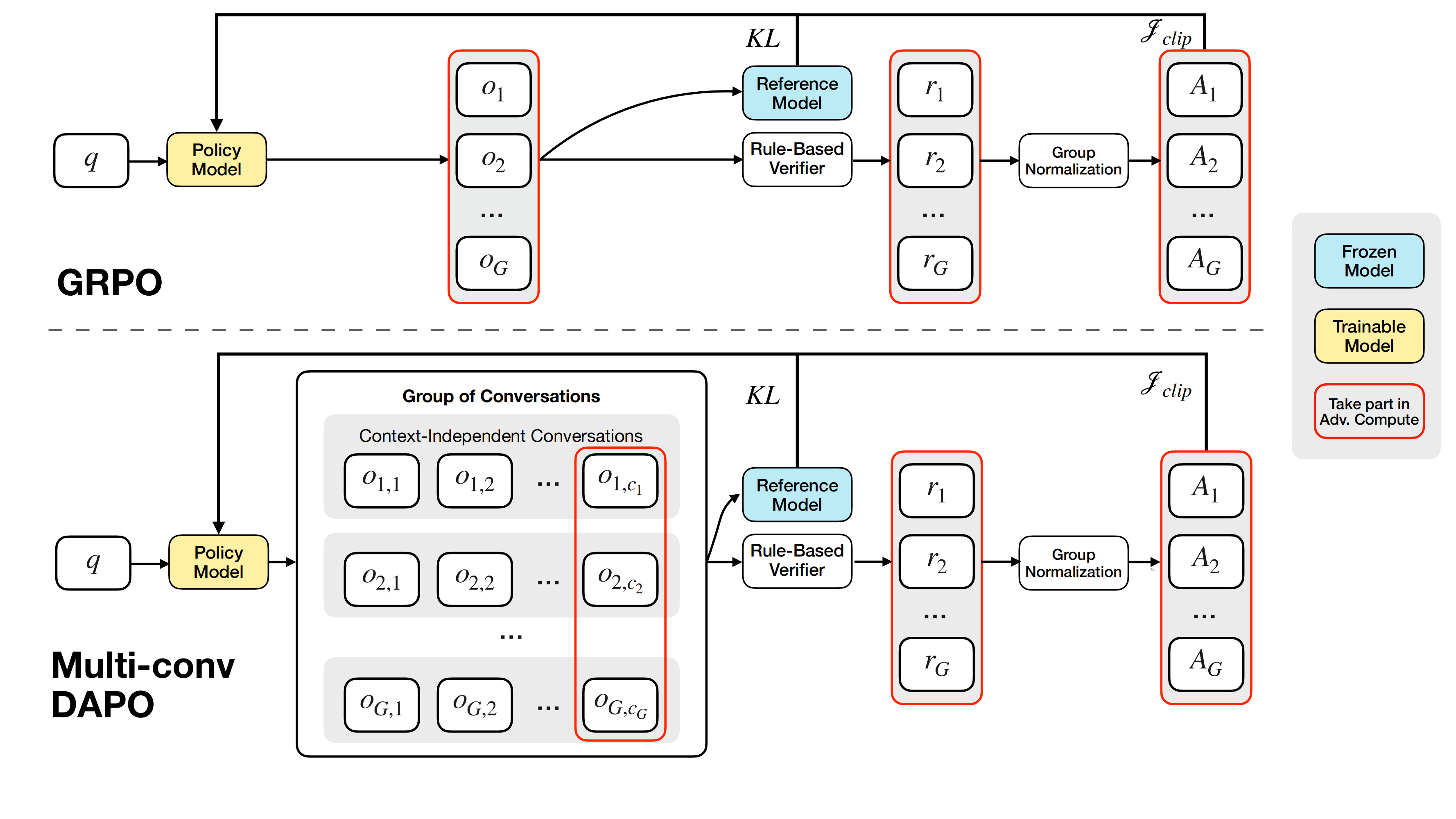
- [2025/06] We release RL-MemAgent-14B and RL-MemAgent-7B models achieving nearly lossless performance on 3.5M token contexts task.
📖Introduction
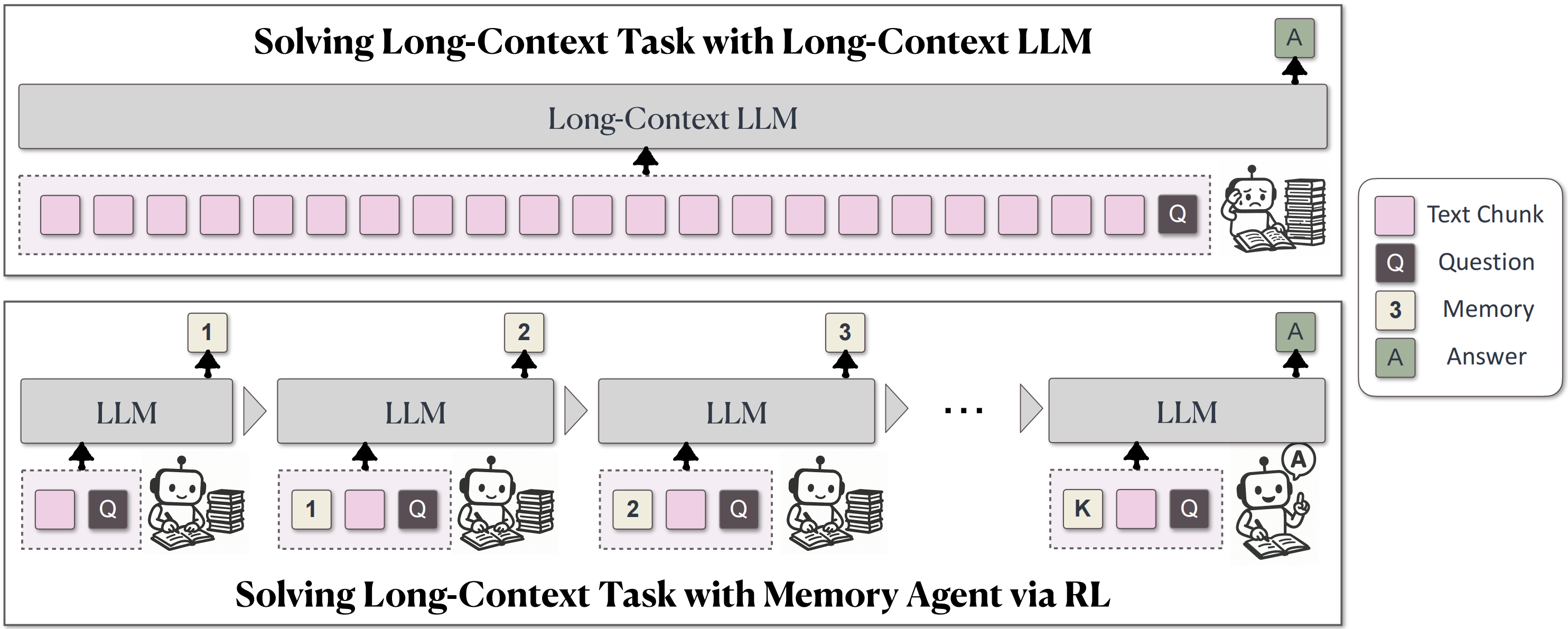
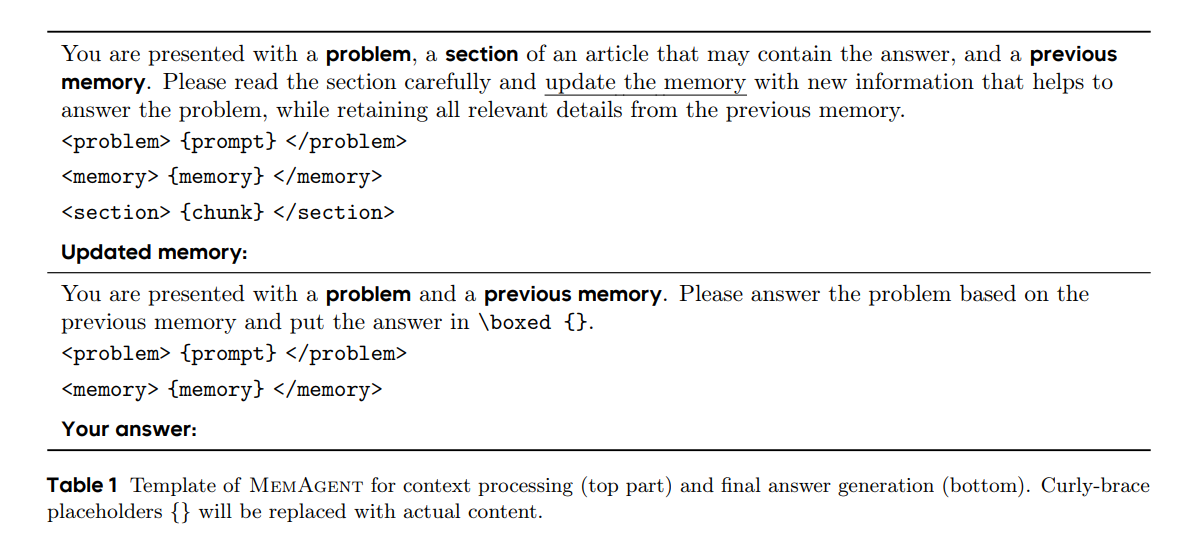
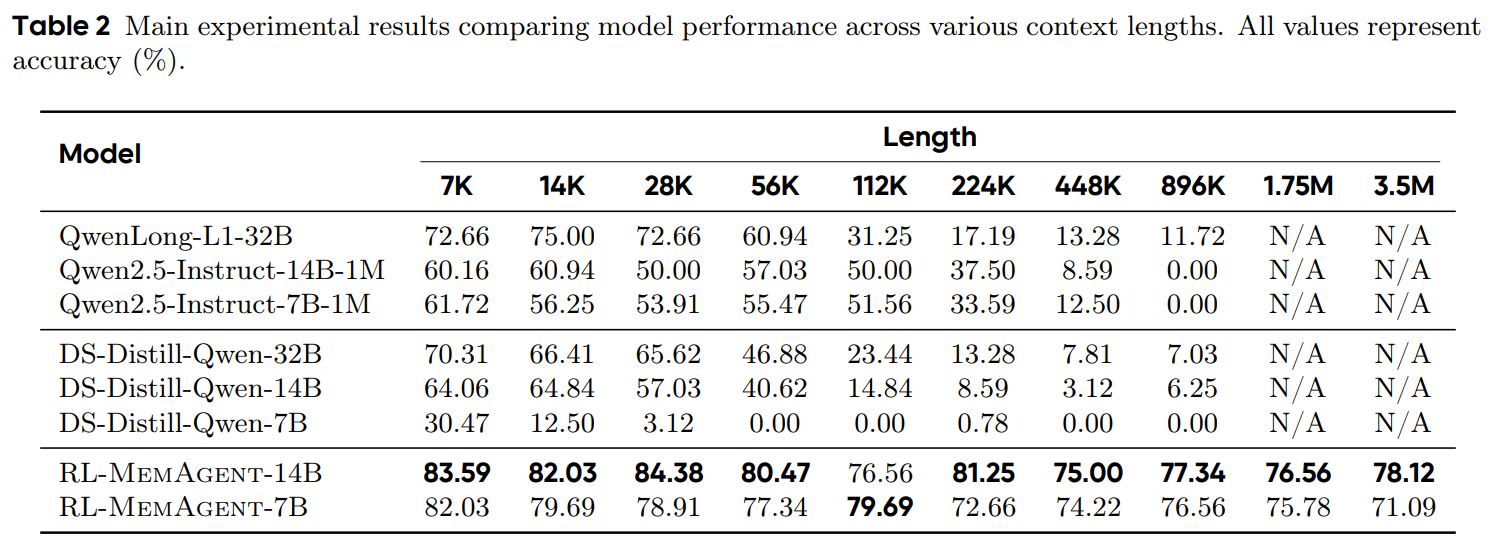
We propose a novel long-context processing framework — MemAgent, which directly optimizes long-context tasks through end-to-end Reinforcement Learning without altering the underlying model architecture. MemAgent has demonstrated superb long-context capabilities, being able to extrapolate from an 8K context trained on 32K text to a 3.5M QA task with performance loss < 5% and achieves 95%+ accuracy in 512K RULER test.
Highlights:
-
🚀 Novel memory mechanism Introduces MemAgent architecture enabling arbitrarily long input processing within fixed context windows, overcoming traditional context window length limitations.
-
⚡ Linear time Complexity Breaks through computational bottlenecks in long-text processing, achieving linear scaling of resources with text length.
-
🎯 RL-driven extrapolation Through RL training with MemAgent architecture, enables models to extrapolate to vastly longer texts with minimal performance degradation.
Multi-conv RL Framework
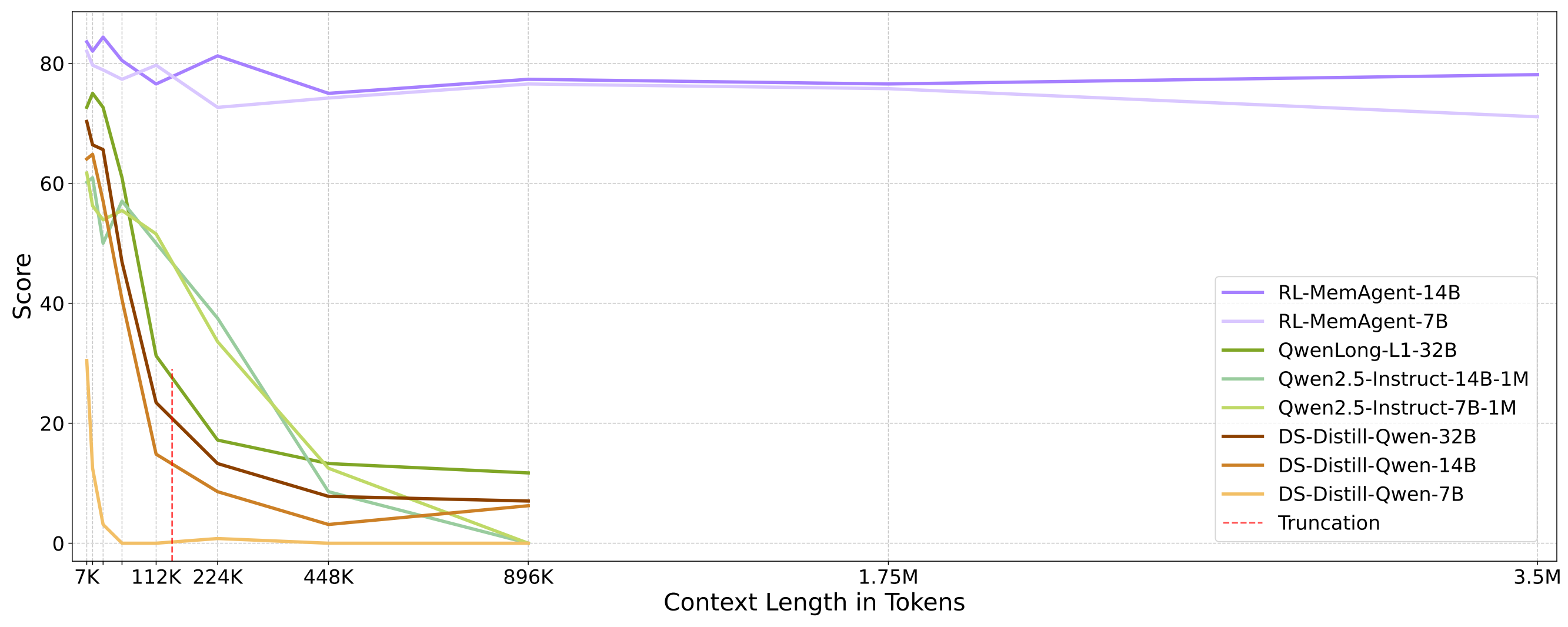
We use Reinforcement Learning from Verifiable Rewards (RLVR) to train MemAgent, extending the DAPO algorithm to support end-to-end optimization of Agent Workflows with multi-turn context-independent conversations.
Results
RL-MemAgent demonstrates exceptional stability in ultra-long context processing:
- 14B model: Performance degradation <5.5% on 3.5M token tasks, achieving truly lossless extrapolation.
- 7B model: Only 11% performance decline in longest contexts, significantly outperforming existing long-context models
Quickstart
quickstart.py offers a straightforward way to begin using MemAgent, supporting both local deployment and integration with online model services.
vLLM Local Deployment
-
Start the
vllmserver:vllm serve BytedTsinghua-SIA/RL-MemoryAgent-14B --tensor_parallel_size 2 -
Run
quickstart.py:python quickstart.py --model BytedTsinghua-SIA/RL-MemoryAgent-14B
Online LLM Service
For online LLM services, you'll need to configure your model endpoint and API key as environment variables.
e.g. gpt-4o-2024-11-20:
- Normal online services: Simply use
https://{endpoint}. - Azure OpenAI: Use the format
https://{endpoint}/openai/deployments/gpt-4o-2024-11-20.
export URL=
export API_KEY=
python quickstart.py --model gpt-4o-2024-11-20
Reproducibility
Use vllm==0.8.2 to reproduce the experiments
Performance
In reproduction, you may find that the validation score during training is not equal to the final score (about 50% vs 80%). This behavior is expected because during training we actually used a stricter version of the verifier to prevent reward hacking, while during testing we used a more lenient verifier. Specifically
-
In the training verifier, the model’s answer must be placed inside
\boxed{}with exact case matching and no additional characters. -
In the testing verifier, articles like “a/the” are ignored, as are case differences and punctuation.
The stricter training verifier was inherited from earlier math-related RL work, whereas the more relaxed testing verifier aligns with practices in long-context projects such as Ruler and Qwen-Long.
Testing Results
pip install httpx==0.23.1 aiohttp -U ray[serve,default] vllm
- Prepare QA data
cd taskutils/memory_data
bash download_qa_dataset.sh
- Download the dataset
cd ../..
bash hfd.sh BytedTsinghua-SIA/hotpotqa --dataset --tool aria2c -x 10
export DATAROOT=$(pwd)/hotpotqa
- Preparing models
The model used in tests will be downloaded from HuggingFace. However, Qwen2.5-Instruct series models needs to be downloaded manually and properly config their config.json to activate YaRN. Please follow the instruction in Qwen2.5-Instruct Repo
bash hfd.sh Qwen/Qwen2.5-7B-Instruct --tool aria2c -x 10
bash hfd.sh Qwen/Qwen2.5-14B-Instruct --tool aria2c -x 10
bash hfd.sh Qwen/Qwen2.5-32B-Instruct --tool aria2c -x 10
# then change the config.json manually
export MODELROOT=/your/path/to/models # move to your model root directory, this env variable is used in the run.py script
mv Qwen2.5-7B-Instruct $MODELROOT/Qwen2.5-7B-Instruct-128K
mv Qwen2.5-14B-Instruct $MODELROOT/Qwen2.5-14B-Instruct-128K
mv Qwen2.5-32B-Instruct $MODELROOT/Qwen2.5-32B-Instruct-128K
- Running
Note: This will take a few days to run all the tests, you may want to specify which tests/models to run.
cd taskutils/memory_eval
python run.py
Note: This scripts will use all available GPUs to serve the
models. If you have multiple GPU nodes, you can create a ray cluster and run the script in one of cluster nodes. Use SERVE_PORT and DASH_PORT to specify the ports for the ray cluster.
cd taskutils/memory_eval
SERVE_PORT=8000 DASH_PORT=8265 python run.py # port numbers here are default values, you may need to specify them as the serve/dashboard port in your ray cluster
Training
Fistly specify PROJ_ROOT (for checkpoints) and DATASET_ROOT (for training data, should be the same as used in testing) in run_memory_7B.sh and run_memory_14B.sh.
Then run this script directly to launch a single-node training, or config a ray cluster properly and run the script in one of the cluster nodes.
Data
Please run the following commnads in this section under thetaskutils/memory_data directory.
cd taskutils/memory_data
pip install nltk pyyaml beautifulsoup4 html2text wonderwords tenacity fire
- Train & dev split: hotpotqa_train.parquet & hotpotqa_dev.parquet
- Download qa dataset and synthetic data, skip this step if you have downloaded it in the previous step:
bash download_qa_dataset.sh
python processing.py # Dataprocess, synthetic long context multihop-QA
-
Deploy Qwen-7B in localhost:8000 and Qwen-7B-Instruct in localhost:8001
-
filtering
python filter.py -i hotpotqa_dev_process.parquet -o hotpotqa_dev_result --noresume
python filter.py -i hotpotqa_train_process.parquet -o hotpotqa_train_result --noresume
python3 filter2.py # Filtering out sample which can be answered correctly by LLM without any context:
2. Main task: eval_{50|100|200|...}.json
export DATAROOT="your_dir_to_hotpotqa_dev.parquet"
python convert_to_eval.py # Convert the `hotpotqa_dev` to `eval_200.json`
python different_docs_eval.py.py # Create eval dataset with different number of documents
3. OOD task: eval_{rulersubset}_{8192|16384|...}.json
export DATAROOT="your_dir_to_hotpotqa_dev.parquet"
python download_paulgraham_essay.py
bash download_qa_dataset.sh
bash ruler_data_prepare.sh
Engineering
Sync mode: From tool-calling to general workflow
Inspired by Search-R1, we implement a framework for general multi-conversation workflow with indepedent context. Therefore the context is not limited to be a concatenated string of all previous conversations as in original tool-calling. This framework make it possible to optimize a multi-step agent in a end-to-end manner. Memory agent is one of the examples of this framework, demonstrating how the reinforcement learning can be applied to optimize the agent's performance in a multi-step workflow.
See the recurrent/impls/memory.py for implementation details and recurrent/interface.py, recurrent/generation_manager.py for our interface design.
Async mode: Agent as a function
Based on the server mode generation, we further implement a brand new framework which allows users to implement an agent as a function which calling LLMs in openai-api style, without worrying about batched tensor operation such as tokenization, padding, state tracing, which often requires a lot of boilerplate code or even a state machine.
In this view, each agent is a function that returns one or more list of {"role":"", "content":""} dicts:
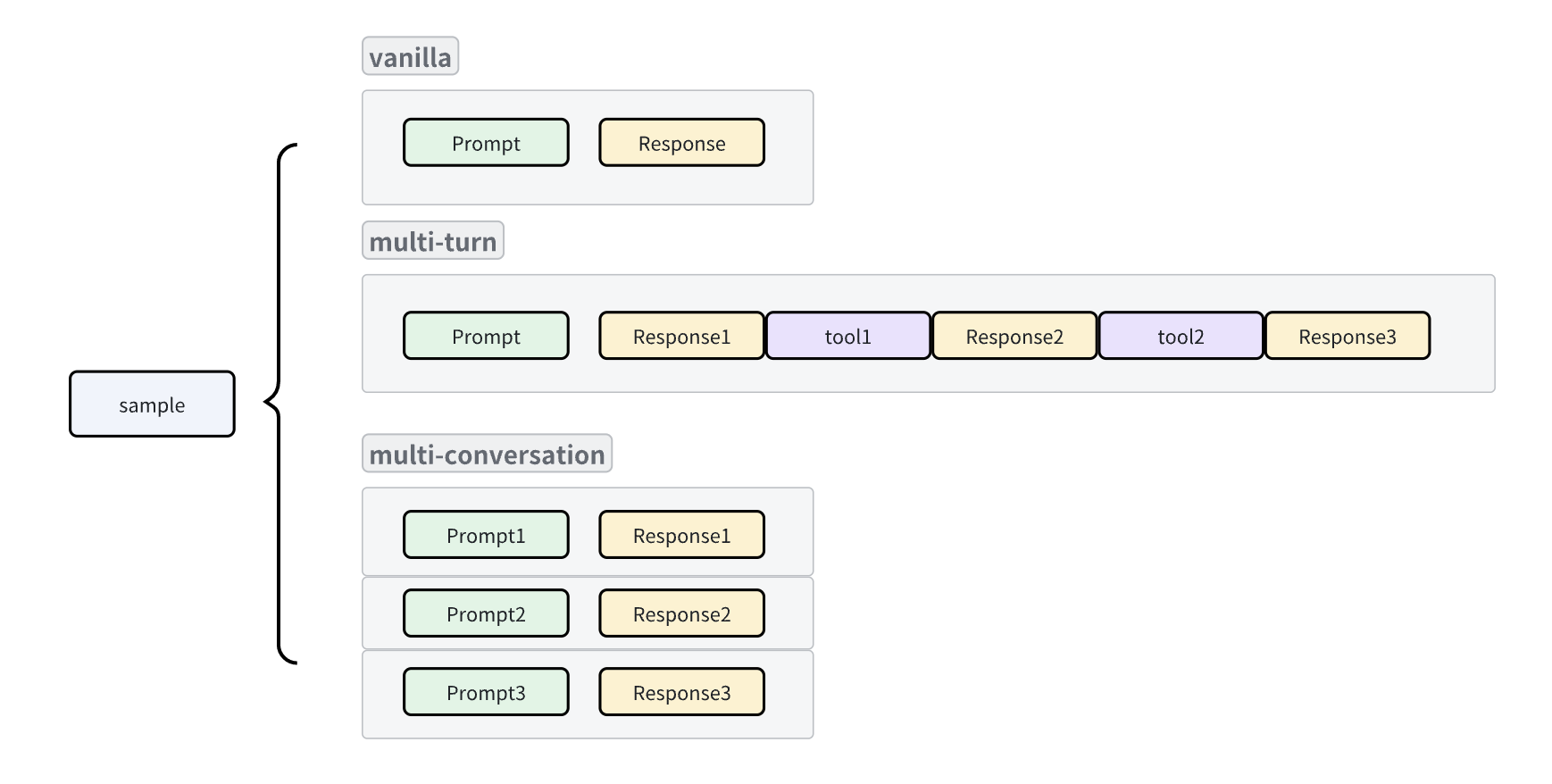
- vanilla:
[{"role":"user","content":pmt},{"role":"assistant""content":rsp}] - multi-turn tool-calling:
[{"role":"user","content":pmt},{"role":"assistant","content":rsp1},{"role":"tool","content":obs},{"role":"assistant","content":rsp2}], - context-indepedent multi-conversation:
[{"role":"user","content":pmt1},{"role":"assistant","content":rsp1}], [{"role":"user","content":pmt2},{"role":"assistant","content":rsp2}]
We modify the chat_template to support tool-response masking without any tensor operations.
See the rollout method implementation of agent class defined in recurrent/impls/async_*.py for more details and recurrent/interface.py, recurrent/async_generation_manager.py for our framework design.
RayActor Process pool
Computation-intensive reward computation or tool calling may stuck the head node from sending generation requests to LLMs. To promote the efficiency of cpu-intensive tasks, we create a RayActor in each node that runs a process pool and accepts tasks from the head node.
Therefore, the cpu task can be executed asynchronously by submitting to ray actor, so does the gpu task:LLM generation.
See verl/workers/reward_manager/thread.py for more details.
Acknowledgements
We thank verl team for providing a flexible and powerful infrastructure.
We thank the authors of the server mode generation for their great work, which provides a solid foundation for our async agent framework.
Citation
If you find this work useful, please consider citing our paper:
@article{yu2025memagent,
  title={MemAgent: Reshaping Long-Context LLM with Multi-Conv RL-based Memory Agent},
  author={Yu, Hongli and Chen, Tinghong and Feng, Jiangtao and Chen, Jiangjie and Dai, Weinan and Yu, Qiying and Zhang, Ya-Qin and Ma, Wei-Ying and Liu, Jingjing and Wang, Mingxuan and others},
  journal={arXiv preprint arXiv:2507.02259},
  year={2025}
}