ReCall: Learning to Reason with Tool Call for LLMs via Reinforcement Learning
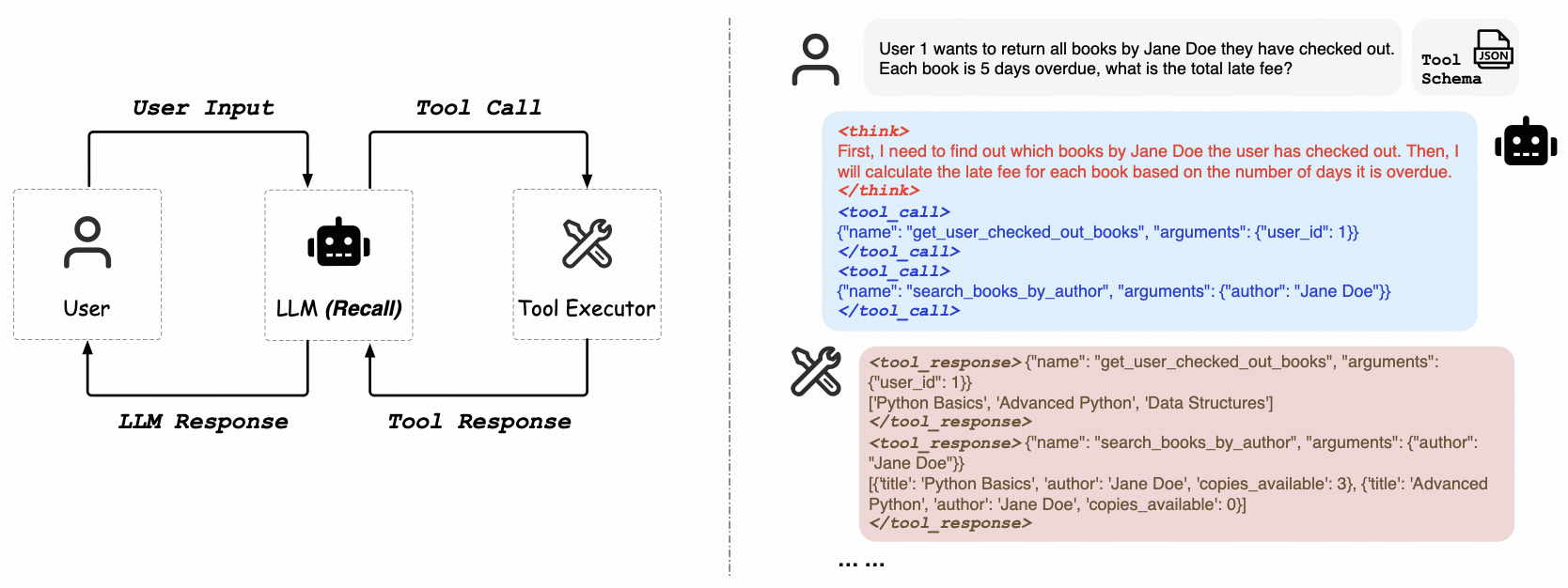
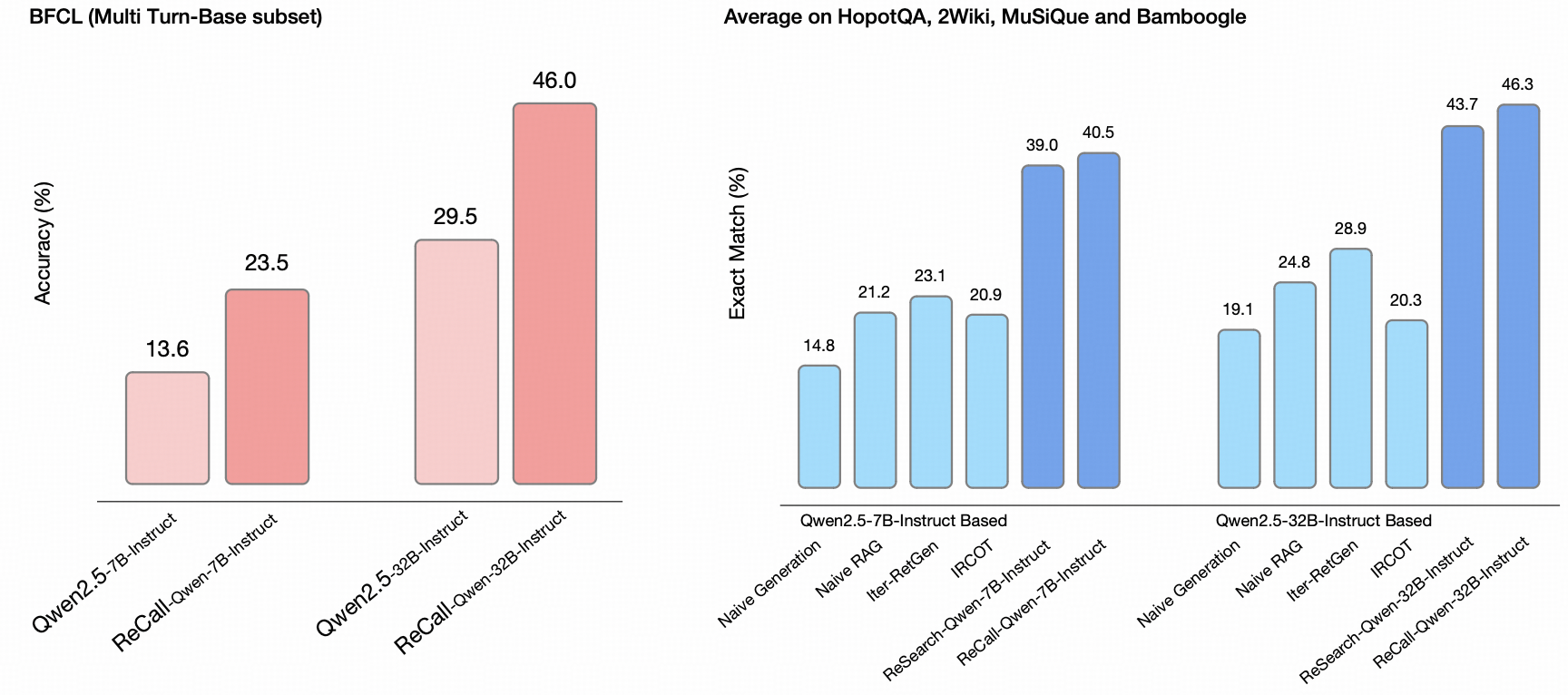
We introduce ReCall, a novel framework that trains LLMs to Reason with Tool Call via reinforcement learning—without requiring any supervised data on tool use trajectories or reasoning steps. ReCall empowers LLMs to agentically use and combine arbitrary tools like OpenAI o3, offering an accessible approach toward general-purpose agents. Additionally, we provide a novel perspective to generate synthetic data with diverse environments and complex multi-step tasks, enabling LLMs to develop sophisticated tool-based reasoning capabilities. This is a work in progress and we are actively working on it.
[!IMPORTANT] ReCall is the successor to ReSearch and represents a more comprehensive framework that extends beyond the search tool to support reasoning with any user-defined tools. It can be a drop-in replacement of ReSearch. We've archived the original implementation of ReSearch in the branch
re-search.
📰 News
- [2025-04-24] 🎉 We release the first version of ReCall, and archive the original implementation of ReSearch.
- ➡️ The name of the repository is changed from ReSearch to ReCall.
- 📝 We release a blog to introduce the idea of ReCall.
- 📦 Current implementation of ReCall is based on verl 0.3.0 + vllm 0.8.4.
- [2025-03-27] 🤗 We release our trained ReSearch models on Hugging Face, please check it out!
- [2025-03-26] 🎉 We release the paper and update the code of ReSearch.
- 📝 The paper is released on arXiv, more details and evaluation results can be found in our paper.
- 🛠️ The repository is updated with the new implementation, especially the rollout with search during RL training. This version of implementation is based on the latest release of verl.
- [2025-03-03] ✅ We have released the preview version of ReSearch implementation.
📦 Installation
We recommend using conda to manage the environment. First create a conda environment and activate it.
conda create -n re-call python==3.10
conda activate re-call
Then install dependencies, and the packages under src/ will be installed in the editable mode. Check out setup.py for details.
git clone https://github.com/Agent-RL/ReCall.git
cd ReCall
pip3 install -e .
pip3 install flash-attn --no-build-isolation
If you want to host a Wikipedia RAG system based on FlashRAG, you need to install faiss-gpu as follow. As described in the FlashRAG, due to the incompatibility when installing faiss using pip, we need to use the following conda command to install faiss-gpu.
conda install -c pytorch -c nvidia faiss-gpu=1.8.0
🚀 Quick Start
If you want to learn the details of current version of ReCall, please refer to the blog first.
Data Preparation
ReCall is trained on a mixture of our synthetic dataset SynTool and the training set of MuSiQue. You can download the preprocessed training data from here, and use such data directly for training. For preparing your own data with specific tools, you can refer to the data/prepare_musique_recall.py, where we provide the script of preparing the data for MuSiQue with Wikipedia search tool.
Sandbox Serving
Since tools are implemented in executable Python code, the tool executor is responsible for running the Python code. To ensure safety and security, we implement a sandbox for running Python code on a remote server. To launch the sandbox service, run the following command:
cd scripts/serving
python sandbox.py --port {port}
Note: The current implementation is a basic sandbox environment. We plan to use a more robust and secure sandbox in future updates. We recommend hosting the sandbox on a remote server, as local hosting may expose your machine to potential security risks.
Retriever Serving
For training on MuSiQue data with a Wikipedia search tool, we provide a Wikipedia retriever service implemented using FlashRAG and FastAPI. Before starting the retriever serving, you need download the pre-indexed wikipedia, wikipedia corpus and corresponding retriever models. More details can be found in the documentation of FlashRAG.
For starting the retriever serving, you need to first fill the scripts/serving/retriever_config.yaml with the correct path to the retrieval model, index, and corpus, and available GPU ids. Then, you can run the following command to start the retriever serving:
cd scripts/serving
python retriever_serving.py \
    --config retriever_config.yaml \
    --num_retriever {num_retriever} \
    --port {port}
Training
Our training framework is based on verl, a powerful reinforcement learning framework for LLMs. We deeply customize the verl code to fit our needs, and the modified version of verl is under the src/verl directory. The example of training scripts are under scripts/train.
Single-node training
Here is an example of training Qwen2.5-7B-Instruct with 4 GPUs locally. Note that the training script below is just an example for single-node training, using small batch size for quick start, and do not assure the training performance.
cd scripts/train
bash train.sh \
    --train_batch_size 8 \
    --ppo_mini_batch_size 4 \
    --use_re_call True \
    --prompt_template_name re_call_template_sys \
    --actor_model_path {model/path/to/qwen2.5-7b-instruct} \
    --search_url {your-hosted-retriever-url} \
    --sandbox_url {your-hosted-sandbox-url} \
    --project_name {wandb-project-name} \
    --experiment_name {wandb-experiment-name} \
    --nnodes 1 \
    --n_gpus_per_node 4 \
    --save_freq 5 \
    --test_freq 5 \
    --total_epochs 2 \
    --wandb_api_key {your-wandb-api-key} \
    --save_path {path/to/save} \
    --train_files "['train1.parquet', 'train2.parquet']" \
    --test_files "['test1.parquet', 'test2.parquet']"
Multi-node training
If you want to fully reproduce ReCall, please refer to the multi-node training script in scripts/train/train_multi_node.sh.
Inference
This section demonstrates how to perform inference using the trained ReCall model. We provide a standard wrapper class in src/re_call/inference/re_call.py that simplifies the inference process. To get started, you only need to provide the model URL and sandbox URL, then use the run function to execute inference. The ReCall class handles all the orchestration between model generation and tool execution internally. For a practical example of using the ReCall class, please refer to our sample implementation at scripts/inference/re_call_use_case.py.
For model serving, we recommend using SGLang. You can either download our open-source models or train your own models to conduct the inference. Here is an example of how to launch the model service:
python3 -m sglang.launch_server \
        --served-model-name {trained/model/name} \
        --model-path {trained/model/path} \
        --tp 2 \
        --context-length 8192 \
        --enable-metrics \
        --dtype bfloat16 \
        --host 0.0.0.0 \
        --port 80 \
        --trust-remote-code \
        --disable-overlap \
        --disable-radix-cache
Evaluation
Multi-hop QA
For the evaluation on multi-hop QA, we use FlashRAG as the standard evaluation environment. For downloading the evaluation data, please run the following command:
cd data
bash download_dataset.sh
Here is an example of evaluating the performance of ReCall-Qwen-7B-Instruct on Bamboogle test set.
cd scripts/evaluation
python run_eval.py \
    --config_path eval_config.yaml \
    --method_name re-call \
    --data_dir {root/path/to/evaluation/data} \
    --dataset_name bamboogle \
    --split test \
    --save_dir {your-save-dir} \
    --save_note re-call_qwen7b_ins
    --sgl_remote_url {your-launched-sgl-url} \
    --remote_retriever_url {your-hosted-retriever-url} \
    --generator_model {your-local-model-path} \
    --sandbox_url {your-hosted-sandbox-url}
For more details about the configuration, please refer to the scripts/evaluation/eval_config.yaml file.
BFCL
We will release the evaluation code on BFCL soon.
🤝 Acknowledge
This training implementation is based on verl and the evaluation is based on FlashRAG and BFCL. The serving of sandbox and retriever is based on FastAPI. The model serving is based on SGLang. ReCall models are trained based on Qwen2.5. We sincerely appreciate their contributions to the open-source community.
📚 Citation
If you find this work useful, please cite it as follows:
@misc{chen2025research
  title={ReSearch: Learning to Reason with Search for LLMs via Reinforcement Learning},
  author={Mingyang Chen and Tianpeng Li and Haoze Sun and Yijie Zhou and Chenzheng Zhu and Haofen Wang and Jeff Z. Pan and Wen Zhang and Huajun Chen and Fan Yang and Zenan Zhou and Weipeng Chen},
  year={2025},
  eprint={2503.19470},
  archivePrefix={arXiv},
  primaryClass={cs.AI},
  url={https://arxiv.org/abs/2503.19470},
}