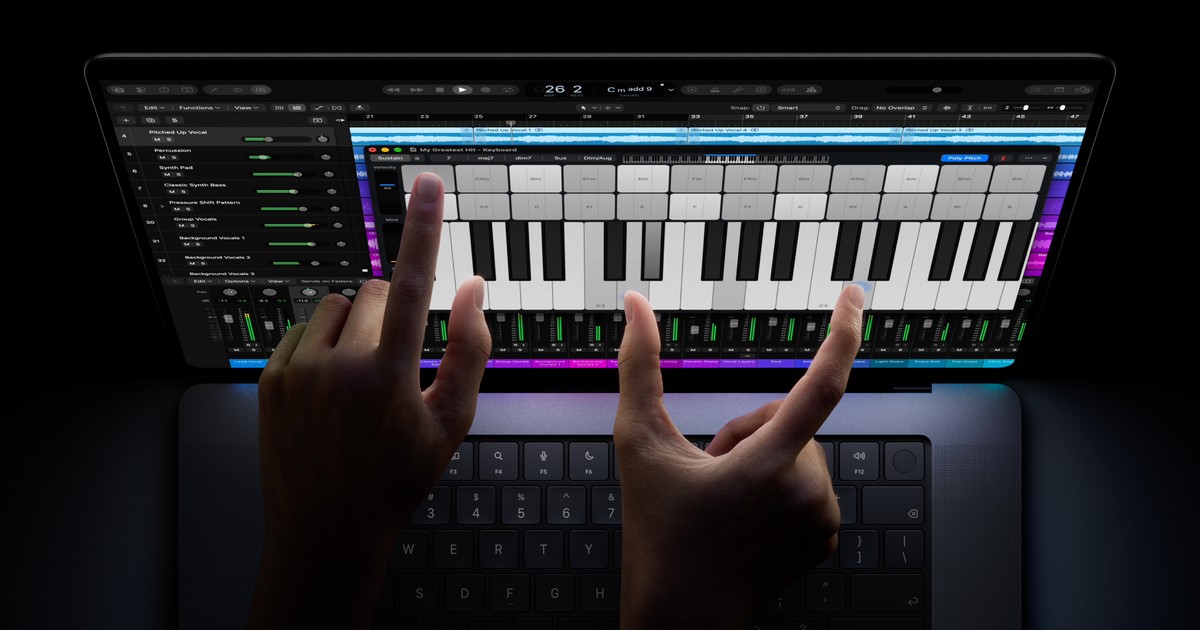
Apple announced new 14- and 16-inch MacBook Pro models on October 28, 2026, with a PROLED XDR tandem OLED display and Touch on Mac for the first time. The machines use M5 Pro and M5 Max, with up to 128GB of unified memory and up to 16TB of storage. Pre-orders started the same day in the U.S. and other listed markets; shipments and retail availability begin Friday, November 6, 2026. This lineup is separate from the M6 14-inch MacBook Pro Apple also discussed around the same period.
Key Facts
| Details | |
|---|---|
| Announced | October 28, 2026 (Apple Newsroom) |
| Sizes | 14-inch (14.2-inch diagonal) and 16-inch (16.3-inch diagonal) |
| Display | PROLED XDR tandem OLED; up to 2000 nits peak HDR and SDR; 10,000,000:1 contrast; ProMotion 10–120Hz; P3 and Adobe RGB |
| Touch | First Mac Touch; sensor built into the panel, not layered on top |
| Dynamic Island | Spotlight, Live Activities, and Siri AI (Spotlight moves there only if Siri AI is available and enabled) |
| Chips | M5 Pro / M5 Max (not the M6 14-inch model) |
| Memory / storage | Up to 128GB unified memory; up to 16TB storage |
| Weight | About 3 lb (14-inch) and 4 lb (16-inch); weight varies by configuration |
| Battery | Up to about 24 hours (Apple September 2026 testing; varies by use) |
| On-device AI | Neural Accelerator per GPU core; Apple says M5 Max can run LLMs with hundreds of billions of parameters on device |
| Software | macOS 27 with Apple Intelligence and Siri AI (beta details in footnotes) |
| Pre-order / ship | Pre-order from October 28; availability from November 6, 2026 |
| U.S. starting prices | 14" M5 Pro $2,899 (edu $2,749); 16" M5 Pro $3,399 (edu $3,199); 14" M5 Max $4,499 (edu $4,199); 16" M5 Max $4,799 (edu $4,499) |
Background
Apple says PROLED XDR uses two self-illuminating pixel layers for contrast and highlights without blooming typical of some LCD HDR designs. The display engine adjusts color and luminance per pixel, and ProMotion ranges from 10Hz to 120Hz. Color coverage includes P3 and Adobe RGB in one default preset; Apple cites more than 80% Rec. 2020 coverage for HDR grading. A nano-texture glass option is available.
Touch is framed for scrolling, pinch-zoom, drag-and-drop, and pro tasks such as on-canvas drawing, on-screen instruments, and testing iOS/iPadOS apps on the laptop panel. macOS can map touches to clicks so many existing apps work without changes; updated gesture APIs are for Touch-native apps. Third-party titles named for later support include Notion, Canva, Zoom, Microsoft Office apps, Lightroom, DaVinci Resolve, Blender, Cinema 4D, ZBrush, Shapr3D, and djay Pro.
The Dynamic Island hosts Spotlight, Live Activities, and Siri AI. Siri AI is described as a more capable assistant in macOS 27, with personal context, Visual Intelligence via a keyboard shortcut, and writing help in many text fields. Apple Intelligence features cited include Safari tab organization, site-change notices, custom extensions from a description, and Shortcuts automations from natural language. Footnote language on the Newsroom page says Siri AI is in beta in macOS 27.2 on supported languages, and that Siri AI is currently unavailable in the EU on iOS, iPadOS, and watchOS while Apple talks with the EU. Siri AI is not available for users under 13. Some server-side Apple Intelligence features have daily limits.
Connectivity includes three Thunderbolt 5 ports, HDMI, SDXC, MagSafe, and a headphone jack. M5 Pro supports up to three external displays; M5 Max up to four. Wi-Fi 7 and Bluetooth 6 are listed. Apple also cites a redesigned six-speaker system with 50% deeper bass and closed-lid audio tuning for external-display use.
Reactions and Impact
The Verge highlights that Apple long resisted touchscreen Macs, citing past comments from Tim Cook and Steve Jobs, and notes the glowing lid logo's return. MacRumors reports the OLED Touch models sit alongside mini-LED MacBook Pros and the separate M6 14-inch MacBook Pro, with the same M5 Pro/Max silicon generation previously used in March machines plus a redesigned thermal path that directs heat away from the display.
What We Don't Know Yet
- Independent lab measurements of brightness, contrast, and battery life outside Apple's September 2026 testing claims
- How well third-party Touch optimizations ship after launch (Apple says listed apps arrive later this year)
- How EU availability for Siri AI on Mac evolves relative to the iOS/iPadOS/watchOS footnote
- Exact thickness deltas and final weights by SKU beyond Apple's approximate figures
Sources
- Apple unveils groundbreaking MacBook Pro with PROLED XDR Display — Apple Newsroom, October 28, 2026 (primary)
- Apple announces its first touchscreen MacBook Pro — The Verge, October 28, 2026
- Apple Announces OLED MacBook Pro With Touch Display — MacRumors, October 28, 2026
Cover image: Apple Newsroom product imagery; editorial composition by AI Rank.